Notifications are one of the most visible and disruptive interaction patterns in contemporary digital systems. They are designed to provide timely information, yet they frequently interrupt ongoing tasks, fragment attention and impose cognitive and emotional costs on users. For interaction design and UX, notifications are not a secondary feature but a main mechanism through which systems attract user attention.
This blog focuses on research that examines how notifications affect productivity, attention and emotional state and also what these findings imply for UX design.
Fragmented work as the default condition
Research by Mark, Gonzalez and Harris shows that modern knowledge work is inherently fragmented. Through observational studies of information workers, they demonstrate that work is characterized by frequent task switching, interruptions and activities rather than long periods of uninterrupted focus.1 Importantly, interruptions are not isolated events; they accumulate and create ongoing reorientation costs as users attempt to resume previous tasks.
From a UX perspective, I think this reframes the role of notifications. Rather than happening in more stable contexts, notifications enter environments where users are already managing multiple cognitive threads. Each interruption forces users to suspend their current task, encode it’s state into memory1, attend to new information then later reconstruct the previous context. This process increases cognitive load and contributes to stress and reduced task efficiency.1
I think that this finding directly challenges notification systems that assume users are always available or inactive. Designing notifications without accounting for fragmented work environments risks applying cognitive strain rather than supporting task continuity.
Removing notifications: productivity versus emotional cost
Pielot and Rello’s “Do Not Disturb” field experiment provides a focused lens on the consequences of push notifications. In their study, participants disabled notification alerts for 24 hours across devices and reported their experiences compared to a baseline day.2
The results reveal a clear tension. Participants reported higher perceived productivity and reduced distraction without notifications. At the same time, they experienced increased anxiety about missing important information and feelings of social disconnection. Notifications therefore serve a dual role: they disrupt focused work, yet they also function as signals of social presence and availability.
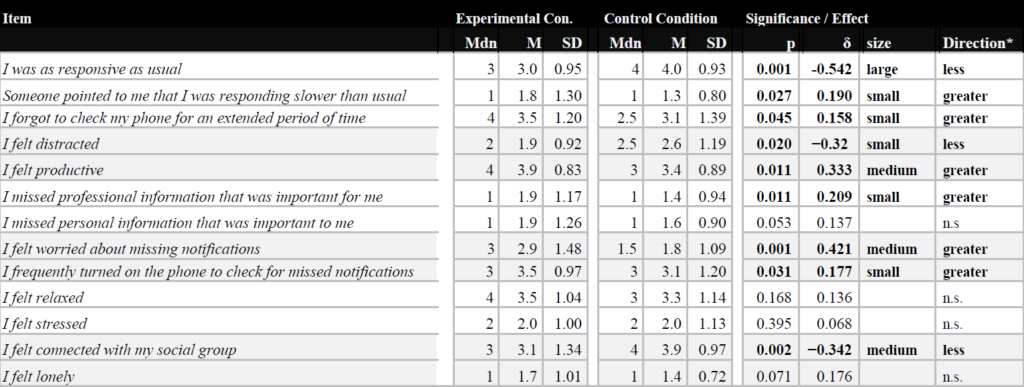
Table 1 : Statistical analysis of the responses to the questionnaires that were filled out after the days with and without notifications.2
For interaction design, this highlights that notifications are not merely informational triggers. They shape users’ sense of responsiveness and feeling of obligation to connect. Eliminating notifications entirely is not a viable solution; instead, systems must negotiate between cognitive efficiency and social expectations.
The study also introduces an important systemic concern. When users experience notification overload, they tend to disable notifications broadly rather than selectively. Pielot and Rello describe this as a “Tragedy of the Commons,” where individual applications compete for attention, leading users to withdraw from the notification ecosystem altogether.2 This has long term implications for both usability and trust.
Attention span myths and design justification
Bradbury’s critical review of attention span research addresses a common justification for aggressive notification strategies: the assumption that users inherently have very short attention spans. Bradbury demonstrates that widely cited claims, such as the “8-second attention span,” are often based on weak or misinterpreted evidence.3
He argues that attention is difficult to define, highly context-dependent and strongly influenced by content quality and delivery rather than fixed biological limits. For UX design, I think this is significant. When designers rely on oversimplified attention metrics, interruptions can be framed as necessary adaptations to human limitations rather than as design choices with consequences.
This perspective aligns with notification research that shows attention fragmentation is not inevitable but shaped by system behavior. Treating attention as limited source does not justify constant interruption. It places responsibility on designers to minimize unnecessary competition for it.
Design implications for notification systems
Across these studies, notifications emerge as a design “tradeoff” rather than a neutral feature. Research evidence consistently shows that poorly managed notifications can increase fragmentation, cognitive load and emotional strain while their complete removal introduces anxiety and social friction.
For interaction design, this can suggest several principles:
- Notifications should be designed as part of a broader attention system, not as isolated prompts.
- Interruption cost and resumption effort must be considered explicitly, especially in fragmented work contexts.
- Systems should support user agency in managing availability and responsiveness, rather than enforcing constant real-time interaction.
- Metrics such as open rates or immediacy should not override cognitive and emotional well-being.
Industry-oriented UX writing points out many of these points by advising for relevance, timing and restraint in notification design.4 5 However, I think without grounding in academic research, such guidelines can risk becoming optimization checklists rather than principled design strategies. The academic literature makes clear that notification design operates at the intersection of productivity, emotion and social norms and cannot be reduced to surface-level best practices.
Positioning within the broader research trajectory
Within the broader scope of my research project, notification experiments provide concrete evidence of how interruptions affect flow, recovery and user experience over time. They establish notifications as a critical case study for understanding interruption as a structural condition of contemporary interaction design.
References (APA 7)
- Mark, G., Gonzalez, V. M., & Harris, J. (2005). No task left behind? Examining the nature of fragmented work. Proceedings of the SIGCHI Conference on Human Factors in Computing Systems, 321–330. https://doi.org/10.1145/1054972.1055017
- Pielot, M., & Rello, L. (2017). Productive, anxious, lonely: 24 hours without push notifications. Proceedings of the 19th International Conference on Human-Computer Interaction with Mobile Devices and Services, 1–11. https://doi.org/10.1145/3098279.3098506
- Bradbury, N. A. (2016). Attention span during lectures: 8 seconds, 10 minutes, or more? Advances in Physiology Education, 40(4), 509–513. https://doi.org/10.1152/advan.00109.2016
- Warren, A. (n.d.). The fine art of notifications in UX. Medium. https://medium.com/@thatameliawarren/the-fine-are-of-notifications-in-ux-19a41a0b0c15
- Interaction Design Foundation. (n.d.). How to design notifications for better mobile interactions. https://www.interaction-design.org/literature/article/how-to-design-notifications-for-better-mobile-interactions
AI Assistance Disclaimer:
AI tools were used at certain stages of the research process, primarily for source exploration, grammar refinement and structural editing. All conceptual development, analysis and final writing were made by the author.
