D&R2 02 – From Interruption to Adaptation: Narrowing a Research Direction

In my first blog post of this semester, written after the lo-fi prototyping session, I described a frustration that felt more important than the prototype itself. Moving from theoretical research into a quick physical test forced me to confront something I had been postponing: my topic is difficult to make visible. Attention, interruption and cognitive recovery are not things you can easily point at on a screen. They happen internally, across time and often become visible only through their consequences.

At the time, that post was mostly about the limitations of the format I had tested. Looking back, it was also the beginning of a more important question. If the topic I am researching is hard to prototype, then maybe the issue is not only the prototype. Maybe I had not yet defined clearly enough what kind of design problem I was actually trying to make visible.

This post continues that questioning.

Where the First Semester Left Off

Last semester I wrote ten posts about attention, flow, interruption, memory, emotion, and neuroadaptive interfaces. Taken one by one they look scattered. Taken together, they were building toward something I could not yet name.

The clearest position I reached was in my final post: interruption is not a problem to eliminate, it is a condition to design for. What matters is not whether a system interrupts, but whether it does so at the right moment, with the right cost, and with enough support for the user to recover.

That framing felt like a conclusion at the time. Looking back, it was more like a door. The research had built a detailed picture of what goes wrong attention fractures, cognitive load spikes, emotional friction accumulates, memory decays but it had not yet said what to do about it, in what context, using what kind of design.

That is what this semester is supposed to resolve.

A Detour That Wasn’t Really a Detour

Earlier this semester I joined a project connected to CERN’s IdeaSquare initiative through our university. My group was working on individual and communal spaces, specifically the idea of modular, adaptive environments that can shift and reconfigure themselves in response to the people using them.

At some point during the project I pushed the team toward a particular angle: spaces that adapt to their users, not the other way around. The environment should read who is there, what they are doing, and what they need, then reorganize accordingly. Less about static design and more about responsive systems.

I did not connect this to my research at the time. It just felt like the right direction for that project.

Later I realized I had done exactly the same thing I had been studying. The question I brought into that spatial design project was the same question underneath my first semester work: what would it look like if systems adapted to human state, rather than expecting humans to adapt to them? In the CERN project, the system was a physical space. In my research, it had been a digital interface. But the logic was identical.

That overlap was worth noting. Not because it proves anything, but because it confirmed something: this is not an academic interest I adopted for a class. It is genuinely how I think about design.

The Problem With Where I Was

After last semester, I had a topic cluster but not a research direction. There is a real difference. A topic cluster is a set of connected ideas you can read about indefinitely. A research direction has a specific question, a context, and a method.

My cluster was attention, interruption, cognitive load, recovery, neuroadaptive systems. Interesting and defensible, but I was circling the same ideas without committing to a specific design problem.

The first blog post of this semester already hinted at this. The lo-fi prototype did not fail because the topic was weak. It struggled because I was trying to represent an internal and temporal topic before fully deciding what form of intervention I was actually designing toward. The session was useful precisely because it exposed that gap.

The second semester also added a different kind of pressure. The business-framing exercises pushed me to specify who is affected, how and what a system would actually do. Together with the prototyping difficulties, this made clear that narrowing was not optional anymore.

What I Actually Want to Research

The direction I have arrived at is best described as adaptive interaction design.

Not notification management. Not UX for focus apps. The broader question is what it would mean for interfaces to adapt their behavior based on the user’s current cognitive state, rather than treating every moment as equally available for input, output, or interruption.

The interest in neuroadaptive and EEG-based systems from last semester was never really about brainwaves. It was about the interaction logic they represent: a closed-loop system that reads the user continuously and responds accordingly. That loop, not the hardware, is what I find compelling. The philosophical stance is that machines should adapt to humans, not the other way around. The sensor stack is just one implementation of that idea.

What has become clearer this semester is that newer forms of adaptive systems make this question even more urgent. When systems act, update, or reorganize information while the user is absent, the moment of return becomes a design problem in itself. My earlier research on interruption, memory, and resumption maps directly onto this. The cognitive science is already there. What is still missing is a clear design response.

Where This Is Heading

I am not committing to a final thesis question this semester. That is not what this phase is for. What I am committing to is a direction: adaptive interaction design, specifically the intersection of cognitive state, interruption, and resumption in contexts where systems change while the user is absent.

The medium is still open. It could remain screen-based. It could later move into spatial or wearable contexts if the research actually needs that. I do not want to decide the form too early.

What I want to do this semester is go deeper into the literature on workload-aware systems, neuroadaptive interaction, and newer adaptive interface models, then develop a prototype concept that makes the re-entry problem testable. Not to solve it immediately, but to make it visible enough to study.

The first blog post of this semester started with a prototype that revealed the limits of my current framing. This post is the continuation of that realization. The question is no longer only how to prototype interruption and recovery. It is how to define a research direction where adaptation itself becomes the design material.

That is the point I seem to have reached. Now the next task is to see whether I can narrow it without losing what made it interesting in the first place.

D&R2 SED – D2

Customer Profile & Value Proposition Map

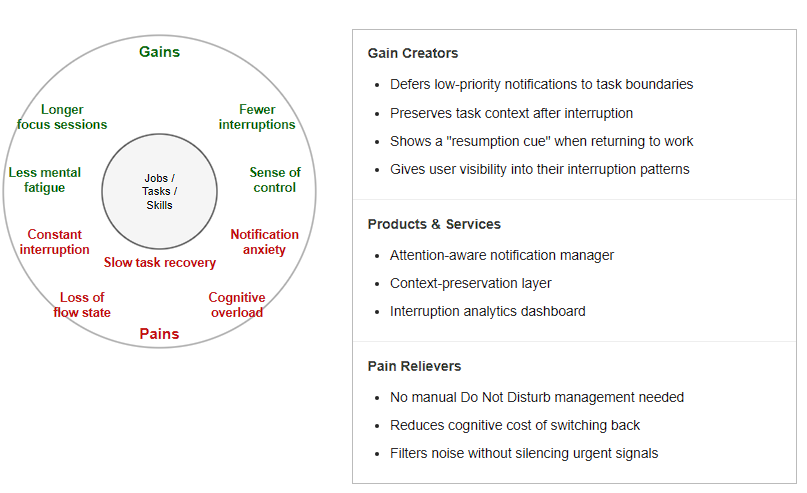
Persona I – The Deep Worker

A knowledge worker or student who needs extended periods of uninterrupted focus to do their best work. They are productive in flow states but regularly pulled out of them by notifications, messages, and contextual switches. They need a system that protects their attention without requiring constant manual management.

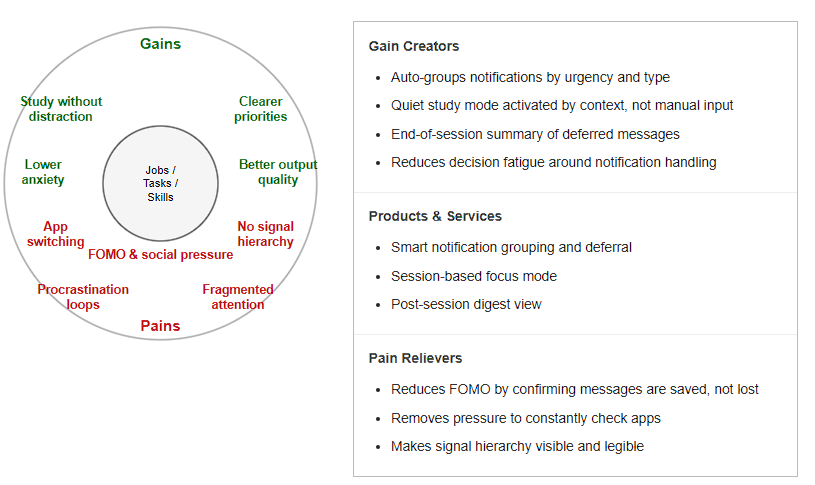
Persona II – The Overloaded Student

A university student juggling coursework, communication apps, and social media across the same device. They struggle to distinguish between urgent and non-urgent signals, and often spend more time managing notifications than doing the actual work. They need a system that reduces the noise without them having to think about it.

Business Idea

What problem are you solving?

Digital interfaces are built to deliver information as fast as possible: but human attention does not work that way. Every interruption carries a cognitive recovery cost that current systems completely ignore. The result is a generation of users who are constantly reactive, chronically distracted, and unable to reach the deep focus states where their best thinking happens. There is no mainstream product that treats attention as a resource worth protecting at the system level.

Why should we care about it?

Attention is not just a productivity concern, it is a mental health issue. Sustained notification overload is linked to higher cortisol levels, reduced working memory performance, and increased anxiety. At the same time, the economic cost of fragmented attention in knowledge work is measurable: studies estimate billions in lost productive hours annually due to interruption-driven task switching. The problem affects every person who works or studies with a digital device which is effectively everyone.

What is the solution? How does it work?

An attention-aware notification layer that sits between the operating system and the user’s apps. It uses behavioral signals: typing rhythm, app dwell time, task duration, time of day, to infer whether the user is in a focused state. When focus is detected, non-urgent notifications are held and batched for delivery at a natural task boundary. When an interruption does occur, the system provides a resumption cue, a lightweight context snapshot that helps the user return to their previous task faster. No manual configuration required; the system learns the user’s patterns over time.

Who is the target audience / customer?

The primary users are knowledge workers and students: anyone whose productivity depends on sustained focus. The paying customers are organizations: companies that want to reduce burnout and increase deep work capacity among employees, educational institutions looking to support student focus, and productivity software companies that want to integrate attention-awareness into their existing tools as a premium feature.

What is going to happen? (Change & Impact)

We move from a model where every moment is equally interruptible to one where digital systems respect the rhythm of human cognition. Interruptions do not disappear, they are timed better. Users reclaim extended focus periods without having to fight their devices to do it. Over time, this reduces the normalization of fragmented attention and establishes a new expectation: that technology should protect focus, not just compete for it.

D&R2 SED – D1

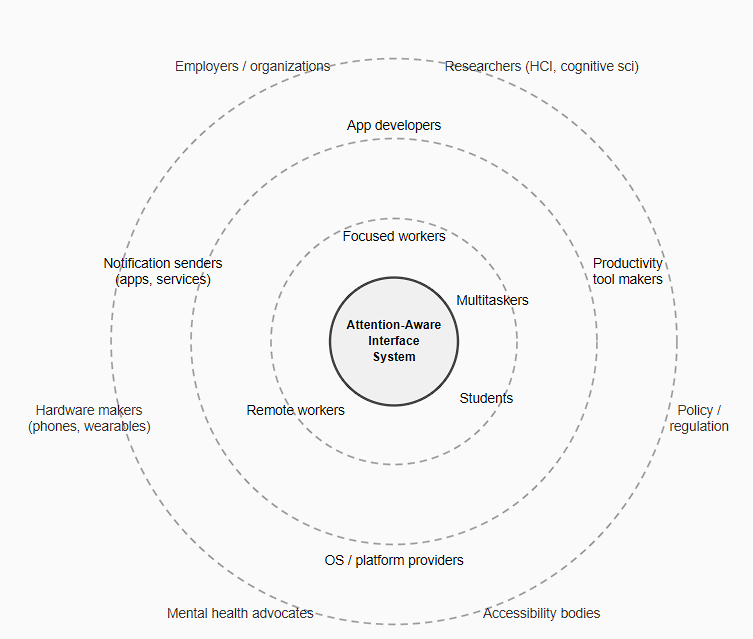
System Map

At the center is the Attention-Aware Interface System, a framework designed to make digital environments sensitive to a user’s attentional state before delivering interruptions, rather than eliminating them entirely. The inner ring holds the direct users: knowledge workers, students, remote workers, and multitaskers, each experiencing interruptions differently based on task type and cognitive load. Surrounding them are the groups that shape interruption conditions: app developers, OS providers, and notification senders and at the outer edge, the institutional forces of employers, researchers, hardware makers, and policy bodies. Together, these layers show that attention is not just a personal resource, it is a systemic one.

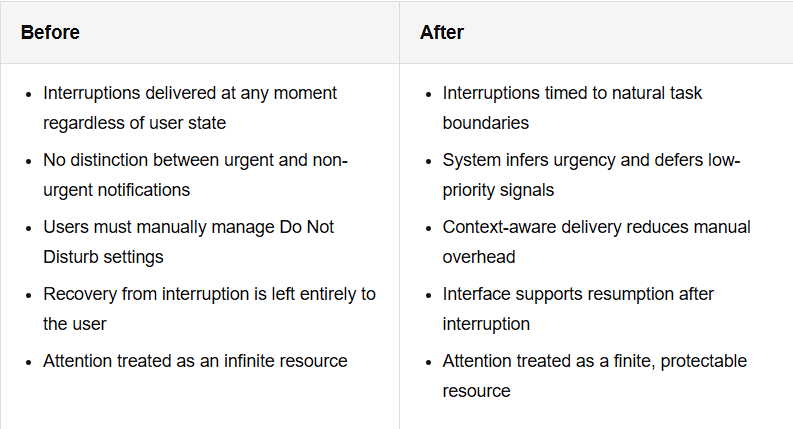
Change and Impact

This comparison highlights the shift from interruption-blind digital systems to attention-aware design. Current notification architectures are built around the sender’s intent, not the receiver’s cognitive state. A message is delivered the moment it is sent, regardless of whether the recipient is mid-task, in a flow state, or already cognitively overloaded. The result is a system optimized for immediacy at the cost of sustained focus.

Inclusion & Accessibility

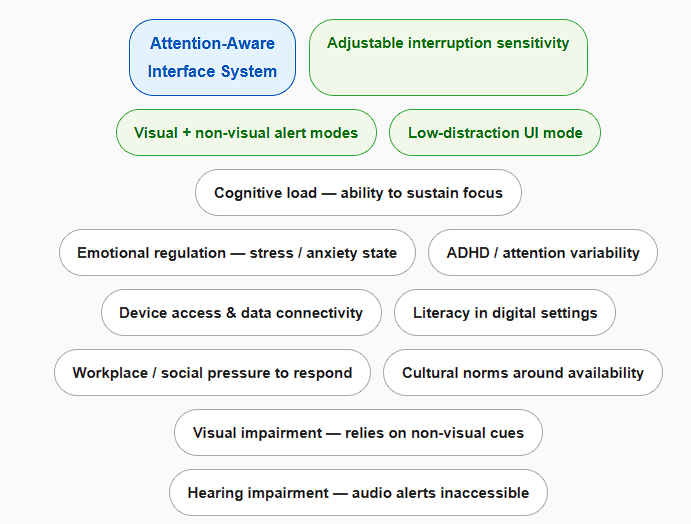
Access to an attention-aware system is not uniform. The ability to benefit from interruption management depends on a range of cognitive, physical, and social factors that are unevenly distributed across users. Some barriers are internal: a person with ADHD may experience interruption recovery very differently from a neurotypical user: for them, even a brief disruption can cascade into a much longer loss of focus. Users in high-stress or high-anxiety states are more vulnerable to the compounding effects of notification overload. Inclusion here is about cognitive and emotional accessibility, not just physical or perceptual access.

D&R2 01 – LoFi Prototyping

New semester, new researches and new problems…Moving from theoretical research into lo-fi prototyping forced me to confront something I had been putting off: my topic is hard to make it physical. Research on attention, interruption and cognitive recovery does not translate naturally into a clickable mockup or a paper sketch. The phenomenon I am studying is internal and time-dependent. You cannot see it on a screen.

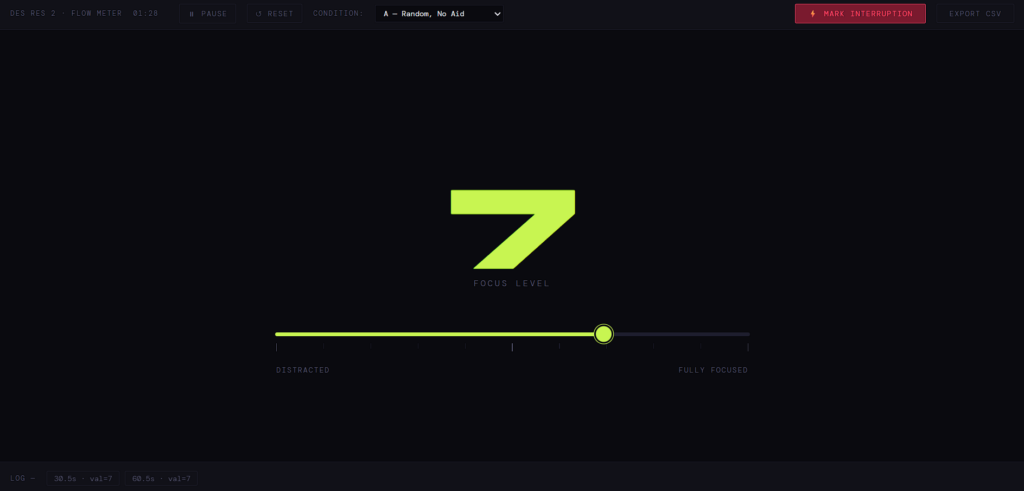
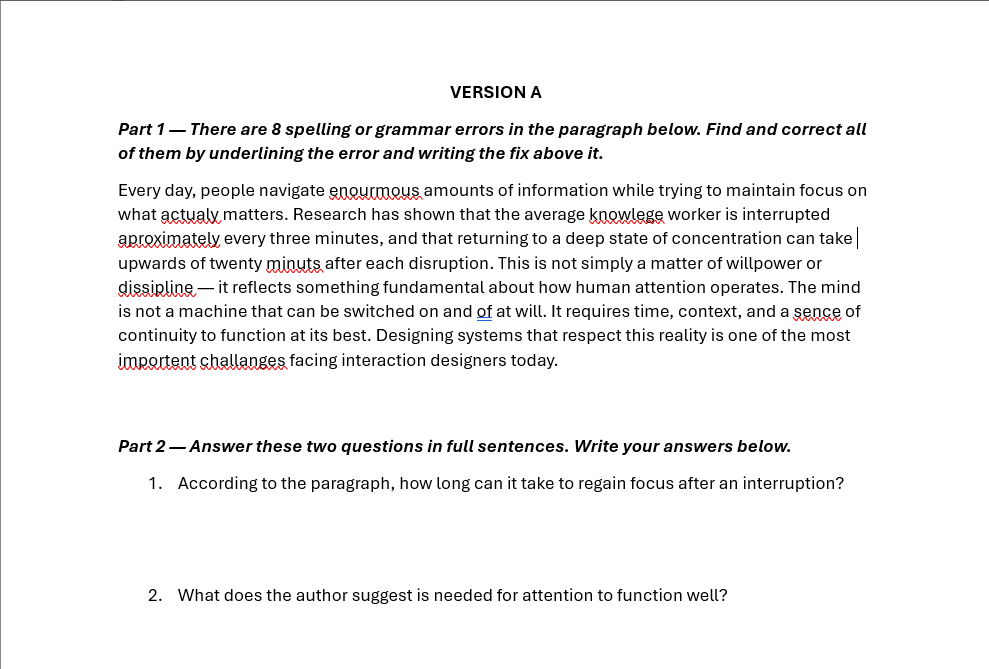
The approach I took was a simple behavioural task. A participant reads a short text and corrects errors in it while thinking aloud. I interrupt them once with a spoken question, then observe how they return to the task. To capture focus levels over time, I built a small browser tool; a slider the participant adjusts continuously, which logs their self-reported focus every thirty seconds and marks the exact moment of the interruption. At the end of the session it exports a CSV, so it is easier to track the data. It is low-tech, but it produces real data grounded directly in the literature.


The first test format was a speed dating exercise: five-minute exchanges rotating between participants. The idea is to get fast, varied feedback, and it works well for many types of prototypes. For mine, it was harder to make useful. Five minutes is not long enough for a person to actually get into the task before the interruption happens. Most of the time was spent explaining the setup rather than experiencing it, so the feedback reflected how clearly I could describe the concept more than how the prototype itself worked.

The most consistent piece of feedback was about the setup: having the task on one device and the focus slider on another felt fragmented. Several people pointed out that if I am studying attention, adding friction between two separate tools is counterproductive. It is a fair observation and one I plan to address, consolidating everything into a single interface makes more sense both practically and conceptually.

The session was useful in a different way than I expected. It did not tell me much about interruption and recovery, but it did clarify the limits of the current prototype as a communication tool. My research sits closer to the theoretical end of the spectrum for now, and that makes it genuinely difficult to prototype in a format that works for quick explanation to someone unfamiliar with the underlying psychology.

The plan is to run the full session individually, without the time pressure, in a setting where the participant can actually reach a state of focus before the interruption lands. I also want to think about whether a behavioural experiment alone is the right form, or whether the research needs a more designed artefact alongside it, something that makes the concept visible rather than just measurable.

ID1 – NIME Article Review

Paper Review – Concerts of the Future: Designing an Interactive Musical Experience in VR

Ciaran Frame. 2024. Concerts of the Future: Designing an interactive musical experience in VR. Proceedings of the International Conference on New Interfaces for Musical Expression. DOI: 10.5281/zenodo.13904880


For this semester’s assignment we were asked to review a paper from the NIME (New Interfaces for Musical Expression) conference. This topic sits somewhat outside the research direction I explored last semester, which focused more on interruption, attention and interaction design. However, I think stepping outside of that research boundary could offer me an interesting opportunity to look at how immersive technologies are being used in other creative fields.

The paper “Concerts of the Future: Designing an Interactive Musical Experience in VR” by Ciaran Frame presents a virtual reality system that attempts to bridge the gap between passive music listening and active musical participation. The project allows participants to enter a VR concert environment and perform alongside a chamber ensemble using a gestural digital instrument called the AirStick. Importantly, the system is designed for people without any musical training, meaning that the experience focuses more on accessibility and participation rather than musical expertise.

The motivation behind the project comes from an interesting observation: while the majority of people regularly listen to music, only a small portion actively create or perform it. Traditional concert formats reinforce a strict separation between composer, performer and audience. The project therefore explores whether VR could blur these boundaries by placing audience members directly into the performance environment.

The experience itself combines several technological and design components. Participants first enter a physical “green room” where they are introduced to the AirStick and given time to experiment with it. After this preparation phase, they put on a VR headset and are transported to a virtual concert stage where recorded musicians appear around them in a 360-degree environment. Movement of the AirStick is translated into musical output through MIDI mapping, allowing participants to generate sound by performing gestures in the air.

From a design perspective, one of the most interesting aspect of the project for me is how the creators intentionally limit the possible musical outcomes. Early tests showes that participants were often anxious about “playing the wrong note” or disrupting the performance. To address this, the system constrains the musical input so that participants always remain harmonically aligned with the ensemble. This design choice effectively creates “musical guardrails,” ensuring that users feel safe experimenting within the system.

Another notable design decision is the use of extra-VR elements, such as the green room and staged performance environment. These elements extend the experience beyond the headset and I believe it helps to construct a narrative context around the interaction. Instead of VR functioning as an isolated digital space, the project integrates physical staging to strengthen immersion.

From my perspective as someone with a background in game design and interactive media, the use of VR here is interesting primarily in terms of embodied interaction. Similar to many VR games, the experience relies on physical movement and spatial presence to create engagement. However, unlike most game environments, the participant’s agency is intentionally constrained to maintain musical coherence. This highlights a tension between creative freedom and system control, which is a recurring design challenge in interactive systems.

Overall, the paper demonstrates how VR can be used not only as a visual medium but also as a participatory performance platform. While the project is rooted in experimental music practice, it also raises broader questions about how immersive technologies can reshape the relationship between audiences and creative content. Even though my own interests lie more in interaction design than in musical interfaces, the project offers an interesting example of how immersive systems can transform traditionally passive cultural experiences.

Designing for Interrupted Experiences

Across my previous research and posts, interruption has appeared repeatedly as a central condition of contemporary interaction. From notifications and social media to cognitive load, emotional cost and recovery, interruption is not an exception to interaction but a structural feature of it. This final blog brings these strands together and reframes interruption as a design material rather than a problem to eliminate.

One of the most consistent findings across HCI research is that when an interruption occurs matters as much as that it occurs. Adamczyk and Bailey’s work on interruption timing demonstrates that interruptions placed at structurally meaningful moments within a task; such as boundaries between subtasks, produce significantly less frustration, annoyance, and cognitive effort than interruptions that occur mid-action.¹ This supports the idea that interruption cost is not uniform, but highly sensitive to task structure and temporal context.

From a design perspective, this challenges the dominant notification model used in many smart devices and platforms, where interruption timing is driven by system priorities rather than user activity. Treating all moments as equally interruptible ignores how users mentally segment tasks and weakens recovery. Designing for interrupted experiences therefore requires an understanding of how users perceive time, progress, and task continuity.

Liikkanen and Gómez argue that interaction design actively shapes user’s experience of time, not just efficiency or usability.² Interfaces that fragment attention, accelerate pace or constantly reset context distort temporal experience and increase the subjective cost of interruption. This aligns with earlier discussions in my research on flow and recovery: interruptions are not only breaks in attention but breaks in temporal coherence.

Recent design research responds to this by shifting focus from preventing interruption to supporting attention. Monge Roffarello et al. introduce digital attention heuristics that prioritize continuity, predictability and cognitive respect in interface behavior.³ Rather than maximizing engagement, these heuristics aim to reduce unnecessary attentional demand and help users maintain control over their focus. This approach contrasts sharply with attention capture patterns identified in deceptive interface designs, where interruption is deliberately used to redirect behavior.⁴

Designing for interrupted experiences therefore has an ethical dimension. When interruption is used strategically to capture attention, it externalizes cognitive cost onto the user. In contrast, attention supportive design acknowledges limits, supports recovery and reduces friction. This distinction becomes particularly relevant in educational and blended environments, where users report feeling constantly interrupted yet unable to disengage from digital systems. Pattermann et al. show that students experience digital interruption as both disruptive and unavoidable, reinforcing the need for design strategies that support regulation rather than escalation.⁵

Several applied design approaches address this challenge directly. Rydén’s user-centered work on designing for distraction emphasizes understanding interruption from the user’s lived experience rather than abstract performance metrics.⁶ By mapping when, why and how users feel interrupted, designers can identify points where systems should step back rather than intervene. This aligns with earlier discussions in my research on polite and adaptive systems, where responsiveness replaces control.

Taken together, these studies suggest that designing for interrupted experiences means accepting interruption as inevitable but designing it’s consequences. This includes supporting recovery, preserving context, respecting task boundaries and also making attention visible as a shared responsibility between user and system.

As a concluding position, my research does not argue for interruption free design. Instead, it proposes a shift in design intent: from capturing attention to caring for it. Designing for the interrupted means designing systems that understand timing, support memory, respect emotional cost or help users return; not just react.

This framing of mine sets the foundation for future thesis work (hopefully) that explores interruption not as a usability flaw, but as a core interaction condition that demands deliberate, human-centered design responses.

References

  1. Adamczyk, P. D., & Bailey, B. P. (2004). If not now, when?: The effects of interruption at different moments within task execution. Proceedings of CHI 2004.
  2. Liikkanen, L. A., & Gómez, R. (2013). Designing interactive systems for the experience of time. Proceedings of CHI 2013.
  3. Monge Roffarello, A., et al. (2025). The digital attention heuristics: Supporting the user’s attention by design.
  4. Monge Roffarello, A., et al. (2023). Defining and identifying attention capture deceptive designs in digital interfaces.
  5. Pattermann, M., et al. (2022). Perceptions of digital device use and accompanying digital interruptions in blended learning.
  6. Rydén, J. (Year). Designing for the distracted: A user-centered approach to explore and act on the user experience of distraction.

    AI Assistance Disclaimer:
    AI tools were used at certain stages of the research process, primarily for source exploration, grammar refinement and structural editing. All conceptual development, analysis and final writing were made by the author.

Interruption in Smart Devices and Social Media

As I also mentioned in some of my previous posts, Interruptions in digital systems are no longer limited to isolated notification events. In smart devices and social media platforms, interruption has become a persistent interaction condition shaped by continuous connectivity, algorithmic attention capture and social expectations. Rather than being occasional disruptions, interruptions are increasingly embedded into everyday interaction flows, influencing how users relocate their attention and switch tasks while using it.

Research on social media distraction consistently shows that interruptions operate through both external and internal mechanisms. External interruptions include notifications, alerts, and interface prompts, while internal interruptions emerge as urges, thoughts or habitual checking behaviors triggered by platform design.1 This distinction is important for interaction design, as it shifts the problem from simply “reducing notifications” toward understanding how interfaces create conditions that sustain attentional vulnerability even in the absence of explicit prompts.

Several studies demonstrate that social media interruptions negatively affect task performance and cognitive efficiency. Experimental work by Marotta and Acquisti5 shows that even brief social media interruptions can reduce performance on cognitively demanding tasks, particularly when users resume work without structural support. Similarly, Okoshi et al.6 found that frequent smartphone notifications increase cognitive load and disrupt task continuity, reinforcing the idea that interruption cost is cumulative rather than momentary.

At the same time, interruptions persist because they fulfill social and psychological needs. Koessmeier and Büttner1 identify social connection and fear of missing out as central drivers of social media distraction, alongside task avoidance and self-regulation failure. This aligns with findings from Tams et al.7, who show that restricting smartphone access can increase stress and social threat perceptions, suggesting that interruption is not only a usability issue but also an affective and relational one. From an HCI perspective, this reinforces the idea that interruptions cannot be evaluated solely in terms of efficiency loss.

Smart devices makes this dynamic more intense by extending interruption beyond the smartphone. Wearables, smart assistants and ambient displays introduce new channels through which attention can be captured or fragmented. Light and Cassidy3 frame this condition as one where disconnection itself becomes a socially and economically charged act, making uninterrupted interaction increasingly difficult to sustain. In such environments, interruption becomes a structural property of interaction ecosystems rather than a design flaw in a single interface.

Recent work has begin to explore design interventions that do not simply suppress interruptions but reshape how and when they occur. Weber et al.8 examine user-defined notification delay, showing that allowing users to postpone interruptions can reduce perceived disruption without eliminating access to information. Okoshi et al.’s Attelia6 system similarly demonstrates that context-aware notification management can lower cognitive load by aligning interruptions with moments of lower demand.

More recent approaches focus on changing attention capture patterns at a system level. Some researchers introduce the concept of “Purpose Mode,” which reduces distraction by altering how social media interfaces surface content during goal-directed activities. Rather than blocking access, such systems attempt to weaken damaging attention loops while preserving user groups. This reflects a broader shift away from binary solutions toward adaptive interaction strategies.

Taken all together, these studies suggest that interruption in smart devices and social media should be understood as a “design tradeoff” rather than a problem to be eliminated. Interruptions support connection, awareness and engagement but they also fragment attention and increase cognitive strain. The challenge for interaction design is not to remove interruptions, but to shape them in ways that respect user capacity, context, and recovery.

This positions interruption as a central concern for contemporary interaction design. As smart devices and social platforms increasingly mediate everyday activity, designers must consider how systems distribute attention over time, how interruptions accumulate, and how users regain control after disruption. Rather than asking how to stop interruption, the more productive question becomes how to design interactions that acknowledge interruption as an inevitable condition and respond to it responsibly.

References

  1. Koessmeier, C., & Büttner, O. B. (2021). Why are we distracted by social media? Distraction situations and strategies, reasons for distraction, and individual differences. Frontiers in Psychology, 12, 711416.
    https://doi.org/10.3389/fpsyg.2021.711416
  2. Lee, M., et al. (2025). Purpose Mode: Reducing distraction through toggling attention capture damaging patterns on social media.
  3. Light, A., & Cassidy, E. (2014). Strategies for the suspension and prevention of connection: Rendering disconnection as socioeconomic practice.
  4. Liu, Y. (Year). The attention crisis of digital interfaces and how to consume media more mindfully.
  5. Marotta, V., & Acquisti, A. (2018). Interrupting interruptions: A digital experiment on social media and performance.
  6. Okoshi, T., et al. (2015). Attelia: Reducing users’ cognitive load due to interruptive notifications on smartphones.
  7. Tams, S., et al. (2018). Smartphone withdrawal creates stress: A moderated mediation model of nomophobia, social threat, and stress.
  8. Weber, F., et al. (2018). Snooze! Investigating the user-defined deferral of mobile notifications.

AI Assistance Disclaimer:
AI tools were used at certain stages of the research process, primarily for source exploration, grammar refinement and structural editing. All conceptual development, analysis and final writing were made by the author.

Memory and Recovery: Designing for Resumption After Interruption

Up to this point, my research has focused on how interruptions disrupt attention and flow. However, interruptions do not end when the disruption occurs. What follows (the process of resuming a task) is often where the real cost appears. This brings memory into focus, not as a cognitive abstraction, but as a practical interaction design concern.

When a user is interrupted, they do not simply return to where they left off. They must remember what they were doing, why they were doing it and what the next step was supposed to be. This resumption process relies on short-term memory, contextual cues and sometimes an external support from the interface. If these elements are weak or missing, recovery becomes slow, error-prone and frustrating.

Research on memory for goals shows that interrupted tasks remain mentally active, but their activation decays over time. The longer and more demanding the interruption, the harder it becomes to recall the original goal state. From an interaction design perspective, this can mean that poor recovery is not a user failure but a predictable outcome of how memory works under interruption.

This is where I think interface design plays a critical role. Interfaces can either support memory during recovery or actively work against it. Continuous feeds, disappearing context and forced state changes increase the cognitive effort required to resume the task. In contrast, stable visual cues, persistent task states and meaningful markers can act as external memory aids, reducing the mental burden placed on the user.

Several studies on interruption recovery that I have examined show that even small cues; such as highlighting the last action, preserving task structure or offering lightweight reminders, can significantly improve resumption performance. These cues do not need to explain everything. Their value lies in reactivating the user’s memory by reconnecting them with the task context they previously constructed.

From a UX perspective, this reframes memory as an interaction problem rather than an internal process. Memory is distributed across the user and the interface. When interfaces erase context, reorder information or prioritize immediacy over continuity, they shift the entire recovery burden onto the user. This is especially visible in environments shaped by constant notifications, multitasking, and fragmented attention.

Design research on memory supplementation further supports this view. Instead of assuming users will remember, these approaches treat the interface as a partner in recall. By externalizing task state, progress and reasoning traces, systems can support problem solving and reduce the cost of interruption. This does not mean eliminating interruptions but designing for their aftermath.

There is also a temporal part to memory and recovery. Fast systems are often optimized for immediate response, not for long-term comprehension. However, memory formation and recall require time, repetition and moments of reflection. Interfaces that constantly refresh, replace, or overwrite information sometimes undermine these processes. In this sense, recovery is not only about returning to a task but about preserving meaning over time.

Seen through this lens, memory and recovery become central to interaction design in interrupted environments. The question shifts from “How do we prevent interruptions?” to “How do we help users return?” Designing for recovery means acknowledging that interruption is inevitable but disorientation does not have to be.

My research positions memory not as a background cognitive function, but as a design material. If interaction design shapes how users remember, forget and resume, then recovery is not a side effect, it is a responsibility. This perspective directly informs the next stage of my research, which moves toward designing explicitly for interrupted experiences.

References

Altmann, E. M., & Trafton, J. G. (2002). Memory for goals: An activation-based model. Cognitive Science, 26(1), 39–83.

Bruya, B., & Tang, Y. Y. (2018). Is attention really effort? Revisiting Daniel Kahneman’s influential 1973 book Attention and Effort. Frontiers in Psychology, 9, 1133.

Chen, X., Li, Z., & Wang, Y. (2025). The effects of cues on task interruption recovery in a concurrent multitasking environment. International Journal of Human–Computer Studies.

Yang, S. (2019). UX design for memory supplementation to support problem-solving tasks in analytic applications (Master’s thesis).

Zannoni, M., & Pollini, A. (2022). Are memories an interaction design problem? PAD Pages on Arts and Design, 15(23).

AI Assistance Disclaimer:
AI tools were used at certain stages of the research process, primarily for source exploration, grammar refinement and structural editing. All conceptual development, analysis and final writing were made by the author.

Neuroadaptive Interfaces and EEG Research in Interaction Design

During a recent workshop in the university, I was introduced to consumer EEG devices and had the opportunity to experiment with them in a hands-on setting. The focus was not on clinical accuracy, but on understanding how basic brainwave signals can be captured using lightweight devices such as Muse. While the setup was clearly far from laboratory-grade neuroscience equipment, the experience raised an important question for me as an interaction designer: what happens when interfaces respond not only to explicit user input, but also to signals that reflect the user’s internal state?

I started doing more about these devices and this question led me to something called “closed-loop biocybernetic systems”. At a basic level, these systems continuously monitor physiological signals from the user, interpret them in real time and adapt system behavior accordingly. Unlike traditional interfaces, where interaction flows in one direction (from user action to system response) closed-loop systems operate through constant feedback. The system observes the user, adapts its behavior and then observes again, forming an ongoing loop rather than a sequence of separate interactions.

What makes this idea particularly relevant for interaction design (and also my research) is not it’s scientific precision, but it’s interaction logic. Closed-loop systems treat the user as a dynamic participant whose cognitive state changes over time, rather than as a stable user performing isolated actions. This aligns closely with earlier discussions in my research around interruption, cognitive load and recovery, where the timing and context of interaction matter as much as the interaction itself.

In existing UX and HCI practice, adaptation is usually based on explicit signals such as clicks, taps, scrolling behavior or settings chosen in advance. Closed-loop systems introduce a different layer of interaction, where adaptation can be driven by indirect signals like workload, engagement or stress. EEG becomes one possible alternative among others, not because it offers direct access to mental states but because it provides a continuous stream of data that reflects change over time. For interaction design, this continuity is more valuable than accuracy, especially when the goal is to sense transitions rather than define precise cognitive states.

Research I have found on adaptive automation has explored closed-loop systems in high-stakes contexts such as aviation and safety-critical environments. For example, work conducted by NASA examined how EEG-based indicators of engagement could be used to dynamically adjust task allocation between human operators and automated systems. While these studies are far removed from everyday digital products, I think they demonstrate that closed-loop interaction is not just theoretical. It has been operationalized in environments where managing attention and workload is critical and where poorly timed interaction can have serious consequences.

What is a Closed Loop System

From an interaction design perspective, the most compelling aspect of closed-loop systems is not automation, but responsiveness. A system that becomes quieter when cognitive demand increases, delays non-urgent information during moments of strain or supports recovery after disruption behaves very differently from one that treats all moments as equal. This resonates strongly with earlier discussions in my research about interruptions and emotional side of it. Instead of optimizing for constant engagement, such systems acknowledge that users have unpredictable capacity.

This ideas also connects closely to something called “polite or neuroadaptive interfaces”. These interfaces aim to adapt subtly and respectfully, without drawing attention to the adaptation itself. Rather than aggressively pushing notifications or optimizing for responsiveness, polite interfaces adjust their behavior quietly, often by waiting rather than acting. Framed this way, politeness is not a metaphor but a design stance that prioritizes cognitive boundaries and timing.

At the same time, there are clear limitations. Consumer EEG devices (like the one we experienced, Muse) do not provide reliable or countable measurements of complex mental states such as attention or flow. Brain signals are noisy, highly context-dependent and difficult to understand even under controlled conditions. Treating EEG data as ground truth would be misleading. However, closed-loop interaction design does not require perfect measurement.

References

  1. Freeman, F. G., & Mikulka, P. J. (1993). Effects of a psychophysiological system for adaptive automation on performance, workload, and situation awareness. Human Factors, 35(3), 413–434. https://doi.org/10.1177/001872089303500302
  2. Gevins, A., & Smith, M. E. (2003). Neurophysiological measures of cognitive workload during human–computer interaction. Theoretical Issues in Ergonomics Science, 4(1–2), 113–131. https://doi.org/10.1080/14639220210159717
  3. NASA. (n.d.). Biocybernetic adaptation and mental workload assessment. National Aeronautics and Space Administration.
  4. Polite Interface Research. (n.d.). Neuroadaptive interfaces.
  5. Pope, A. T., Bogart, E. H., & Bartolome, D. S. (1995). Biocybernetic system evaluates indices of operator engagement in automated task. Biological Psychology, 40(1–2), 187–195. https://doi.org/10.1016/0301-0511(95)05116-3

    AI Assistance Disclaimer:
    AI tools were used at certain stages of the research process, primarily for source exploration, grammar refinement and structural editing. All conceptual development, analysis and final writing were made by the author.

Emotional Design: Why Interruptions Are Never Neutral

Up to this point in my research, I have mostly been discussing interruptions in terms of attention, performance and also recovery. However, interruptions are never purely cognitive events. Every interruption also carries an emotional signal, whether intentional or not. In interaction design, this emotional layer often remains indirect, yet it strongly shapes how interruptions are perceived, tolerated or resisted.

Research in emotional design and affective HCI consistently shows that emotion is not something that happens after interaction, but something that actively shapes it.1 From this perspective, interruptions are not just breaks in task flow; they are moments where systems communicate priorities, urgency and value to the user. These moments can generate calm, trust, irritation, anxiety, or stress depending on how they are designed.

Donald Norman’s framework of emotional design is particularly useful here, as it separates interaction into visceral, behavioral, and reflective levels.4 Interruptions operate across all three. Viscerally, a sudden sound, vibration, or visual alert can trigger immediate affective reactions such as startle or irritation. Behaviorally, interruptions interfere with ongoing action and can either support or hinder smooth task continuation. Reflectively, users interpret interruptions as signals about importance, social obligation or system intent. Together, these layers explain why two notifications with the same content can feel completely different depending on timing, modality and context.

In HCI research, affect is increasingly understood as intertwined with cognition rather than opposed to it. Beale and Peter argue that emotional responses influence attention, decision-making and control, especially in interactive systems that demand frequent shifts of focus.1 From this view, emotionally charged interruptions can narrow attention and reduce cognitive flexibility, while calmer or well-aligned interruptions may support reorientation and recovery.

This relationship becomes especially relevant under conditions of high cognitive load. When users are already mentally engaged, interruptions do not just compete for attention; they amplify emotional responses such as stress or frustration.3 Emotional overload can therefore compound cognitive overload, increasing the perceived cost of interruption even when task disruption is minimal.

Recent work in emotional design and user experience also highlights that emotional responses to interaction accumulate over time. Dybvik  shows that repeated exposure to small design decisions can shape long-term user experience, even when individual interactions seem insignificant.2 Applied to interruptions, this suggests that notification systems are not evaluated moment by moment but as part of an ongoing emotional relationship between user and system. Persistent feelings of pressure, obligation or loss of control can emerge even when no single interruption feels severe.

This perspective helps explain why users often describe notification-heavy systems as “stressful” or “exhausting” rather than merely distracting. The issue is not only frequency, but emotional tone and predictability. Lottridge et al. emphasizes that affective interaction design must account for how systems signal intent and respond to user state. Interruptions that ignore context or emotional readiness risk being perceived as intrusive or hostile, regardless of their functional relevance.3

From an interaction design standpoint, emotional design reframes interruptions as relational events rather than technical events. Designing for interruption therefore involves more than reducing frequency or optimizing timing. It requires attention to how interruptions feel, what they imply and how they position the user within the system. Calm transitions, respectful signaling, and clear recovery cues can all reduce emotional friction, even when interruptions are unavoidable.

Within the broader trajectory of this research, emotional design connects cognitive disruption with lived experience. Interruptions fragment not only tasks but also emotional continuity. Understanding this layer is essential for moving toward design strategies that support flow, recovery and long-term engagement without treating users as purely rational or purely efficient actors.

References (APA 7)

  1. Beale, R., & Peter, C. (2008). The role of affect and emotion in HCI. In Affect and emotion in human–computer interaction (pp. 1–11). Springer. https://doi.org/10.1007/978-3-540-85099-1_1
  2. Dybvik, H. (2022). Experiences with emotional design. Master’s thesis, Norwegian University of Science and Technology.
  3. Lottridge, D., Chignell, M., Jovicic, A., & Riekhoff, J. (2011). Affective interaction: Understanding, evaluating, and designing for human emotion. Reviews of Human Factors and Ergonomics, 7(1), 197–217. https://doi.org/10.1177/1557234X11410309
  4. Norman, D. A. (2004). Emotional design: Why we love (or hate) everyday things. Basic Books.
  5. Mueller, J. (2004). Review essay: Emotional design by Donald A. Norman. ACM SIGCHI Bulletin, 36(3), 12–16.

    AI Assistance Disclaimer:
    AI tools were used at certain stages of the research process, primarily for source exploration, grammar refinement and structural editing. All conceptual development, analysis and final writing were made by the author.