Interruption in Smart Devices and Social Media

As I also mentioned in some of my previous posts, Interruptions in digital systems are no longer limited to isolated notification events. In smart devices and social media platforms, interruption has become a persistent interaction condition shaped by continuous connectivity, algorithmic attention capture and social expectations. Rather than being occasional disruptions, interruptions are increasingly embedded into everyday interaction flows, influencing how users relocate their attention and switch tasks while using it.

Research on social media distraction consistently shows that interruptions operate through both external and internal mechanisms. External interruptions include notifications, alerts, and interface prompts, while internal interruptions emerge as urges, thoughts or habitual checking behaviors triggered by platform design.1 This distinction is important for interaction design, as it shifts the problem from simply “reducing notifications” toward understanding how interfaces create conditions that sustain attentional vulnerability even in the absence of explicit prompts.

Several studies demonstrate that social media interruptions negatively affect task performance and cognitive efficiency. Experimental work by Marotta and Acquisti5 shows that even brief social media interruptions can reduce performance on cognitively demanding tasks, particularly when users resume work without structural support. Similarly, Okoshi et al.6 found that frequent smartphone notifications increase cognitive load and disrupt task continuity, reinforcing the idea that interruption cost is cumulative rather than momentary.

At the same time, interruptions persist because they fulfill social and psychological needs. Koessmeier and Büttner1 identify social connection and fear of missing out as central drivers of social media distraction, alongside task avoidance and self-regulation failure. This aligns with findings from Tams et al.7, who show that restricting smartphone access can increase stress and social threat perceptions, suggesting that interruption is not only a usability issue but also an affective and relational one. From an HCI perspective, this reinforces the idea that interruptions cannot be evaluated solely in terms of efficiency loss.

Smart devices makes this dynamic more intense by extending interruption beyond the smartphone. Wearables, smart assistants and ambient displays introduce new channels through which attention can be captured or fragmented. Light and Cassidy3 frame this condition as one where disconnection itself becomes a socially and economically charged act, making uninterrupted interaction increasingly difficult to sustain. In such environments, interruption becomes a structural property of interaction ecosystems rather than a design flaw in a single interface.

Recent work has begin to explore design interventions that do not simply suppress interruptions but reshape how and when they occur. Weber et al.8 examine user-defined notification delay, showing that allowing users to postpone interruptions can reduce perceived disruption without eliminating access to information. Okoshi et al.’s Attelia6 system similarly demonstrates that context-aware notification management can lower cognitive load by aligning interruptions with moments of lower demand.

More recent approaches focus on changing attention capture patterns at a system level. Some researchers introduce the concept of “Purpose Mode,” which reduces distraction by altering how social media interfaces surface content during goal-directed activities. Rather than blocking access, such systems attempt to weaken damaging attention loops while preserving user groups. This reflects a broader shift away from binary solutions toward adaptive interaction strategies.

Taken all together, these studies suggest that interruption in smart devices and social media should be understood as a “design tradeoff” rather than a problem to be eliminated. Interruptions support connection, awareness and engagement but they also fragment attention and increase cognitive strain. The challenge for interaction design is not to remove interruptions, but to shape them in ways that respect user capacity, context, and recovery.

This positions interruption as a central concern for contemporary interaction design. As smart devices and social platforms increasingly mediate everyday activity, designers must consider how systems distribute attention over time, how interruptions accumulate, and how users regain control after disruption. Rather than asking how to stop interruption, the more productive question becomes how to design interactions that acknowledge interruption as an inevitable condition and respond to it responsibly.

References

  1. Koessmeier, C., & Büttner, O. B. (2021). Why are we distracted by social media? Distraction situations and strategies, reasons for distraction, and individual differences. Frontiers in Psychology, 12, 711416.
    https://doi.org/10.3389/fpsyg.2021.711416
  2. Lee, M., et al. (2025). Purpose Mode: Reducing distraction through toggling attention capture damaging patterns on social media.
  3. Light, A., & Cassidy, E. (2014). Strategies for the suspension and prevention of connection: Rendering disconnection as socioeconomic practice.
  4. Liu, Y. (Year). The attention crisis of digital interfaces and how to consume media more mindfully.
  5. Marotta, V., & Acquisti, A. (2018). Interrupting interruptions: A digital experiment on social media and performance.
  6. Okoshi, T., et al. (2015). Attelia: Reducing users’ cognitive load due to interruptive notifications on smartphones.
  7. Tams, S., et al. (2018). Smartphone withdrawal creates stress: A moderated mediation model of nomophobia, social threat, and stress.
  8. Weber, F., et al. (2018). Snooze! Investigating the user-defined deferral of mobile notifications.

AI Assistance Disclaimer:
AI tools were used at certain stages of the research process, primarily for source exploration, grammar refinement and structural editing. All conceptual development, analysis and final writing were made by the author.
Memory and Recovery: Designing for Resumption After Interruption

Up to this point, my research has focused on how interruptions disrupt attention and flow. However, interruptions do not end when the disruption occurs. What follows (the process of resuming a task) is often where the real cost appears. This brings memory into focus, not as a cognitive abstraction, but as a practical interaction design concern.

When a user is interrupted, they do not simply return to where they left off. They must remember what they were doing, why they were doing it and what the next step was supposed to be. This resumption process relies on short-term memory, contextual cues and sometimes an external support from the interface. If these elements are weak or missing, recovery becomes slow, error-prone and frustrating.

Research on memory for goals shows that interrupted tasks remain mentally active, but their activation decays over time. The longer and more demanding the interruption, the harder it becomes to recall the original goal state. From an interaction design perspective, this can mean that poor recovery is not a user failure but a predictable outcome of how memory works under interruption.

This is where I think interface design plays a critical role. Interfaces can either support memory during recovery or actively work against it. Continuous feeds, disappearing context and forced state changes increase the cognitive effort required to resume the task. In contrast, stable visual cues, persistent task states and meaningful markers can act as external memory aids, reducing the mental burden placed on the user.

Several studies on interruption recovery that I have examined show that even small cues; such as highlighting the last action, preserving task structure or offering lightweight reminders, can significantly improve resumption performance. These cues do not need to explain everything. Their value lies in reactivating the user’s memory by reconnecting them with the task context they previously constructed.

From a UX perspective, this reframes memory as an interaction problem rather than an internal process. Memory is distributed across the user and the interface. When interfaces erase context, reorder information or prioritize immediacy over continuity, they shift the entire recovery burden onto the user. This is especially visible in environments shaped by constant notifications, multitasking, and fragmented attention.

Design research on memory supplementation further supports this view. Instead of assuming users will remember, these approaches treat the interface as a partner in recall. By externalizing task state, progress and reasoning traces, systems can support problem solving and reduce the cost of interruption. This does not mean eliminating interruptions but designing for their aftermath.

There is also a temporal part to memory and recovery. Fast systems are often optimized for immediate response, not for long-term comprehension. However, memory formation and recall require time, repetition and moments of reflection. Interfaces that constantly refresh, replace, or overwrite information sometimes undermine these processes. In this sense, recovery is not only about returning to a task but about preserving meaning over time.

Seen through this lens, memory and recovery become central to interaction design in interrupted environments. The question shifts from “How do we prevent interruptions?” to “How do we help users return?” Designing for recovery means acknowledging that interruption is inevitable but disorientation does not have to be.

My research positions memory not as a background cognitive function, but as a design material. If interaction design shapes how users remember, forget and resume, then recovery is not a side effect, it is a responsibility. This perspective directly informs the next stage of my research, which moves toward designing explicitly for interrupted experiences.

References

Altmann, E. M., & Trafton, J. G. (2002). Memory for goals: An activation-based model. Cognitive Science, 26(1), 39–83.

Bruya, B., & Tang, Y. Y. (2018). Is attention really effort? Revisiting Daniel Kahneman’s influential 1973 book Attention and Effort. Frontiers in Psychology, 9, 1133.

Chen, X., Li, Z., & Wang, Y. (2025). The effects of cues on task interruption recovery in a concurrent multitasking environment. International Journal of Human–Computer Studies.

Yang, S. (2019). UX design for memory supplementation to support problem-solving tasks in analytic applications (Master’s thesis).

Zannoni, M., & Pollini, A. (2022). Are memories an interaction design problem? PAD Pages on Arts and Design, 15(23).

AI Assistance Disclaimer:
AI tools were used at certain stages of the research process, primarily for source exploration, grammar refinement and structural editing. All conceptual development, analysis and final writing were made by the author.

Neuroadaptive Interfaces and EEG Research in Interaction Design

During a recent workshop in the university, I was introduced to consumer EEG devices and had the opportunity to experiment with them in a hands-on setting. The focus was not on clinical accuracy, but on understanding how basic brainwave signals can be captured using lightweight devices such as Muse. While the setup was clearly far from laboratory-grade neuroscience equipment, the experience raised an important question for me as an interaction designer: what happens when interfaces respond not only to explicit user input, but also to signals that reflect the user’s internal state?

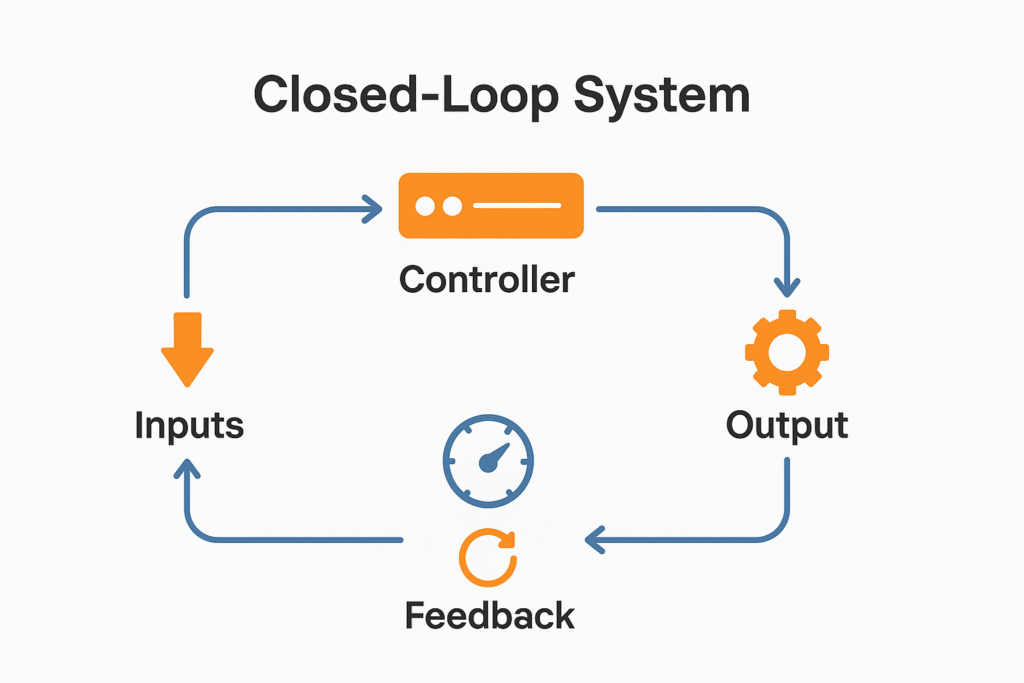
I started doing more about these devices and this question led me to something called “closed-loop biocybernetic systems”. At a basic level, these systems continuously monitor physiological signals from the user, interpret them in real time and adapt system behavior accordingly. Unlike traditional interfaces, where interaction flows in one direction (from user action to system response) closed-loop systems operate through constant feedback. The system observes the user, adapts its behavior and then observes again, forming an ongoing loop rather than a sequence of separate interactions.

What makes this idea particularly relevant for interaction design (and also my research) is not it’s scientific precision, but it’s interaction logic. Closed-loop systems treat the user as a dynamic participant whose cognitive state changes over time, rather than as a stable user performing isolated actions. This aligns closely with earlier discussions in my research around interruption, cognitive load and recovery, where the timing and context of interaction matter as much as the interaction itself.

In existing UX and HCI practice, adaptation is usually based on explicit signals such as clicks, taps, scrolling behavior or settings chosen in advance. Closed-loop systems introduce a different layer of interaction, where adaptation can be driven by indirect signals like workload, engagement or stress. EEG becomes one possible alternative among others, not because it offers direct access to mental states but because it provides a continuous stream of data that reflects change over time. For interaction design, this continuity is more valuable than accuracy, especially when the goal is to sense transitions rather than define precise cognitive states.

Research I have found on adaptive automation has explored closed-loop systems in high-stakes contexts such as aviation and safety-critical environments. For example, work conducted by NASA examined how EEG-based indicators of engagement could be used to dynamically adjust task allocation between human operators and automated systems. While these studies are far removed from everyday digital products, I think they demonstrate that closed-loop interaction is not just theoretical. It has been operationalized in environments where managing attention and workload is critical and where poorly timed interaction can have serious consequences.

What is a Closed Loop System

From an interaction design perspective, the most compelling aspect of closed-loop systems is not automation, but responsiveness. A system that becomes quieter when cognitive demand increases, delays non-urgent information during moments of strain or supports recovery after disruption behaves very differently from one that treats all moments as equal. This resonates strongly with earlier discussions in my research about interruptions and emotional side of it. Instead of optimizing for constant engagement, such systems acknowledge that users have unpredictable capacity.

This ideas also connects closely to something called “polite or neuroadaptive interfaces”. These interfaces aim to adapt subtly and respectfully, without drawing attention to the adaptation itself. Rather than aggressively pushing notifications or optimizing for responsiveness, polite interfaces adjust their behavior quietly, often by waiting rather than acting. Framed this way, politeness is not a metaphor but a design stance that prioritizes cognitive boundaries and timing.

At the same time, there are clear limitations. Consumer EEG devices (like the one we experienced, Muse) do not provide reliable or countable measurements of complex mental states such as attention or flow. Brain signals are noisy, highly context-dependent and difficult to understand even under controlled conditions. Treating EEG data as ground truth would be misleading. However, closed-loop interaction design does not require perfect measurement.

References

  1. Freeman, F. G., & Mikulka, P. J. (1993). Effects of a psychophysiological system for adaptive automation on performance, workload, and situation awareness. Human Factors, 35(3), 413–434. https://doi.org/10.1177/001872089303500302
  2. Gevins, A., & Smith, M. E. (2003). Neurophysiological measures of cognitive workload during human–computer interaction. Theoretical Issues in Ergonomics Science, 4(1–2), 113–131. https://doi.org/10.1080/14639220210159717
  3. NASA. (n.d.). Biocybernetic adaptation and mental workload assessment. National Aeronautics and Space Administration.
  4. Polite Interface Research. (n.d.). Neuroadaptive interfaces.
  5. Pope, A. T., Bogart, E. H., & Bartolome, D. S. (1995). Biocybernetic system evaluates indices of operator engagement in automated task. Biological Psychology, 40(1–2), 187–195. https://doi.org/10.1016/0301-0511(95)05116-3

    AI Assistance Disclaimer:
    AI tools were used at certain stages of the research process, primarily for source exploration, grammar refinement and structural editing. All conceptual development, analysis and final writing were made by the author.

Emotional Design: Why Interruptions Are Never Neutral

Up to this point in my research, I have mostly been discussing interruptions in terms of attention, performance and also recovery. However, interruptions are never purely cognitive events. Every interruption also carries an emotional signal, whether intentional or not. In interaction design, this emotional layer often remains indirect, yet it strongly shapes how interruptions are perceived, tolerated or resisted.

Research in emotional design and affective HCI consistently shows that emotion is not something that happens after interaction, but something that actively shapes it.1 From this perspective, interruptions are not just breaks in task flow; they are moments where systems communicate priorities, urgency and value to the user. These moments can generate calm, trust, irritation, anxiety, or stress depending on how they are designed.

Donald Norman’s framework of emotional design is particularly useful here, as it separates interaction into visceral, behavioral, and reflective levels.4 Interruptions operate across all three. Viscerally, a sudden sound, vibration, or visual alert can trigger immediate affective reactions such as startle or irritation. Behaviorally, interruptions interfere with ongoing action and can either support or hinder smooth task continuation. Reflectively, users interpret interruptions as signals about importance, social obligation or system intent. Together, these layers explain why two notifications with the same content can feel completely different depending on timing, modality and context.

In HCI research, affect is increasingly understood as intertwined with cognition rather than opposed to it. Beale and Peter argue that emotional responses influence attention, decision-making and control, especially in interactive systems that demand frequent shifts of focus.1 From this view, emotionally charged interruptions can narrow attention and reduce cognitive flexibility, while calmer or well-aligned interruptions may support reorientation and recovery.

This relationship becomes especially relevant under conditions of high cognitive load. When users are already mentally engaged, interruptions do not just compete for attention; they amplify emotional responses such as stress or frustration.3 Emotional overload can therefore compound cognitive overload, increasing the perceived cost of interruption even when task disruption is minimal.

Recent work in emotional design and user experience also highlights that emotional responses to interaction accumulate over time. Dybvik  shows that repeated exposure to small design decisions can shape long-term user experience, even when individual interactions seem insignificant.2 Applied to interruptions, this suggests that notification systems are not evaluated moment by moment but as part of an ongoing emotional relationship between user and system. Persistent feelings of pressure, obligation or loss of control can emerge even when no single interruption feels severe.

This perspective helps explain why users often describe notification-heavy systems as “stressful” or “exhausting” rather than merely distracting. The issue is not only frequency, but emotional tone and predictability. Lottridge et al. emphasizes that affective interaction design must account for how systems signal intent and respond to user state. Interruptions that ignore context or emotional readiness risk being perceived as intrusive or hostile, regardless of their functional relevance.3

From an interaction design standpoint, emotional design reframes interruptions as relational events rather than technical events. Designing for interruption therefore involves more than reducing frequency or optimizing timing. It requires attention to how interruptions feel, what they imply and how they position the user within the system. Calm transitions, respectful signaling, and clear recovery cues can all reduce emotional friction, even when interruptions are unavoidable.

Within the broader trajectory of this research, emotional design connects cognitive disruption with lived experience. Interruptions fragment not only tasks but also emotional continuity. Understanding this layer is essential for moving toward design strategies that support flow, recovery and long-term engagement without treating users as purely rational or purely efficient actors.

References (APA 7)

  1. Beale, R., & Peter, C. (2008). The role of affect and emotion in HCI. In Affect and emotion in human–computer interaction (pp. 1–11). Springer. https://doi.org/10.1007/978-3-540-85099-1_1
  2. Dybvik, H. (2022). Experiences with emotional design. Master’s thesis, Norwegian University of Science and Technology.
  3. Lottridge, D., Chignell, M., Jovicic, A., & Riekhoff, J. (2011). Affective interaction: Understanding, evaluating, and designing for human emotion. Reviews of Human Factors and Ergonomics, 7(1), 197–217. https://doi.org/10.1177/1557234X11410309
  4. Norman, D. A. (2004). Emotional design: Why we love (or hate) everyday things. Basic Books.
  5. Mueller, J. (2004). Review essay: Emotional design by Donald A. Norman. ACM SIGCHI Bulletin, 36(3), 12–16.

    AI Assistance Disclaimer:
    AI tools were used at certain stages of the research process, primarily for source exploration, grammar refinement and structural editing. All conceptual development, analysis and final writing were made by the author.

Cognitive Load and Interruption in Interaction Design

Digital interruptions are often discussed as a problem of timing or frequency, but research on cognitive load suggests that the deeper issue lies in how much mental capacity is already in use when an interruption occurs. From an interaction design perspective, interruptions are not neutral events: they directly compete with limited cognitive resources and shape whether users can maintain focus, recover (or resumption) or disengage entirely.

Cognitive Load Theory provides a useful foundation for understanding this problem. Originally developed in educational psychology, the theory distinguishes between intrinsic load (the complexity of the task itself), extraneous load (unnecessary demands imposed by the system) and germane load (effort that supports learning or task completion).1 While this framework is not specific to interaction design, it becomes highly relevant when applied to digital systems that constantly introduce new stimuli.

Interruptions almost always add extraneous load. Notifications, alerts, pop-ups, and task switches force users to allocate attention away from their primary task, even if the interruption is brief. Importantly, this cost is not limited to the moment of interruption. Research on fragmented work shows that once attention is broken, users often struggle to fully return to the original task, resulting in longer completion times and reduced efficiency.3

This effect becomes clearer when cognitive load is examined alongside attention control. Lavie’s load theory of attention shows that distraction behaves differently depending on what type of load is dominant.2 When perceptual load is high, irrelevant stimuli are more easily filtered out. However, when cognitive control or working memory load is high, people become more vulnerable to distraction. In other words, users performing cognitively demanding tasks are precisely the ones least able to handle interruptions.

For interaction design, this creates a structural problem. Many digital systems interrupt users during moments of high cognitive demand; writing, problem-solving, decision-making, when working memory is already saturated. Under these conditions, even small interruptions can produce disproportionate disruption, increasing error rates, stress and resumption time. The interruption itself may appear minor, but its cognitive cost is not.

Recent reviews further reinforce this point. Koundal et al. (2024) synthesize evidence, showing that interruptions significantly increase mental workload, particularly in complex or time sensitive tasks. Their review highlights that performance degradation is not simply a result of distraction, but of accumulated cognitive demand that exceeds users’ capacity to recover smoothly.4

From a design perspective, I think this shifts the problem away from whether interruptions are useful and toward when and under what cognitive conditions they happen. An interruption that might be manageable during low-demand activity can become harmful during high-load tasks. This suggests that static notification rules or generic “best practices” are insufficient. Without accounting for cognitive load, even well-intentioned designs risk undermining user performance.

Rather than treating interruptions as isolated UI elements, I think they should be understood as events that interact with users’s cognitive state. Designing for interrupted experiences therefore requires attention to task complexity, working memory demands, and recovery support, not just visual hierarchy or timing thresholds.

In this sense, cognitive load is not a background theory but a central constraint. Any system that interrupts users without considering their mental workload is effectively designing against sustained attention. For interaction design, acknowledging this constraint is a necessary step toward more humane, resilient and interruption-aware systems.

  References (APA 7)

  1. Sweller, J., & Chandler, P. (1991). Evidence for cognitive load theory. Cognition and Instruction, 8(4), 351–362. https://doi.org/10.1207/s1532690xci0804_5
  2. Lavie, N. (2010). Attention, distraction, and cognitive control under load. Current Directions in Psychological Science, 19(3), 143–148. https://doi.org/10.1177/0963721410370295
  3. Mark, G., Gonzalez, V. M., & Harris, J. (2005). No task left behind? Examining the nature of fragmented work. Proceedings of the SIGCHI Conference on Human Factors in Computing Systems, 321–330. https://doi.org/10.1145/1054972.1055017
  4. Koundal, D., Sharma, A., & Kumar, S. (2024). Effect of interruptions and cognitive demand on mental workload: A critical review. Applied Ergonomics, 114, 104158. https://doi.org/10.1016/j.apergo.2023.104158

AI Assistance Disclaimer:
AI tools were used at certain stages of the research process, primarily for source exploration, grammar refinement and structural editing. All conceptual development, analysis and final writing were made by the author.

Taxonomies of Interaction and Why They Matter for Interruption Design

As interactive systems become more complex, designers need ways to describe and compare interactions beyond individual features or interfaces. One approach that appears repeatedly in HCI research is the use of taxonomies: structured ways of classifying interactions, systems and design choices. Rather than founding direct solutions, taxonomies help clarify what kind of interaction is taking place and under which conditions.

In the context of interruptions and flow, taxonomies are useful because interruptions are not all the same. A notification on a phone, a system alert in a cockpit or a haptic warning in a wearable device may all interrupt attention, but they do so through different interaction channels and with different consequences.

Early taxonomies of human–system interaction

Agah and Tanie propose one of the early comprehensive taxonomies for research on human interactions with intelligent systems. Their framework classifies interaction research along several dimensions: application domain, research approach, system autonomy, interaction distance and interaction media.1

What is important here is not the specific categories themselves, but the idea that interaction can be analyzed across multiple layers at the same time. For example, an interaction can be local or remote, involve visual or auditory feedback also operate with varying degrees of system autonomy. This already suggests that interruptions should not be treated as a single design problem, but as events shaped by media or system behavior.

Agah later expands this work into a broader research taxonomy that includes human-computer, human-machine and human-robot interactions.2

The taxonomy emphasizes that intelligent systems increasingly share space and tasks with humans, rather than operating in isolation. From an interaction design perspective, this is a key shift: interruptions now happen inside shared environments not just between a user and a screen.

Interaction media and attention

One part of Agah’s taxonomy that is especially relevant to interruption design is interactionmedia. Interaction can happen through visual displays, audio signals, tactile feedback, body movements, voice or combinations of these. Each medium places different demands on attention.2

For example, visual interruptions often require users to shift gaze and visual focus, while auditory interruptions can break concentration even when the user is not looking at a device. Tactile feedback may be less intrusive in some contexts but can still disrupt fine motor tasks. Taxonomies help make these differences explicit instead of treating all notifications as equivalent.

This becomes important when thinking about flow. Flow relies on sustained attention and smooth interaction. An interruption that forces a modality switch (for example, from visual focus to auditory alert) may break flow more strongly than one that stays within the same modality.

From system-centered to human-centered taxonomies

While early taxonomies often focused on systems, devices or tasks, Augstein and Neumayr argue for a human-centered taxonomy of interaction modalities. Their framework classifies interaction based on what humans can actively sense and produce, rather than on specific technologies or devices.3

This shift matters for interaction design because technologies change quickly, but human perceptual capabilities change slowly. By grounding classification in human senses and actions, the taxonomy remains useful even as devices evolve. For interruption design, this suggests that the critical question is not “what device delivers the interruption,” but “how the interruption is perceived by the human.”

Augstein and Neumayr also highlight that many existing taxonomies reduce interaction to a narrow set of modalities; typically vision, audition and touch.3

In practice, however, interactions often combine modalities or rely on subtle perceptual hints. Ignoring this complexity can lead to blunt design decisions, such as defaulting to visual notifications in contexts where visual attention is already overloaded.

Taxonomies as design tools, not checklists

Across these papers, taxonomies are not presented as rigid classification systems but as thinking tools. They help designers and researchers ask better questions: What kind of interaction is this? Through which sensory system does it operate? How autonomous is the system? How close is it to the user?

In the context of interruptions, this means moving away from treating notifications as a single UX pattern. Instead, interruptions can be understood as events that vary along multiple dimensions, each with different effects on attention, flow and recovery.

This perspective supports a more nuanced approach to interaction design. Rather than optimizing interruption frequency or timing in isolation, we as designers can reason about how different interaction modalities and system characteristics shape the interruption experience as a whole.

Positioning within the research trajectory

Within this research project, taxonomies provide a structural bridge between research findings on interruptions and later design strategies for recovery and flow. They offer a shared language for describing interaction complexity without reducing it to simple metrics.

By combining early system-oriented taxonomies with more recent human-centered approaches, interaction design can better account for how interruptions are perceived, processed and integrated into everyday interaction.

References (APA 7)

  1. Agah, A., & Tanie, K. (1999). Taxonomy of research on human interactions with intelligent systems. IEEE.
  2. Agah, A. (2000). Human interactions with intelligent systems: Research taxonomy. Computers & Electrical Engineering, 27(1), 71–107.
  3. Augstein, M., & Neumayr, T. (2019). A human-centered taxonomy of interaction modalities and devices. Interacting with Computers, 31(5), 451–476. https://doi.org/10.1093/iwc/iwz003


AI Assistance Disclaimer:
AI tools were used at certain stages of the research process, primarily for source exploration, grammar refinement and structural editing. All conceptual development, analysis and final writing were made by the author.

Notification Experiments and Research

Notifications are one of the most visible and disruptive interaction patterns in contemporary digital systems. They are designed to provide timely information, yet they frequently interrupt ongoing tasks, fragment attention and impose cognitive and emotional costs on users. For interaction design and UX, notifications are not a secondary feature but a main mechanism through which systems attract user attention.

This blog focuses on research that examines how notifications affect productivity, attention and emotional state and also what these findings imply for UX design.

Fragmented work as the default condition

Research by Mark, Gonzalez and Harris shows that modern knowledge work is inherently fragmented. Through observational studies of information workers, they demonstrate that work is characterized by frequent task switching, interruptions and activities rather than long periods of uninterrupted focus.1 Importantly, interruptions are not isolated events; they accumulate and create ongoing reorientation costs as users attempt to resume previous tasks.

From a UX perspective, I think this reframes the role of notifications. Rather than happening in more stable contexts, notifications enter environments where users are already managing multiple cognitive threads. Each interruption forces users to suspend their current task, encode it’s state into memory1, attend to new information then later reconstruct the previous context. This process increases cognitive load and contributes to stress and reduced task efficiency.1

I think that this finding directly challenges notification systems that assume users are always available or inactive. Designing notifications without accounting for fragmented work environments risks applying cognitive strain rather than supporting task continuity.

Removing notifications: productivity versus emotional cost

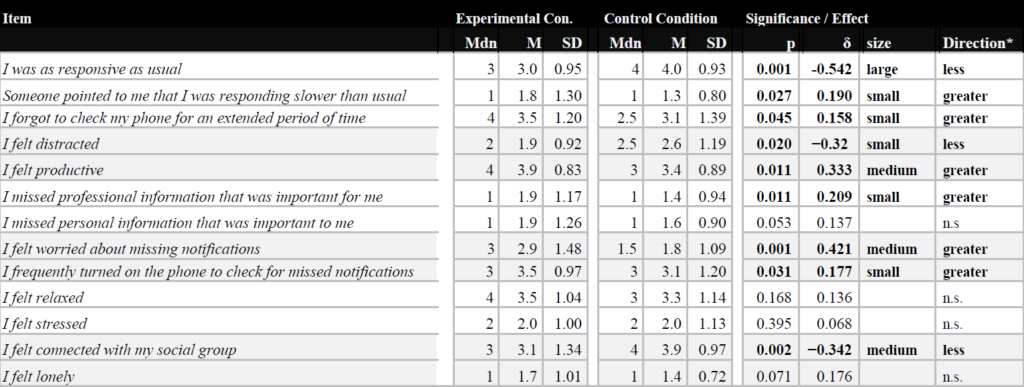
Pielot and Rello’s “Do Not Disturb” field experiment provides a focused lens on the consequences of push notifications. In their study, participants disabled notification alerts for 24 hours across devices and reported their experiences compared to a baseline day.2

The results reveal a clear tension. Participants reported higher perceived productivity and reduced distraction without notifications. At the same time, they experienced increased anxiety about missing important information and feelings of social disconnection. Notifications therefore serve a dual role: they disrupt focused work, yet they also function as signals of social presence and availability.

Table 1 : Statistical analysis of the responses to the questionnaires that were filled out after the days with and without notifications.2

For interaction design, this highlights that notifications are not merely informational triggers. They shape users’ sense of responsiveness and feeling of obligation to connect. Eliminating notifications entirely is not a viable solution; instead, systems must negotiate between cognitive efficiency and social expectations.

The study also introduces an important systemic concern. When users experience notification overload, they tend to disable notifications broadly rather than selectively. Pielot and Rello describe this as a “Tragedy of the Commons,” where individual applications compete for attention, leading users to withdraw from the notification ecosystem altogether.2 This has long term implications for both usability and trust.

Attention span myths and design justification

Bradbury’s critical review of attention span research addresses a common justification for aggressive notification strategies: the assumption that users inherently have very short attention spans. Bradbury demonstrates that widely cited claims, such as the “8-second attention span,” are often based on weak or misinterpreted evidence.3

He argues that attention is difficult to define, highly context-dependent and strongly influenced by content quality and delivery rather than fixed biological limits. For UX design, I think this is significant. When designers rely on oversimplified attention metrics, interruptions can be framed as necessary adaptations to human limitations rather than as design choices with consequences.

This perspective aligns with notification research that shows attention fragmentation is not inevitable but shaped by system behavior. Treating attention as limited source does not justify constant interruption. It places responsibility on designers to minimize unnecessary competition for it.

Design implications for notification systems

Across these studies, notifications emerge as a design “tradeoff” rather than a neutral feature. Research evidence consistently shows that poorly managed notifications can increase fragmentation, cognitive load and emotional strain while their complete removal introduces anxiety and social friction.

For interaction design, this can suggest several principles:

  • Notifications should be designed as part of a broader attention system, not as isolated prompts.
  • Interruption cost and resumption effort must be considered explicitly, especially in fragmented work contexts.
  • Systems should support user agency in managing availability and responsiveness, rather than enforcing constant real-time interaction.
  • Metrics such as open rates or immediacy should not override cognitive and emotional well-being.

Industry-oriented UX writing points out many of these points by advising for relevance, timing and restraint in notification design.4 5 However, I think without grounding in academic research, such guidelines can risk becoming optimization checklists rather than principled design strategies. The academic literature makes clear that notification design operates at the intersection of productivity, emotion and social norms and cannot be reduced to surface-level best practices.

Positioning within the broader research trajectory

Within the broader scope of my research project, notification experiments provide concrete evidence of how interruptions affect flow, recovery and user experience over time. They establish notifications as a critical case study for understanding interruption as a structural condition of contemporary interaction design.

References (APA 7)

  1. Mark, G., Gonzalez, V. M., & Harris, J. (2005). No task left behind? Examining the nature of fragmented work. Proceedings of the SIGCHI Conference on Human Factors in Computing Systems, 321–330. https://doi.org/10.1145/1054972.1055017
  2. Pielot, M., & Rello, L. (2017). Productive, anxious, lonely: 24 hours without push notifications. Proceedings of the 19th International Conference on Human-Computer Interaction with Mobile Devices and Services, 1–11. https://doi.org/10.1145/3098279.3098506
  3. Bradbury, N. A. (2016). Attention span during lectures: 8 seconds, 10 minutes, or more? Advances in Physiology Education, 40(4), 509–513. https://doi.org/10.1152/advan.00109.2016
  4. Warren, A. (n.d.). The fine art of notifications in UX. Medium. https://medium.com/@thatameliawarren/the-fine-are-of-notifications-in-ux-19a41a0b0c15
  5. Interaction Design Foundation. (n.d.). How to design notifications for better mobile interactions. https://www.interaction-design.org/literature/article/how-to-design-notifications-for-better-mobile-interactions

    AI Assistance Disclaimer:
    AI tools were used at certain stages of the research process, primarily for source exploration, grammar refinement and structural editing. All conceptual development, analysis and final writing were made by the author.

Understanding Flow Theory in User Experience

I first encountered Mihaly Csikszentmihalyi’s work during my second bachelor’s degree in Game Design. We discussed his theories alongside the work of Johan Huizinga on play theory, specifically the idea that serious institutions often start as games or contexts for goal-directed action. Now, revisiting his work for this research, I want to focus on how relevant these psychological concepts are for general user experience (UX) and interaction design.

Defining Optimal Experience

As designers we often talk about “frictionless” experiences or engagement metrics. However, the psychological state we are actually aiming for is what Csikszentmihalyi calls “optimal experience”.3 In his research he defines flow as a state of concentration so focused that it amounts to absolute absorption in an activity.

It is a common misconception that this state is about relaxation or passivity. Flow actually occurs when a person’s body or mind is stretched to its limits in a voluntary effort to accomplish something difficult and worthwhile.4 People in flow typically feel strong, alert, in effortless control and unselfconscious. For interaction design this means we aren’t just trying to make things “easy.” We are trying to facilitate a specific type of intense engagement.

The Architecture of Flow in Design

What makes this theory so useful for my research is that Csikszentmihalyi deconstructs the conditions required to enter this state. He identifies several key elements that generate flow and some of them read almost like a checklist for good interface design:

  • Clear Goals: The user must have a clear understanding of what needs to be done. In a digital system ambiguity is the enemy of flow.3
  • Immediate Feedback: Action and awareness must merge. When a user acts the system must provide immediate feedback to confirm the action was successful.3
  • Balance Between Challenge and Skill: This is perhaps the most critical component for my research. Flow requires a balance between the challenges perceived in a situation and the skills a person brings to it.3

If an interaction is too simple relative to the user’s skill the result is boredom. If the challenge is too high the result is anxiety. In my proposal I noted that games manage this balance well through adaptive difficulty but productivity software often fails here, stucked between boring repetition and frustrating complexity.

The Paradox of Work and Play

One of the most surprising insights I found in the readings is that flow actually happens more often at work than during free time. In an interview Csikszentmihalyi explained that this is because work is structured much more like a game than everyday life is. Work usually has the clear goals, rules and feedback loops that generate flow whereas unstructured leisure time can lead to boredom or apathy.1

This is a crucial realization for my research into interruptions. When we design interactive systems we are essentially building a structure for the user’s attention. If we design these structures poorly or if we allow interruptions to shatter the structure we create “psychic entropy”, a state of disorder in consciousness where the self becomes impaired.3

Attention as a Limited Resource

To understand why interruptions are so damaging to this state we have to look at the biological limits of our attention. Csikszentmihalyi notes that the human nervous system has a limited capacity to process information, estimated at about 126 bits per second.2 This infinite amount of “psychic energy” must be allocated carefully to accomplish any task. When we are in flow our attention is so fully invested in the activity that there is no psychic energy left over for distractions or even for the sense of self. A digital interruption forces the brain to reallocate this scarce resource, breaking the coherent order of consciousness and introducing “noise” into the system.

The Autotelic Nature of Experience

Ultimately the goal of understanding flow in design is to foster what Csikszentmihalyi calls “autotelic” experiences, activities that are worth doing for their own sake. The term comes from the Greek auto (self) and telos (goal), referring to a self-contained activity where the doing itself is the reward.5 In Interaction Design we often focus heavily on the output of a system, such as sending an email or finishing a report. However, Flow theory suggests that the process of interaction is just as important as the result. If we can design interfaces that transform necessary tasks into autotelic experiences we can turn potential sources of frustration into moments of order and enjoyment.

References

  1. Beard, K. S. (2015). Theoretically Speaking: An Interview with Mihaly Csikszentmihalyi on Flow Theory Development and Its Usefulness in Addressing Contemporary Challenges in Education. Educational Psychology Review, 27(2), 353–364.
  2. Cherry, K. (2023, March 23). Mihaly Csikszentmihalyi: The Father of ‘Flow’. PositivePsychology.com. https://positivepsychology.com/mihaly-csikszentmihalyi-father-of-flow/
  3. Csikszentmihalyi, M. (1988). The flow experience and its significance for human psychology. In M. Csikszentmihalyi & I. S. Csikszentmihalyi (Eds.), Optimal experience: Psychological studies of flow in consciousness (pp. 15–35). Cambridge University Press.
  4. Csikszentmihalyi, M. (2000). Flow: The Psychology of Optimal Experience. Harper & Row.
  5. Peifer, C. (2012). Flow theory. In Encyclopedia of human behavior (2nd ed.). Elsevier. https://www.sciencedirect.com/topics/psychology/flow-theory

AI Assistance Disclaimer:
AI tools were used at certain stages of the research process, primarily for source exploration, grammar refinement and structural editing. All conceptual development, analysis and final writing were made by the author.

Flow, Interruption and Recovery in Interaction Design

Background

In a world where digital tools shape almost every aspect of daily life, uninterrupted attention has become a scarce resource for user experience. Whether working on a document, attending an online lecture or simply watching a video, users are constantly interrupted by notifications, pop-ups and interface prompts. While these features are designed to inform or engage, they often lead to fragmented interaction experiences. Our devices or services demand responsiveness, but rarely provide space for focus.
This tension between engagement and distraction has turned into one of the central design challenges of our time. How can systems sustain the user’s sense of continuity in an age of constant interruption?

The psychological foundation of this issue lies in Flow Theory, introduced by Mihaly Csikszentmihalyi. Flow describes a mental state in which people become fully absorbed in an activity, experiencing deep concentration, clarity and enjoyment. In design contexts, flow translates into seamless user experiences where goals are clear, challenges match skill levels and feedback feels immediate. However, digital systems frequently break this rhythm. A notification arriving at the wrong moment or a forced software update, can instantly push a user out of flow. Even minor interruptions transforms into a cognitive burden, leading to fatigue, frustration and reduced task performance.

The Problem of Digital Interruption

Interruptions are not inherently negative. Some are necessary, such as reminders or alerts that prevent mistakes. Yet, the majority of digital interruptions are poorly timed, irrelevant, or overly demanding. They shift control away from the user, forcing attention to fragment across multiple contexts. Psychologically, every interruption requires cognitive order; the user must pause the primary task, process new information and later recall where they left off. Research in cognitive psychology refers to this as “resumption lag”, the mental cost of re-establishing task focus after being distracted.

The modern work environment amplifies these effects. On average, users switch digital tasks every “47 seconds”, often without completing the previous one. This continuous switching prevents the brain from reaching a deeper state of engagement. When digital systems are designed without regard for cognitive continuity, they silently erode attention over time. Instead of enhancing productivity, they generate anxiety and emotional exhaustion.

In contrast, some interactive systems, especially video games and movies, demonstrate how flow can be protected. Games use adaptive pacing, contextual pausing and clear progress indicators to support immersion. Even when interruptions occur, players can usually recover easily, thanks to consistent feedback and memory cues.

Research Focus

My research project aims to investigate how interaction design can manage interruptions more intelligently. The main question guiding my work is:
How can design strategies preserve user flow and support faster cognitive and emotional recovery after interruptions?

The research focuses on three interrelated aspects:

  1. Understanding the psychological impact of interruptions. How do different types of disruptions: external (like notifications) and internal (like self-interruptions), affect users attention, emotions and sense of control?
  2. Identifying design patterns for recovery. What interface elements, transitions or cues help users focus and continue smoothly after being interrupted?
  3. Comparing domains of experience. What can productivity tools learn from entertainment systems, such as games or movies, which often handle interruptions gracefully?

The project draws from existing studies on attention, cognitive load and media psychology. For instance, Marotta and Acquisti (2018) found that even short digital interruptions can lower task performance by increasing cognitive load and emotional irritation. Similarly, Reinecke (2009) highlighted how interactive media can act as recovery spaces, offering emotional balance after periods of stress. Together, these insights suggest that recovery is not only a technical question but also an ethical and emotional one designers shape how users experience focus, fatigue and relief.

Relevance for Design

From a design perspective, this topic bridges psychology and user experience. Interaction design is not only about aesthetics or usability; it is also about shaping the rhythm of attention. The way we design transitions, notifications, or feedback loops determines whether an experience feels calm or chaotic.
In practical terms, exploring interruption and recovery can influence several design areas:

  • Interface design: crafting non-intrusive, adaptive notifications and context-aware pausing.
  • UX strategy: balancing engagement metrics with respect for user attention and mental well-being.
  • System design: creating recovery cues such as “Continue where you left off” or visual markers that help users recall previous actions.
  • Ethical design: addressing the moral responsibility of designers to avoid exploiting users’ attention for profit.

Recent examples show that large tech companies are beginning to integrate these principles. Apple’s “Focus Mode” and Microsoft’s “Focus Assist” both allow users to filter and schedule interruptions intentionally. These features represent early steps toward a design culture that values user agency and mental clarity. Yet, they remain optional features rather than integrated philosophies. My aim through this research is to understand how such mechanisms could be embedded at the core of interaction design, not just added later as fixes.

References

  • Csikszentmihalyi, M. (1990). Flow: The Psychology of Optimal Experience. Harper & Row.
  • Pattermann, J., Pammer, M., Schlögl, S., & Gstrein, L. (2022). Perceptions of digital device use and accompanying digital interruptions in blended learning. Education Sciences, 12(3), 215.
  • Marotta, V., & Acquisti, A. (2018). Interrupting interruptions: A digital experiment on social media and performance. SSRN Electronic Journal. https://doi.org/10.2139/ssrn.3283951
  • Reinecke, L. (2009). Games and recovery: The use of video and computer games to recuperate from stress and strain. Journal of Media Psychology, 21(3), 126–142. https://doi.org/10.1027/1864-1105.21.3.126
  • Mark, G. (2023). Attention Span: A Groundbreaking Way to Restore Balance, Happiness and Productivity. Hanover Square Press.
  • Nielsen Norman Group. (2022). How Notifications Impact User Attention and Task Focus. https://www.nngroup.com/articles/notifications-user-focus/
  • Adobe Blog. (2024). Designing for Digital Well-being: When Less Screen Time Means Better UX. https://blog.adobe.com/en/publish/2024/01/17/designing-for-digital-wellbeing
  • Medium. (2023). Calm UX: Designing Interfaces That Respect Human Attention. https://uxdesign.cc/calm-ux-designing-for-human-attention


    AI Assistance Disclaimer:
    AI tools were used at certain stages of the research process, primarily for source exploration, grammar refinement and structural editing. All conceptual development, analysis and final writing were made by the author.