Continuing my research on the topic of “Slowness”from last semester, I will be doing further work on this topic as part of the Design & Research II course with Birgit Bachler PhD.
For the final assignment, I will need to record a 2-minute video of the final prototype — in my case, I plan to use prototyping in Figma, which each of you will be able to test. The research will again focus more on contextual analysis, as well as user testing, bibliography, and heuristic evaluation.
Psychogeography and Dérive 🧠
One of the ideas that fits my project particularly well is psychogeography. Simply put, psychogeography explores how a city influences our emotions, moods, and behavior. It’s not just about streets and buildings, but about how we experience space as we move through it. In the PDF [1], this topic is introduced through Guy Debord and his work “The Naked City“[2]. It is described as a psychogeographic map that reveals not a conventional map of Paris, but the hidden psychological and emotional connections between urban fragments.
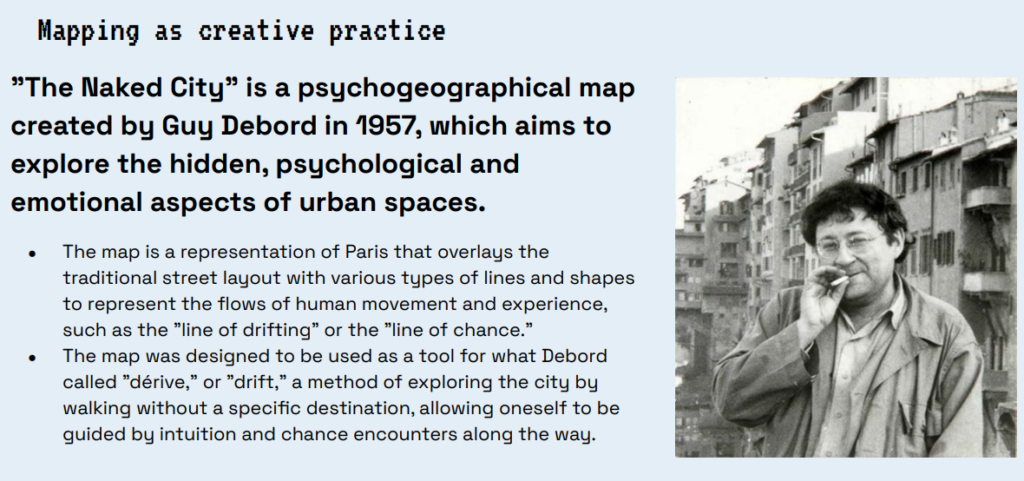
This is a very important shift for my project. Conventional navigation revolves around point A and point B. The user enters an address, the app calculates the route, and that’s it. But psychogeography offers a different way of looking at the city: not as a problem to be solved, but as an environment to be explored.
This is closer to my question: can navigation be not only efficient, but also more mindful, personal, and slow?
This is related to the concept of dérive, or drift [3]. In the presentation, dérive is explained as a method of exploring the city through unplanned, almost aimless wandering. A person does not follow a strictly predetermined route, but instead allows themselves to respond to the atmosphere of the place, random turns, their mood, and unexpected encounters. Debord described dérive as a practice distinct from an ordinary walk because it involves paying attention to the city’s psychogeographical effects and atmospheres.
I don’t want to literally turn the app into a chaotic, aimless wander. But I’m interested in adopting the very principle of dérive: a route can be not only functional but also open-ended. For example, the app could offer not just one “correct” path, but several options: a calm route, a curious route, a green route, or a social route. The user is still moving toward a destination, but the path becomes more flexible and dynamic.
It also helps me take a critical look at modern maps. Many apps try to eliminate uncertainty: turn right, walk 200 meters, and you’ll arrive in 6 minutes. On the one hand, this is convenient. On the other hand, people stop noticing the city around them. They look at the screen instead of their surroundings. In my project, I want to try to bring some of that attention back to the user.
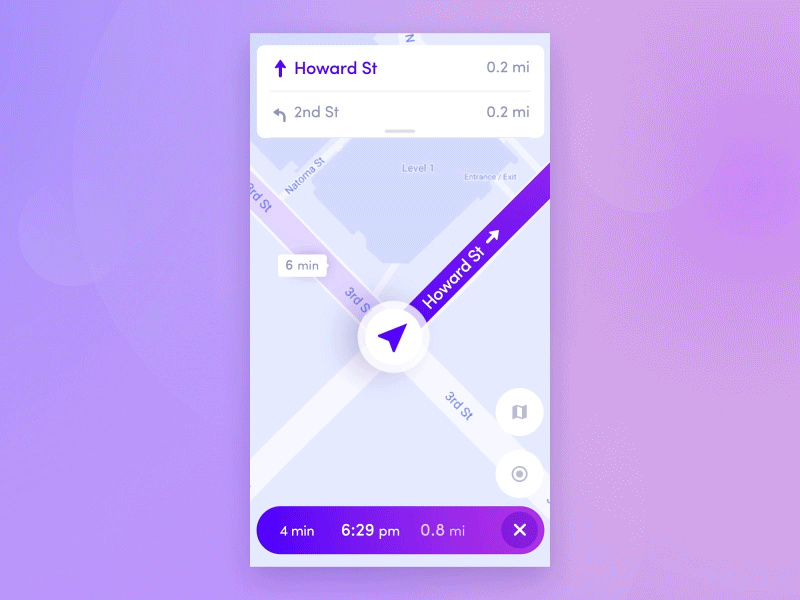
For the prototype, this could take the form of a specific feature. For example, “Explore Mode” might occasionally suggest a slight detour from the route: walking through a park, taking a quieter street, choosing a route with interesting architecture, or making a short stop. It’s important that this isn’t forced, but feels like an invitation.
In this way, psychogeography and dérive help me formulate the foundation of the project: slow navigation isn’t just about “walking longer.” It’s a way to design a route so that a person not only reaches their destination, but also feels, notices, and remembers something along the way.
Sources 🛈
[1] Bachler, B. Intro to Information Design – Session 5: Commuting Cartographies. FH JOANNEUM, 2025.
[2] Debord, G. The Naked City. Psychogeographic Map of Paris, 1957. Available at: https://www.researchgate.net/figure/Guy-Debord-The-Naked-City-A-Psychogeographical-Guide-to-Paris-1955_fig2_370004669
[3] Debord, G. Theory of the Dérive. Internationale Situationniste, no. 2, 1958. Available at: https://rohandrape.net/ut/rttcc-text/Debord2006e.pdf
