Critical Evaluation

Visual Storytelling: A Design Method to Capture and Validate Experience in the Early Stages of the Design Process

Sara Salevati’s Master’s thesis, Visual Storytelling: A Design Method to Capture and Validate Experience in the Early Stages of the Design Process, was submitted in 2010 at Emily Carr University of Art + Design in Canada for a Master of Applied Art in Design.

The thesis explores how visual storytelling can help designers understand complex situations, communicate research findings and validate their assumptions during the early stages of a design process. It is structured in a clear progression, beginning with an introduction and a review of design approaches, followed by chapters on visualization techniques and storytelling. The second half presents a case study, develops a visual storytelling method and concludes with the research findings.

Scientific quality and structure

One of the strongest aspects of this thesis is its clear structure. The chapters build logically from theoretical research towards practical application. The author connects topics such as human-centred design, interaction design, visualization and storytelling to establish a foundation for her own method.

In terms of Gestaltungshöhe and Innovationsgrad, the thesis presents a convincing design approach. Rather than treating storytelling only as a communication tool, Salevati uses it as a method for analysing and validating research. This is particularly interesting because it gives visual design a role beyond its final appearance.

The work also demonstrates a high level of independence. The author identifies a problem from her own design experience and develops a research approach to investigate it. The communication is generally clear, and the use of diagrams, figures and storyboards supports the written explanations.

The scope of the thesis is appropriate, with 69 pages including its bibliography. Its literature review brings together different areas of design research. However, the research is mainly based on existing design literature and a relatively focused case study. The bibliography provides a useful theoretical foundation, although the thesis itself also identifies a lack of literature specifically explaining how to capture user experiences through visual stories. Regarding orthography and accuracy, the document appears carefully organised, but I would not consider this a major strength or weakness without a detailed proofreading assessment.

Evaluation of the practical work

The practical part is based on a case study with fourth-year Interaction Design students at Emily Carr University. They worked on a patient-tracking system for the emergency department of BC Children’s Hospital. Through three workshops, students developed storyboards representing the experiences of different stakeholders, including children, parents, doctors and hospital staff.

This practical work is closely connected to the research questions. The storyboards helped students identify gaps in their understanding, recognise different perspectives and discuss their interpretations with users. Importantly, the practical outcome is not a finished product or application, but a method supported by workshops and visual documentation.

A limitation is that the case study focuses on one specific context and a relatively small group. Therefore, the findings are useful but cannot automatically be generalised to every design situation.

Conclusion and relevance to my own work

Overall, I consider this a strong and relevant Master’s thesis. Its main strength is the connection between theory, visual methods and practical research. Its limitation is the relatively narrow scope of the case study.

For my own work in Communication Design, the most valuable lesson is that visual storytelling can be used not only to present research findings, but also to develop and question them. I find this particularly relevant when working with complex topics that involve different perspectives. It reminds me that visual communication can be part of the research process itself, rather than simply the final way of presenting its results.

you can find the thesis here: https://pdf.core.ac.uk/corefilesystem/pdf/1195/55293266.pdf?se=2026-11-02T20%3A58%3A12Z&sp=r&sv=2026-10-06&sr=b&rscd=inline%3B%20filename%3D%2255293266.pdf%22&rsct=application/pdf&sig=0VPnXiATG9iDfYeVl2tzmTv9Pw4CF3j04eFbsNPrw%2Bk%3D

Impulse 4:

Reading Introduction to Space Syntax in Urban Studies

As part of the course Proseminar Master Thesis, I had the opportunity to read Introduction to Space Syntax in Urban Studies by Akkelies van Nes and Claudia Yamu. Reading this book was a valuable experience for me, as it allowed me to deepen my understanding of spatial awareness and explore how complex topics related to the built environment can be broken down, examined, and analysed. It also encouraged me to look at spaces from a different perspective and to think more carefully about the relationship between spatial design and human behaviour.

One of the aspects I found particularly interesting was the way the authors explain the connection between the configuration of spaces, accessibility, human movement, and social activities. Before reading the book, I had not fully considered how strongly the arrangement and connection of different spaces can influence the way people move through and experience their surroundings. The book introduced me to new ways of looking at spatial relationships and showed me that even seemingly simple questions about how people use a space can involve complex structures and patterns. I found it especially interesting that these relationships can be investigated systematically using different methods of spatial analysis. This helped me understand how a broad and complex topic can be divided into smaller aspects that can then be examined individually.

At the same time, reading the book was quite challenging for me. Until now, I have mainly worked with online articles, shorter academic papers, or selected chapters from books when conducting research. Reading an entire academic book was therefore a new experience and required a different level of commitment. It took more time and concentration to work through the material, especially when several theoretical concepts were introduced and connected to one another. Sometimes, I found it difficult to understand how individual concepts related to the overall topic. I also realised that reading a whole book requires more than simply collecting information that seems relevant at first glance. It is important to follow the authors’ arguments, understand the structure of the book, and recognise how the different chapters build on each other.

Despite the challenges, I really appreciated the opportunity to engage with a topic in greater depth. Reading the book broadened my knowledge and gave me new ideas and perspectives that I can take into my own research. It also made me more aware of how important it is to build a solid theoretical foundation before approaching a research question. Even when a book does not directly address my specific research topic, it can still provide valuable concepts and ways of thinking that help me develop my own approach.

Links:

https://link.springer.com/book/10.1007/978-3-030-59140-3?utm_source=chatgpt.com

https://spacesyntax.com

IMPULSE #1: Entering the HCI Research Community

SIGCHI Austria Fall Meeting | 26 September 2026 | University of Vienna

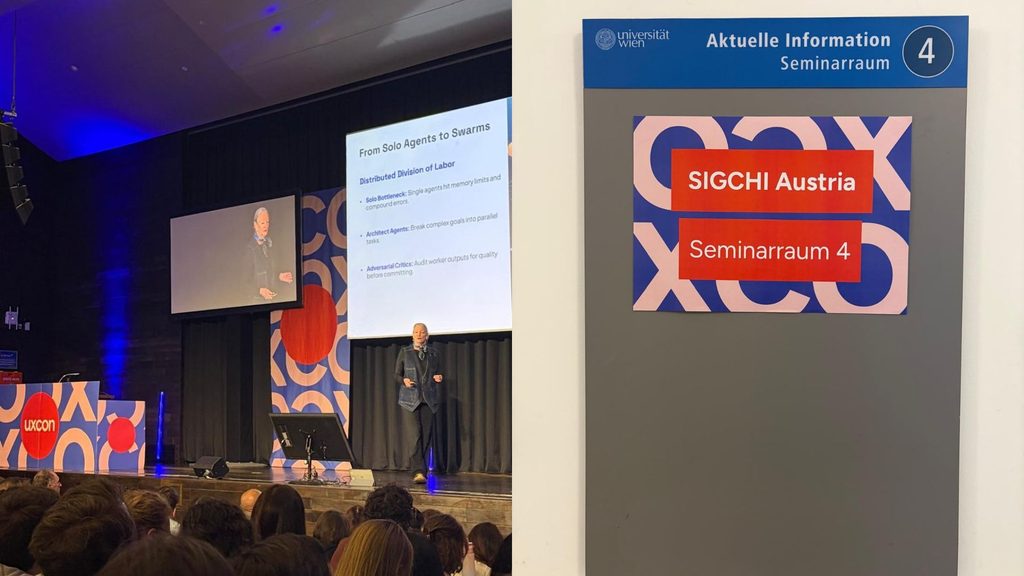
As I continue my master’s studies in Interaction Design, I have been trying to understand where I want to take my research and what opportunities exist beyond my studies. My background is mainly in visual communication and design, but over the past year, I have become increasingly interested in Human–Computer Interaction (HCI), particularly in the research side of the field. This interest led me to join SIGCHI Austria and attend its Fall Meeting, which took place alongside uxcon vienna at the University of Vienna.

The meeting brought together researchers, PhD students, postdoctoral researchers, professors, and people working in different areas of HCI. The programme included research presentations, keynote talks, discussions, and opportunities to meet other participants. It was a full day of presentations and conversations, but for me, the most valuable part was getting to know the community and seeing how people with different backgrounds approach interaction research.

A different perspective on interaction design

One thing I noticed quite quickly was that my background was different from those of many other participants. Most of the people I spoke with were involved in academic research, often coming from technical or scientific disciplines. I was approaching HCI mainly through design, with an interest in how interaction concepts can be developed, prototyped, and evaluated.

This made the experience particularly interesting. I had several conversations about my studies, my interests, and the kind of research I might pursue in the future. Speaking with people who were already doing PhDs, working as postdoctoral researchers, or teaching at universities helped me understand the different paths within HCI.

I also began thinking more about the relationship between design and research. In design education, we often work towards an outcome, whether it is an interface, an experience, or an interactive prototype. In academic research, the contribution can also be a better understanding of a problem, an experimental finding, or a method that others can build upon.

These are not completely separate approaches, but I am still learning how to bring them together in my own work.

Research presentations and discussions

Throughout the day, I attended the research presentations and discussions organized by SIGCHI Austria.

What I appreciated about the format was that each presentation was followed by discussion. The audience could ask questions, share suggestions, and discuss possible directions for the research. It was interesting to see research being discussed while it was still developing, rather than only encountering it as a finished publication.

Another highlight was Elizabeth Churchill’s keynote, “Intelligence Reimagine – Interaction Redefined,” presented as part of uxcon vienna. Churchill has worked across academic HCI research and industry, including leading UX research teams at Google and other technology companies. Her background alone was interesting to me because it demonstrates how research and design practice can be connected throughout a career.

I particularly enjoyed her presence and the way she communicated. She was an engaging speaker with a strong personality, which made her presentation one of the most memorable parts of the event. Her keynote addressed the changing relationship between people, technology, and design in the context of AI. These questions are also relevant to how I am currently thinking about interactive systems.

Finding my place as a Interaction Designer

Beyond the presentations, I think the conversations I had throughout the day were just as important. Meeting people at different stages of their academic careers made the research community feel more accessible.

Before attending, I was familiar with HCI mainly through papers-projects, and the research methods I had been studying. At the meeting, I could see the people behind this work, hear about different research directions, and ask questions about their experiences.

I also offered to contribute to SIGCHI Austria through volunteering, particularly with design, organization, and related activities. I would like to stay involved because I see it as a way to learn from the community while contributing something from my own background.

The experience also made me more confident about approaching researchers, even when I do not have the same technical or academic background. I still have a lot to learn about research methodology and academic work, but I can bring my own perspective as a designer into these conversations.

Impact on my further research

This meeting came at an important point in my studies, as I have been exploring possible directions for my master’s thesis and considering further academic research.

Attending the meeting helped me see the broader field in which my interests could develop. It reminded me that HCI is interdisciplinary and that meaningful contributions can come from different methodological and professional backgrounds.

Perhaps the biggest takeaway was realizing that I do not have to choose between being a designer and becoming a researcher. I can develop both perspectives, and the combination may become an important part of my future work.

Attending SIGCHI Austria was therefore more than an opportunity to listen to presentations. It was my first direct experience of becoming involved in an academic HCI community, and it encouraged me to continue exploring this direction.


Accompanying links

  1. SIGCHI Austria — Autumn Meetup 2026 Official information about the meeting and its collaboration with uxcon vienna.
  2. uxcon vienna 2026 — Day 1 Programme Conference programme, including Elizabeth Churchill’s keynote.
  3. Elizabeth Churchill — Speaker Profile Information about her academic research, professional background, and keynote.

AI Use Disclaimer

AI was used to help organize and edit this reflection. The personal experiences, observations, and reflections are my own.

Can an Adaptive Interface Reduce Frustration? A Master’s Thesis Review

For this assignment, I chose Adaptive Affective Computing: Countering User Frustration by Behzad Aghaei (2013), written at the University of Waterloo. I chose this thesis because it relates to my interests in human-computer interaction, cognitive workload, and adaptive interfaces. I am particularly interested in how interactive systems can recognize changes in a user’s state and respond to them in a useful way.

About the Thesis

The thesis explores whether an adaptive interface can help users recover from frustration. The author tested this using a tablet-based map application that deliberately froze during tasks. Participants wore a skin conductance sensor to measure changes in their physiological arousal. In the adaptive condition, the interface changed its colors and button sizes as part of its response to frustration.

The thesis follows a clear structure, starting with the theoretical background and continuing with the experimental methodology, data analysis, results, and discussion. The practical part involves a working prototype and an experiment comparing a standard interface with an adaptive version. The main idea is to investigate whether changing the interface based on the user’s physiological state can improve their experience.

Academic Quality and Practical Implementation

I think the research question is interesting, especially considering that the thesis was written in 2013. The idea of using physiological signals to influence interface behavior was an experimental approach at the time. I also appreciate that the project goes beyond measuring frustration and attempts to respond to it through interaction design. Although the adaptation itself is relatively simple, the research raises an important question about whether interfaces should automatically react to users’ emotional states.

The experimental approach is one of the strengths of the thesis. The author compared two interface conditions and collected both physiological measurements and participant feedback. This provides different perspectives on the user experience and helps connect the theoretical ideas to measurable results. However, there are some limitations in how the experiment was conducted.

The study initially included 40 participants, but only 22 were included in the final analysis. Although the author explains the reasons for excluding participants, this is still a significant reduction in the sample size. It raises questions about how reliable the findings are and whether similar results would appear with a larger group. Another important issue is that the frustration detection algorithm rarely worked as intended. I think this is particularly problematic because reliable detection is an essential part of the proposed adaptive system. If the system cannot consistently recognize the user’s state, it becomes difficult to evaluate the full potential of the adaptation.

The practical project is documented through screenshots, explanations of the experimental procedure, and graphs. The comparison between the standard and adaptive interfaces is especially helpful for understanding the implementation. Visually, the interface looks functional, but I do not find the design particularly convincing. The adaptation mainly involves color and button size changes, without much exploration of how these decisions affect the overall interaction. The visual changes also seem quite noticeable, which could distract users rather than support them. I think testing different adaptation strategies and conducting usability tests before the main experiment could have made the practical work stronger.

In terms of organization and communication, the thesis is generally clear and easy to follow. The transition from theory to experiment and results is logical, and the author explains the technical concepts in a way that supports the research. However, some parts of the theoretical background feel longer than necessary. I think a more focused discussion could have made the connection between the literature and the actual design decisions clearer.

The scope is also quite ambitious, combining psychology, physiological sensing, software development, and experimental evaluation. This makes the project interesting, but it also creates technical and methodological challenges. In my opinion, focusing more on the quality of the adaptation and its evaluation might have been more valuable than trying to cover so many areas at once.

The literature covers relevant academic fields and provides a useful foundation for the research. The author uses previous studies to explain physiological responses, frustration, and adaptive computing. However, I think the assumptions behind the visual adaptation could have been examined more critically. For example, there is a difference between knowing that certain colors may have calming associations and proving that changing an interface to those colors will actually help someone recover from frustration.

The thesis is generally presented carefully, with references, figures, and methodological explanations. The bibliography is relevant to the research topic, although the connection between some of the literature and the final design decisions could be stronger. I did not notice major problems with the overall presentation, but some methodological decisions could have been justified more clearly, particularly the participant exclusions.

Regarding independence, the author acknowledges that a colleague developed the software system. I do not see collaboration as a problem, especially in a technical project, but a clearer explanation of the author’s individual contributions to the practical work would have been helpful. The research direction, experimental approach, and analysis still demonstrate an independent academic investigation.

Results and Overall Evaluation

What I found most interesting is that the adaptive interface did not improve recovery as expected. The overall difference between the two groups was not statistically significant, and the first trial actually showed slower recovery in the adaptive condition.

Some participants also associated the visual changes with the application freezing rather than understanding them as a supportive response. I think this is an important finding from an interaction design perspective. Even when a system is designed to help users, the way it communicates its behavior can create confusion. The intention behind an interaction does not always match how people experience it.

Overall, I think the thesis meets the expectations of a master’s-level research project. It connects a research question with theoretical knowledge, practical implementation, and experimental evaluation. Its main weaknesses are the reduced sample size, unreliable frustration detection, and limited exploration of alternative designs.

However, I appreciate that the author discusses the unexpected results and possible reasons behind them. The prototype did not achieve its intended outcome, but the experiment still provides useful insights into the challenges of adaptive interaction. I think the academic value of the thesis comes more from its research process and findings than from the success of the prototype itself.

Relevance to My Own Thesis

This thesis connects closely to my interests in adaptive interaction, attention, and cognitive workload. I am interested in systems that can respond to users’ changing needs without interrupting their activities unnecessarily.

One thing I would like to take from this thesis is the use of a controlled experiment with clear hypotheses and measurable results. I also find the combination of physiological data and user feedback useful because it allows researchers to compare what a system measures with what users actually experience.

However, I would approach the design process differently. Before conducting the main experiment, I would spend more time testing how users understand and react to the adaptation itself. I would also consider combining physiological sensing with behavioral measurements instead of relying on a single signal. This could provide a more complete understanding of the user’s state and help avoid interpreting physiological arousal as one specific emotion.

Another aspect I would pay attention to is how noticeable an adaptation should be. In some situations, changing the interface might help users, but in others, the change itself could become an interruption. I think this is especially important when designing systems intended to support attention and task continuity.

The most important lesson for me is that an adaptive interface is not automatically a better interface. A system might successfully recognize a change in the user’s state, but its response can still be confusing or distracting. For my own research, I would like to focus not only on whether a system can adapt, but also on whether that adaptation actually supports the user’s experience.

Reference

Aghaei, B. (2013). Adaptive affective computing: Countering user frustration [Master’s thesis, University of Waterloo]. https://hdl.handle.net/10012/7386