New semester, new researches and new problems…Moving from theoretical research into lo-fi prototyping forced me to confront something I had been putting off: my topic is hard to make it physical. Research on attention, interruption and cognitive recovery does not translate naturally into a clickable mockup or a paper sketch. The phenomenon I am studying is internal and time-dependent. You cannot see it on a screen.
The approach I took was a simple behavioural task. A participant reads a short text and corrects errors in it while thinking aloud. I interrupt them once with a spoken question, then observe how they return to the task. To capture focus levels over time, I built a small browser tool; a slider the participant adjusts continuously, which logs their self-reported focus every thirty seconds and marks the exact moment of the interruption. At the end of the session it exports a CSV, so it is easier to track the data. It is low-tech, but it produces real data grounded directly in the literature.
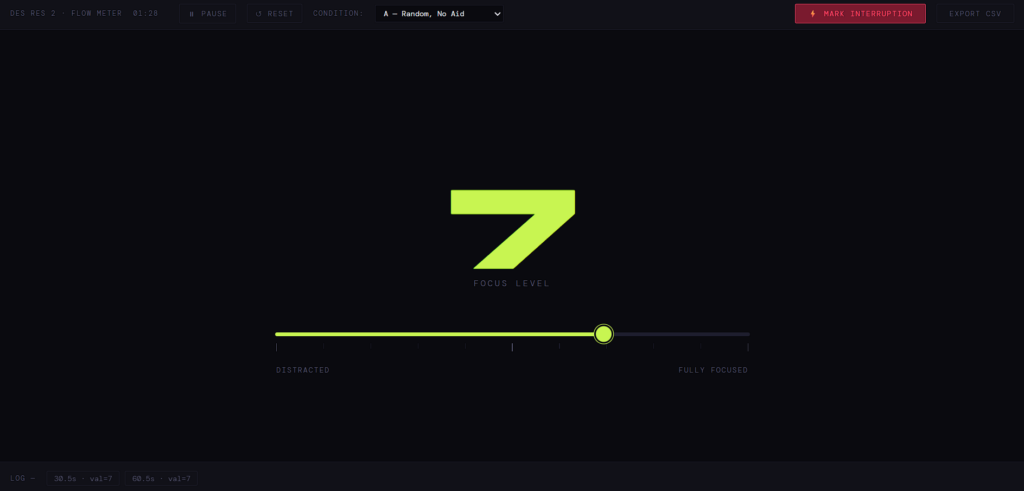
The first test format was a speed dating exercise: five-minute exchanges rotating between participants. The idea is to get fast, varied feedback, and it works well for many types of prototypes. For mine, it was harder to make useful. Five minutes is not long enough for a person to actually get into the task before the interruption happens. Most of the time was spent explaining the setup rather than experiencing it, so the feedback reflected how clearly I could describe the concept more than how the prototype itself worked.
The most consistent piece of feedback was about the setup: having the task on one device and the focus slider on another felt fragmented. Several people pointed out that if I am studying attention, adding friction between two separate tools is counterproductive. It is a fair observation and one I plan to address, consolidating everything into a single interface makes more sense both practically and conceptually.
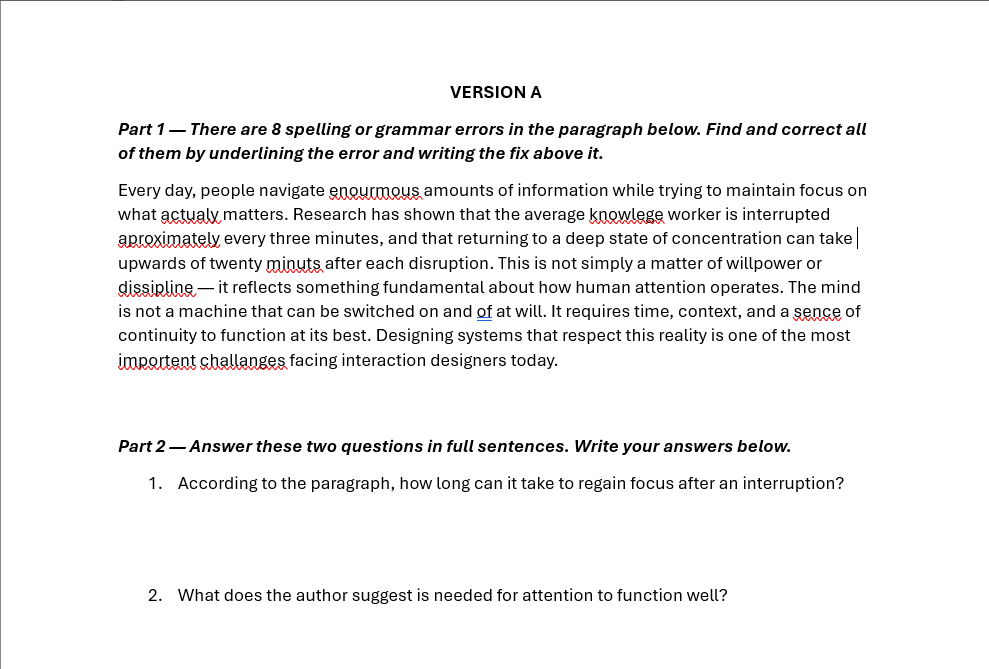
The session was useful in a different way than I expected. It did not tell me much about interruption and recovery, but it did clarify the limits of the current prototype as a communication tool. My research sits closer to the theoretical end of the spectrum for now, and that makes it genuinely difficult to prototype in a format that works for quick explanation to someone unfamiliar with the underlying psychology.
The plan is to run the full session individually, without the time pressure, in a setting where the participant can actually reach a state of focus before the interruption lands. I also want to think about whether a behavioural experiment alone is the right form, or whether the research needs a more designed artefact alongside it, something that makes the concept visible rather than just measurable.
