System Map
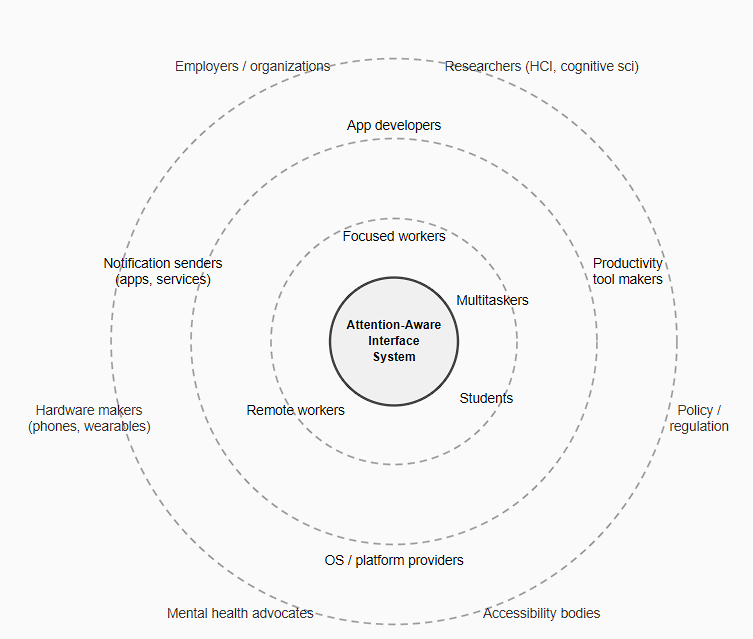
At the center is the Attention-Aware Interface System, a framework designed to make digital environments sensitive to a user’s attentional state before delivering interruptions, rather than eliminating them entirely. The inner ring holds the direct users: knowledge workers, students, remote workers, and multitaskers, each experiencing interruptions differently based on task type and cognitive load. Surrounding them are the groups that shape interruption conditions: app developers, OS providers, and notification senders and at the outer edge, the institutional forces of employers, researchers, hardware makers, and policy bodies. Together, these layers show that attention is not just a personal resource, it is a systemic one.
Change and Impact
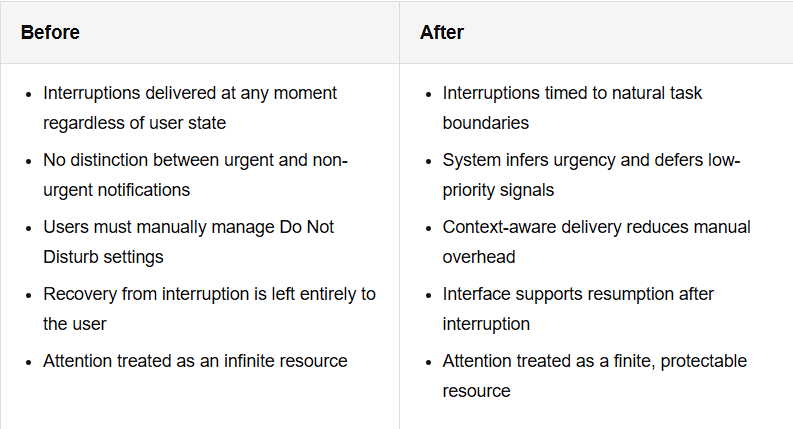
This comparison highlights the shift from interruption-blind digital systems to attention-aware design. Current notification architectures are built around the sender’s intent, not the receiver’s cognitive state. A message is delivered the moment it is sent, regardless of whether the recipient is mid-task, in a flow state, or already cognitively overloaded. The result is a system optimized for immediacy at the cost of sustained focus.
Inclusion & Accessibility
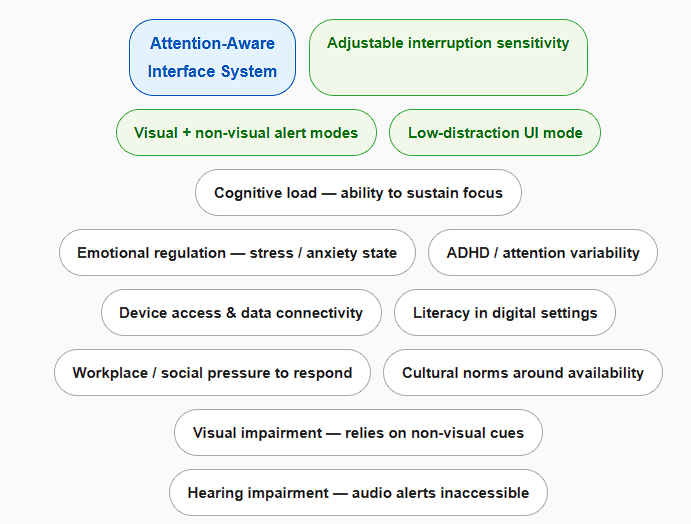
Access to an attention-aware system is not uniform. The ability to benefit from interruption management depends on a range of cognitive, physical, and social factors that are unevenly distributed across users. Some barriers are internal: a person with ADHD may experience interruption recovery very differently from a neurotypical user: for them, even a brief disruption can cascade into a much longer loss of focus. Users in high-stress or high-anxiety states are more vulnerable to the compounding effects of notification overload. Inclusion here is about cognitive and emotional accessibility, not just physical or perceptual access.
