Supermarkets are objects of our everyday lives. They are so invisible almost, that we take them for granted and don’t think about them much, other than doing a quick google search on where the nearest supermarket is. I want to avoid the mistake of skipping the basic and most vital step for my research: putting everything in a bigger picture. To proceed so, I would like to gain a better overview and understanding of supermarkets. In order to do so, I did a quick and informal desktop research on the history of supermarkets. While I still remember the basics (e.g. 1930s USA) from my middle schools geography and economics class I want to get settled on some more details.
History
Thus I watched a TV documentary, followed by a discussion with a business economist. I also took a quick dive into the current status quo of the supermarket business in Germany and Austria and will also share some personal perspectives at the end of the blog post.
As already mentioned, the concept kicked off in the US in the 30s, in a store called King Kullen. A german pilot store opened in the year 1938 in Northern Germany’s town of Osnabrück. According to the researcher Lydia Langer the main pain points that held business people back from opening supermarkets themselves was, that they were afraid A) there will be less one on one interaction with customers and B) customers might steal products in self service stores.
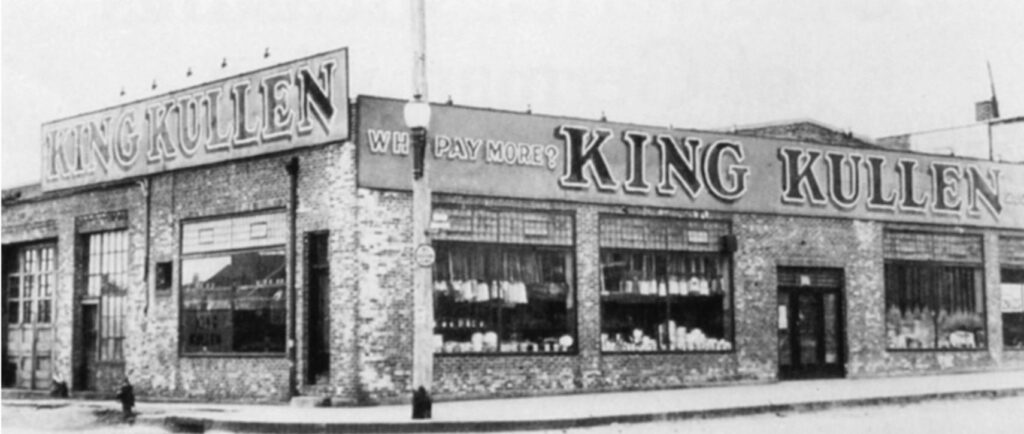
Source: King Kullen
In the early 1950s Germany counts almost 40 stores that have adapted the self service concept. A milestone was reached a few years later when the first supermarket with a retail space of 1700 m2 opened to the public in North Rhine-Westphalia. The landscape of self service grocery shopping drastically changed in the 60s when the Albrecht brothers decided to give it a twist by introducing discounters. They identified high prices as a focal pain point for a lot of customers. By removing certain parts of the typical floor layout – e.g. the meat counter – and by sacrificing the aesthetic of the stores they opened up more possibilities for consumers. The documentary is followed by a discussion with the hosts of a talk show and the business economist where they discuss how the conventional supermarkets managed to backfire – e.g. by also introducing store owned brands. [1]
The fact that a retail space of 1700m2 was noted as revolutionary in the 1950s raised my attention and I got curious about nowadays conventions. For example, a hypermarket store like “INTERSPAR” commonly has something between 2500m2 and 5000m2. [2]
Personal Thoughts
As already mentioned, supermarkets are part of our everyday lives. Having everything in one place is convenient, but can also have downsides. The more products you can find in the store the more space the store requires. According to business economist Alexander Hennig supermarkets first peaked in the 70s when they would be located rather remotely for example in industrial areas of cities. During this time, people also changed their car driving habits. Today however, smaller supermarkets are becoming more and more attracting to customers, especially for those who live in cities and view a supermarket within walking distance as a necessity. [1]
Corporations like Kaufland are aware, that their stores are a focal point of people’s modern lives. In some stores they are currently testing so called “Medical Rooms” to make for example blood sampling possible on spot when grocery shopping [3]. From a personal standpoint however I will admit that I am skeptical towards these plans of the Schwarz-Gruppe. First of all, I fear that the company is rather interested in the profit they might retrieve from this concept, and that these medical check up spots will lack quality instead. Furthermore I am concerned about how this will influence the reduction of so called third spaces.
Why am I mentioning third spaces? As was already pointed out above, supermarkets are places of interaction. This raises the question: WHY do people still appreciate it (e.g. at the “Feinkosttheke”) to have this personal interaction? Düshorn, a village between Hannover and Bremen, has a non-capitalistic approach to grocery shopping. The so called “Dorfladen” in Dushorn originally started out as a compromise to find a solution for the post office, the local bakery and the Sparkasse. It is being operated as a non-profit association (”Genossenschaft”) by residents of the village. On top of buying groceries the aprox. 2.500 people living in Dushorn view the Dorfladen as a possibility to interact and catch up with others.
References
[1]
M. Janning, “Der Supermarkt – Erfolgsmodell unter Druck,” WDR Nachrichten, Dec. 20, 2022. https://www1.wdr.de/mediathek/video-der-supermarkt–erfolgsmodell-unter-druck-100.html (accessed Jan. 05, 2026).
[2]
copyrightInfo, “EUROSPAR, INTERSPAR & Co» Geschäftstypen | SPAR Österreich,” Spar.at, 2024. https://www.spar.at/unternehmen/geschaeftstypen
[3]
APOTHEKE ADHOC, “Telemedizin: „Medical Room“ im Kaufland | APOTHEKE ADHOC,” APOTHEKE ADHOC, Nov. 07, 2025. https://www.apotheke-adhoc.de/nachrichten/detail/markt/telemedizin-medical-room-im-kaufland/# (accessed Jan. 05, 2026).
