Sound communicates emotion even without words in it. Visuals have the ability to translate that emotion into something we can see and adds another layer of media that can be interpreted. Artists like Wassily Kandinsky and Oskar Fischinger believed that colour and movement can form “visual music”, as they could act like notes and rhythm too. They explored the relationship between sound and image in the early 20th century, long before digital tools existed.
In modern VJing or animation, this translation continues in live and digital forms. Delicate melodies might flow as fluid rivers, while a bass drop might trigger a sudden burst of light. A VJ generally adds to the atmosphere by interlinking with sound, rhythm and the structure of the venue. This intensification of sound helps the audience feel rhythm physically, bridging the gap between hearing and movement.
Such an emotional link embodies a shared atmosphere. At a rave, attendees usually not only dance to the set, but dance inside a designed world full of rhythm within sound, light and colour.
Examples of audiovisual work that amplify the sound experience include the work of Ryoji Ikeda, whose minimalist light compositions turn sound frequencies into geometric flashes, creating a precise sensory overload.
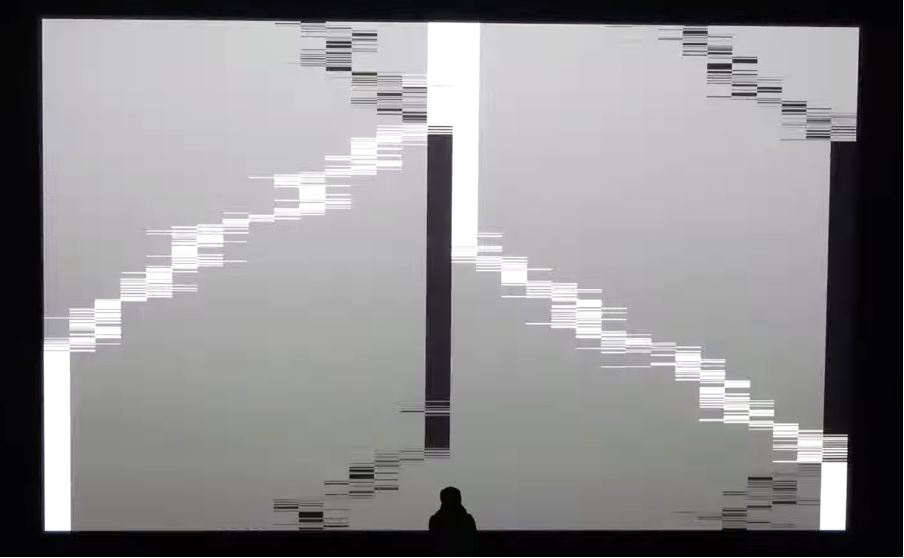
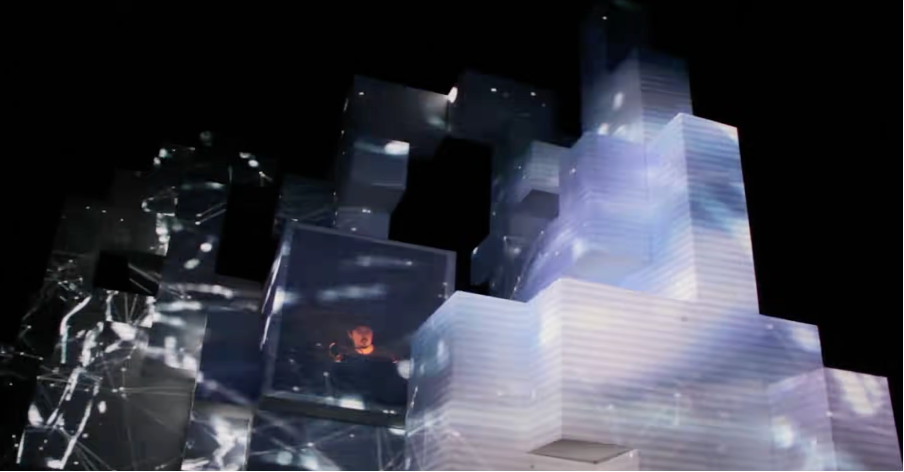
Another example is Amon Tobin’s ISAM Live performance, where 3D projection mapping blurs performer and structure until the stage itself feels alive. In both cases, visuals are an integral part of the experience and actively shape the narrative the artist conveys.
Sources:
Chion, M. (1994). Audio-vision: Sound on screen. Columbia University Press.
Brougher, K., Strick, J., Wiseman, A., & Zilczer, J. (2005). Visual music: Synaesthesia in art and music since 1900. Thames & Hudson.
Ikeda, R. (2016). Datamatics. Elea-Media Art Editions.
Marks, L. E. (1978). The unity of the senses: Interrelations among the modalities. Academic Press.
