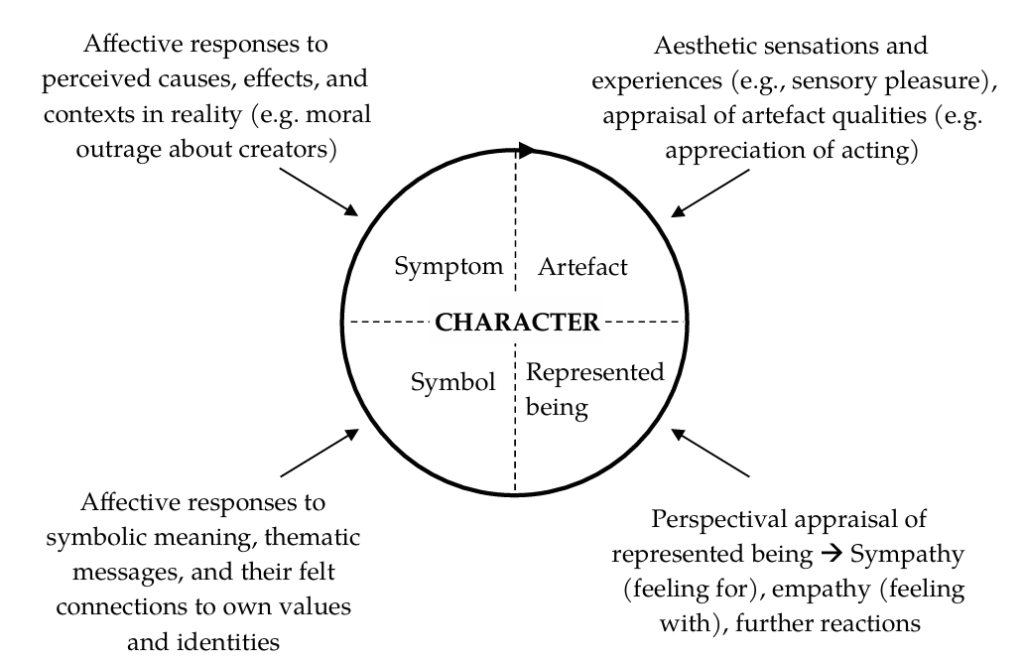
Because my first three blog posts were all about the same topic but lacked a logical structure, I want to give you a brief overview of what I have researched and discussed so far before it gets too confusing:
- Why do we root for the bad guy? A summary of eight reasons why audiences are often drawn to villains and anti-heroes in film and television
- The Jungian Archetype Theory
- The Big Five
- The Character Clock
- A Brief Draft for Building a Customized Model for Villain Analysis
These topics already build a good foundation for creating my own model, but there are still a few steps I need to take before I can develop an actual framework.
The current idea I have for a systematic character analysis framework looks as follows:
- The character as an artefact – analyzing the character using the ACIS framework
- The character as a represented being – analyzing the character using the Big Five
- The character as a symbol – brief notation of possible symbolic meanings the character can carry
So, what will be next?
In this blog post, I want to explore the missing parts, such as discussing the ACIS framework and researching concrete examples of how to use these frameworks, before actually defining the complete framework in one of the next blog posts.
The ACIS Framework
The ACIS Framework was developed by Christine Linke and Eckart Prommer in 2021 as a systematic method for analyzing how characters are represented and visible in audiovisual media (perfect for my use case!). It combines quantitative content analysis with narrative and reception-based approaches. An important aspect of this method is that it analyzes the content as a viewer would experience it, without relying on external context.
The Step-by-Step Procedure of the ACIS Framework
Since I plan on integrating this framework into my own model, I want to explain it by giving you a step-by-step guide on how it is used.
Step 1: Character Identification
The first step in using the ACIS Framework is to distinguish whether the character is a Protagonist or a Main Character. ACIS defines characters based on their role and presence in the narrative.
- Protagonists are characters who take on a leading role and act as the driving force behind the story in a goal-oriented manner. In television, this is often clearly marked by the character’s permanent presence in the ensemble.
- Main characters are persons who are centrally visible on screen, have their names mentioned, and speak dialogue, such as TV hosts, news anchors, reporters, and so on.
Step 2: Character Characteristics Coding
Once the role of the character is identified, the next step is to analyze the character in detail by coding individual characteristics such as:
- Gender
- Age
- Sexual orientation
- Other specific characteristics (body shape, appearance, clothing, etc.)
The key principle here is that these characteristics must be visually or audibly perceivable – not simply taken from the script or other external information.
Step 3: Visibility Dimensions
The ACIS Framework focuses on three dimensions of visibility:
- Frequency: How often does the character appear?
- Density: How much screen time does the character receive?
- Focusing: How prominently is the character positioned or emphasized in the frame?
It also considers when and how much the character speaks, so the analysis includes both visual and audio presence.
Adapting the ACIS Framework for Analyzing Sympathetic Villains

The ACIS Framework serves as an almost perfect method for systematically analyzing the character as an artefact, but I want to modify a few aspects so it fits perfectly with my analysis of sympathetic villains. Keep in mind that all these adaptations currently function as a first draft and will probably be revised and further adjusted as the research progresses.
Since some villains function as protagonists in film and television, and the identification as a main character is primarily used for broadcasting formats, I will either identify the villain as the protagonist or not. I also considered defining three categories for villains, because they can not only be a protagonist or not, but sometimes also act as an omnipresent being, like Sauron in The Lord of the Rings, who serves as the main challenge for the hero but receives hardly any screen time. Since I am unsure about this and would need to create a clear definition for each category, I will just note it here as a thought to keep in mind.
Regarding the second step, Character Characteristics Coding, I would like to incorporate the research of Keen, McCoy, and Powell in Rooting for the Bad Guy: Psychological Perspectives and definitely include attractiveness in some way, based on the third reason they mention: “What is Beautiful is Good.” I know attractiveness is difficult to measure scientifically, but hopefully I will find a method in my future research that provides an easy way to analyze this attribute.
Another aspect I want to consider, which is already included in the ACIS Framework, is the Mere Exposure Effect mentioned by Keen, McCoy, and Powell – that is, the screen time and actual dialogue time of the villain. I have already looked into some AI tools that could help determine a character’s actual screen time without having to watch an entire film or TV series and manually count the time. Unfortunately, I fear these tools have limitations, and I will probably have to focus mainly on movie villains. Hopefully, further research will provide a solution to this problem.
That’s it for this blog post. In the next one, I want to create my first concrete draft of a character analysis model. Looking forward to it!
Until then – see ya.
Literature:
- Linke, Christine, and Elizabeth Prommer. “From fade-out into spotlight: An audio-visual character analysis (ACIS) on the diversity of media representation and production culture.” Studies in Communication Sciences 21.1 (2021): 145-161.
- Keen, Richard, Monica L. McCoy, and Elizabeth Powell. “Rooting for the bad guy: Psychological perspectives.” Studies in Popular Culture 34.2 (2012): 129-148.
Disclaimer: This text was proofread for punctuation, grammar, and spelling errors with the help of Perplexity. The content of the text remains unaffected.