What Makes a Villain? An Introduction to Character Analysis Frameworks (Part 2)

In the first part of this two-part blog series, I explored two well-known character analysis models – Jungian Archetype Theory and the Big Five personality framework. While both offer interesting perspectives for analyzing fictional characters, they fall short of covering the full scope needed for a truly systematic analysis. That’s why, as promised, I’ll introduce another model that is much more detailed and was specifically created for analyzing fictional characters in film and media. I know what you might be thinking:

“Great, another post on dry theoretical character analysis!”

But hang in there – soon we’ll dive into the practical side.

The Character Clock
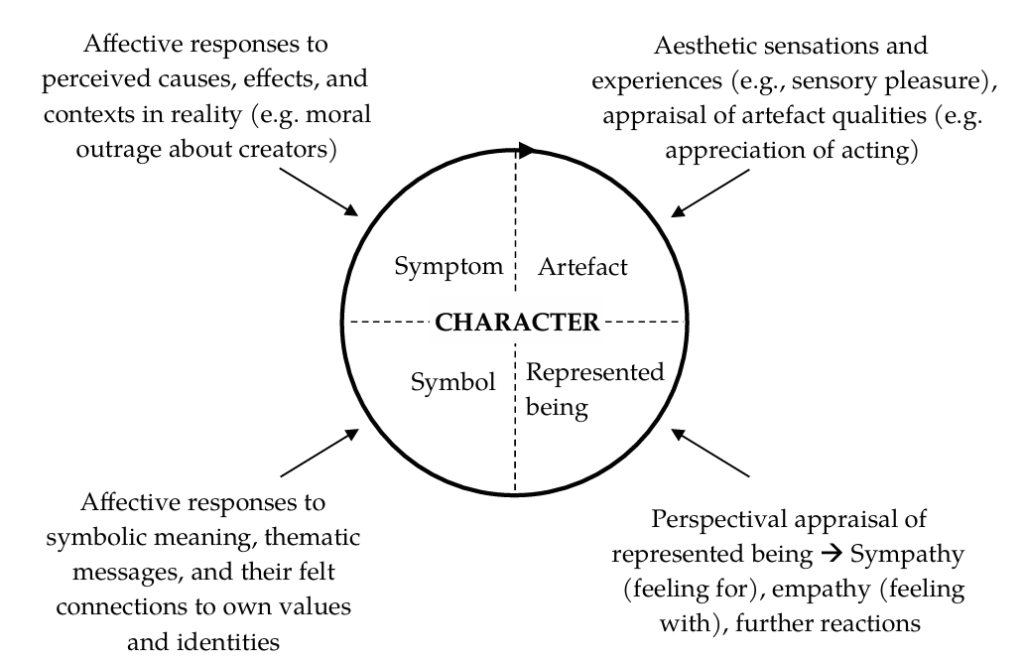
Jens Eder introduced a new character analysis framework called the “Character Clock” in his book Characters in Film and Other Media. The purpose of this model is to analyze different dimensions of fictional characters to provide a complete understanding that includes not only their personality but also their appearance, symbolic meaning, and the context in which the character was created. The name comes from the shape of the model, which resembles a clock and symbolizes how our understanding of a character moves through the four parts he defined.

  1. Artefact:
    The first aspect we notice about a character is their appearance and how they are presented on screen. This includes not only their looks but also their voice, movements, and how these elements are arranged through acting, camera work, and writing style. This stage focuses on the character as a crafted piece of media itself, before considering what the character represents.
  2. Represented Being:
    At this stage, we begin to view the character as a person within the story – a being with a personality. We consider their relationships, emotions, actions, and social roles in the story’s world. This involves imagining the character’s traits and inner life as part of the narrative.
  3. Symbol:
    Characters often symbolize something larger than themselves. Here, we understand that the character not only exists in the story world but also functions as a symbol representing ideas, themes, or social issues. This stage deals with the deeper, often hidden meanings the character can carry.
  4. Symptom:
    Finally, a character can reflect aspects of the real world in which the media was produced. This includes cultural values, political messages, and social stereotypes that influenced the creation. This stage examines why the character was created in a certain way and how audiences might interpret them based on the production and viewing context.

Not every part of the character clock is equally useful for every character or story because some characters might be mostly about their story role, while others are specifically designed as a symbol or to make social commentary.

Defining My Research Focus (Wtf Was This All About?): A Systematic Approach to Villain Analysis

Moving from “How to analyze characters in film and media in general” to “What I aim to research and what is necessary to do that,” I want to combine these methods to suit my specific use case. My goal is to analyze villains systematically, compare them, and highlight what differentiates common villains from the most popular villains, those we actually root for despite their immoral actions. Keep in mind that this is just my main goal. If I manage to create a reliable statistical model, you could use it to compare fictional characters in any way you like. For example, you could compare heroes and villains, sidekicks and heroes, or antiheroes and villains. The possibilities become almost endless once you establish an analytical method focused on building a large database with statistically and systematically researched values.

Adapting the Character Clock: Building a Customized Model for Villain Analysis

I really like Jens Eder’s approach with his Character Clock because it covers all the aspects of a fictional character and not only the personality. Therefore, I want to base my model on his but with a few modifications.

First of all, I don’t want to include the Symptom part. I know that the Symptom is also an interesting aspect of character analysis, but I think it’s more efficient, when analyzing multiple villains, to start with a smaller scope. Otherwise, the analysis for just one character would take way too much time to even gather a database. You could write a whole book analyzing one character if you try to cover each of these four aspects, so I am trying to break it down to the most important ones.

Secondly, I want to mainly focus on the Artefact and the Represented Being parts because they are not only the things we notice first when seeing a character on screen, but also the easiest to compare. I also want to include the Symbol briefly for every character by noting if they represent something bigger, what it is, or if there is even a deeper meaning behind the character.

And last but not least: How do I want to systematically analyze the Artefact and the Represented Being?
I want to use the Big Five for analyzing the Represented Being since it fits perfectly for analyzing multiple characters and is suitable for creating comparable diagrams.

For the Artefact, on the other hand, I want to use a framework called ACIS (Audio-Visual Character Analysis) a systematic method designed for analyzing how characters are represented and visible in audiovisual media, developed by Christine Linke and Eckart Prommer and published not too long ago in 2021. I will present this framework in the next part of this blog series as well as continue to describe what my approach will look like.

I know I promised this to be a two-part blog, but during my research, I realized that I have to cover much more to actually develop my own framework. Sorry!

See ya in the next one.

Literature:

  1. Eder, Jens. Characters in Film and Other Media: Theory, Analysis, Interpretation. Open Book Publishers, 2025.
  2. Linke, Christine, and Elizabeth Prommer. “From fade-out into spotlight: An audio-visual character analysis (ACIS) on the diversity of media representation and production culture.” Studies in Communication Sciences 21.1 (2021): 145-161.

Disclaimer: This text was proofread for punctuation, grammar, and spelling errors with the help of Perplexity. The content of the text remains unaffected.

What Makes a Villain? An Introduction to Character Analysis Frameworks (Part 1)

Simply listing the reasons why people root for villains and antiheroes wasn’t enough for me. I wanted to explore the deeper question of what truly makes a villain a villain. To understand that, I also needed to examine how a typical villain is structured and designed. In other words, this is a matter of character analysis.

Conducting character analysis in a scientific context is far from simple. In my case, I aim not only to analyze several well-known villains but also to compare them in order to identify shared traits and distinct differences among some of the most popular antagonists in contemporary media.

In this two-part blog post, I will present three established models of character analysis and discuss how these frameworks can help reveal the psychological and narrative patterns that define our favorite villains. Furthermore, I will try to combine them and create my own framework for analyzing villains in TV and movies. Keep in mind that many more models exist for analyzing both fictional characters and real people – such as Aristotle’s Poetics, Campbell’s Hero’s Journey, Freytag’s Pyramid, and the Myers-Briggs Type Indicator, just to name a few. I chose these models because they seemed fitting for my plan to analyze and compare villains, and I often came across them during my research.

The Jungian Archetype Theory

The Twelve Archetypes in Marketing

Named after the renowned Swiss psychiatrist Carl Gustav Jung, the Jungian Archetype Theory describes characteristic patterns that categorize attributes into different persona types. While this theory has been highly influential in analyzing characters and crafting stories and narratives, it is not considered a strictly scientific approach to character analysis because it relies heavily on the interpretation of stories, myths, and images, which is subjective and difficult to validate with empirical evidence.

Bassil-Morozow explains in Jungian Theory for Storytellers: A Toolkit that archetypes manifest in narratives as familiar character types – such as the Hero, the Shadow (the villain) and the trickster (among many others). Each archetype represents recurring motifs and psychological dynamics within stories. These archetypes are not rigid but act as flexible templates that can be adapted depending on the context, genre, and cultural interpretation. While Jung originally identified four archetypes, his concept was later developed and expanded to include nine archetypes in analytical psychology, and even twelve archetypes to align with marketing principles.

Since the Jungian Archetype Theory is rather pseudoscientific, I won’t use it for my character analysis of popular villains. However, because it is still quite renowned – and even our lecturer in narratives and dramaturgy, Mr. Köpping, mentioned that I should take a look at it – I thought I might as well present it in this blog post.

The Big Five

Although the Big Five was not originally created as a model for analyzing fictional characters but rather as a framework in personality psychology to describe human personality, it is a scientific approach to understanding personalities. You might have come across this model, as it is widely used in various personality tests available across the internet. The key traits this model focuses on are Extraversion, Neuroticism, Agreeableness, Conscientiousness, and Openness to Experience. In an analysis, each of these traits is assigned a high or low value, which is then interpreted accordingly. These traits are relatively stable over time and have been supported by extensive empirical research.

Extraversion describes whether a person is more introverted or extraverted. While an extraverted person is sociable, energetic, and assertive, introverts tend to be more reserved and solitary.

Neuroticism reflects emotional instability and the tendency to experience negative emotions such as anxiety and sadness. High neuroticism means a person may be more prone to stress and mood swings.

Agreeableness measures how cooperative, kind, and empathetic an individual is toward others. A high score indicates helpfulness and trust, while a low score suggests competitiveness or antagonism.

Conscientiousness refers to self-discipline, organization, and dependability. High conscientiousness is linked to goal-directed behavior, reliability, and a strong sense of duty.

Openness to Experience describes intellectual curiosity, creativity, and preference for novelty. Individuals with high openness enjoy new experiences, cultural pursuits, and abstract thinking, while those lower prefer routine and practicality.

You thought that we were done with boring character analysis models? Unfortunately, I have yet one other framework I want to talk about! But you’re lucky because the third model, as well as my own approach to a combined model, will be presented in Part 2.

See ya!

Literature:

  1. Asendorpf, Jens B. Persönlichkeitspsychologie für Bachelor. Springer Berlin Heidelberg, 2019.
  2. Bassil-Morozow, Helena. Jungian theory for storytellers: A toolkit. Routledge, 2018.

Disclaimer: This text was proofread for punctuation, grammar, and spelling errors with the help of Perplexity. The content of the text remains unaffected.

From Evil to Empathy: Why We Root for Bad Characters

Introduction:
Since I didn’t know how to start my blog series, I picked a topic I am interested in and summarized what has already been researched about it. As a foundation for this blog post, I primarily refer to the article “Rooting for the Bad Guy: Psychological Perspectives” by Richard Keen, Monica L. McCoy, and Elizabeth Powell, which explores why audiences are often drawn to villains and anti-heroes in film and television.
As a reason why I am even interested in this kind of topic, I want to tell you that I am a somewhat huge Attack on Titan fan, and if you have ever seen it, you might have asked yourself the same questions I did when I first finished binge-watching the whole show: “Was the protagonist actually the hero of the story, or was I manipulated into believing he was?” and “I think I understand his motives, but can I really justify his actions?”
With this in mind, I wanted to explore what makes audiences root for bad characters, even when their actions seem indefensible.

What Keen, McCoy, and Powell came up with:
Richard Keen, Monica L. McCoy, and Elizabeth Powell explain the phenomenon of audiences sympathizing with “bad guys” by defining eight narrative and psychological factors that contribute to the humanization of these characters. To provide an overview of their research, I will briefly summarize the main explanations they propose.

  1. Fundamental Attribution Error
    The fundamental attribution error refers to the human tendency to explain others’ negative behavior as a result of their character or morality, while attributing one’s own negative actions to situational circumstances. For example, when we see a stranger act violently, we might regard them as inherently evil, but if we behaved the same way, we might justify it as self-defense.
    Two additional factors influence how strongly this bias appears.
    The first is identification. The more insight we gain into a character’s perspective, the more likely we are to understand or excuse their behavior.
    The second is time delay. Immediately after observing an event, people tend to make quick judgments (the fundamental attribution error). However, over time, as they reflect more carefully, they begin to integrate situational explanations and may grow more understanding of the person’s behavior.
  2. Mere Exposure Effect
    The mere exposure effect is a rather simple one. The more often you are exposed to a stimulus, the more you like it, regardless of its initial appeal. Applied to fiction, this means the more time audiences spend with a villain, the more they tend to like them.
  3. What is Beautiful is Good
    The phenomenon “what is beautiful is good” describes the human tendency to link positive traits to physical attractiveness. This bias influences audiences’ perceptions of fictional characters. Some movies such as The Godfather or Ocean’s Eleven use this bias to make villains seem more appealing despite their immorality. Research also suggests that this effect is stronger with colorful, vivid imagery. Moreover, the traits associated with attractiveness like social skill, confidence, and intellect align perfectly with characteristics that make a villain charismatic and fascinating.
  4. Schemas
    Schemas are mental frameworks formed through experience that help us organize and interpret information. Once established, schemas shape our perception and expectations. When it comes to storytelling, schemas explain why viewers instinctively root for protagonists because traditional media often casts the protagonist as the good guy. In films like The Godfather, this leads audiences to root for Michael Corleone, despite his immoral behavior, simply because he fills the “hero role.”
  5. Aggressive Tendencies
    Aggressive villains appeal to the audience because they trigger deep psychological drives. Due to this topic being relatively complex and broad, I tried to summarize the main theories as clearly as possible.
    Freud’s Psychoanalytic Theory says that people have natural sexual and aggressive urges. Watching violent or sexual scenes lets us safely release these instincts through fiction.
    Lorenz’s Evolutionary Theory says that aggression once helped humans protect resources and attract mates, which mainly refers to men, which explains their stronger attraction to violent, action-packed films.
    Bandura’s Social Learning Theory discusses that people learn aggression by watching others. Those drawn to violent media may become more aggressive, reinforcing their interest in it.
    On a personal note, I don’t think these theories are entirely accurate today, but I might explore and discuss them further in another blog post.
  1. Revenge
    Revenge is a common trope for popular villains and antiheroes. It can be either personal or altruistic. Research in neuroscience shows that revenge activates the brain’s reward center, making it feel satisfying, even at a cost. Especially men tend to find revenge more satisfying than women, showing stronger brain activity and less empathy toward the transgressor. This factor explains why audiences often sympathize with characters seeking vengeance and see their actions as justified.
  2. Bad Boy / Nice Guy
    The “bad boy” effect may explain why audiences are captivated by charming villains. Psychological studies show that women prefer niceness in long-term partners but often value attractiveness and confidence in more short-term or sexual relationships. Most attractive “bad guys” on screen are not real prospects for long-term love but fantasy figures of charisma, danger, and sex appeal. In fiction, traits that are often linked to bad boys such as boldness and unpredictability make the villains far more interesting and enticing.
  3. Psychological Reactance
    Psychological Reactance describes how people desire something more when it’s forbidden or restricted. When people are told not to want or root for something, they experience a motivational push to do exactly that. Applied to fiction, the “forbidden” nature of villains enhances their appeal. Because we are taught by society to root for heroes and not their counterpart, a psychological reactance is triggered, and the bad guy’s rebellion becomes even more attractive. The act of liking the villain becomes an emotional thrill because we are rooting for the “wrong” side.

Literature:

  1. Keen, Richard, Monica L. McCoy, and Elizabeth Powell. “Rooting for the bad guy: Psychological perspectives.” Studies in Popular Culture 34.2 (2012): 129-148.

Disclaimer: This text was proofread for punctuation, grammar, and spelling errors with the help of Perplexity. The content of the text remains unaffected.