This week I dived into research about the neurological disorder to gain a better understanding of it.
Challenges
When researching about a health-related topic, I’ve faced some obstacles while trying to do a superficial research. While writing my Bachelor thesis I learned the importance of understanding that I as a Designer won’t be able to understand every information I come across since most sources are of the medical and therefore full of latin and scientific terms that are hard to understand. But the lesson I learned is to never forget the reason of why I am reading those scientific papers in the first place. The goal isn’t to understand every single detail but to gather a basic understanding of the topic. This base will then enable me to proceed with more knowledge about it and continue with the Design work. As I started reading papers about migraine I kept reminding myself to remember this lesson in order to prevent myself from feeling too lost in detailed sections. Trying to be selective with my sources is also helpful since I am the person choosing them and deciding which sources or sections are diving too deep into neuroscience.
With this in mind I started asking myself which questions could be relevant for a superficial investigation and collected following results:
Terminology
The word migraine comes from the Greek word hemikrania which means half of a skull. This term was then translated to French: migraine. The reason is that the pain affects one side of the head. [1]
The phases of a migraine attack
A migraine attack is usually characterized by four different phases: [2],[3]
- Prodome: occurs hours or days (as early as 3 days) before the headache phase, including symptoms such as appetite changes, thirst, yawning, etc.
- Aura: appears immediately before the headache (usually flickering lights, blurred vision,…)
- Headache: pain phase (usually pulsating)
- Postdrome: after an attack characterized by non-headache symptoms such as cognitive deficits, fatigue, and others
What surprised me most is that the first phase already begins before the one-sided headache pain even starts. The symtoms that are described such as yawyning, appetite changes or thirst also don’t indicate clearly that a migraine attack is about to start. If a person that is menstruating would analyze their symtoms it wouldn’t be easy to identify whether it is due to a migraine or their menstruation. Even mood changes are reported as a symtom which would also cause the same problem.
Migraine can be classified into two categories: Migraine with aura and Migraine without aura.
Visual aura: occurs in approximately 15–33% of patients affected by migraine attacks. I would like to elaborate more on this topic as it is one important aspect of this complex neurological disorder.
Sensory aura: Perceived as pins-and-needles tingling or numbness starting in the lips/tongue, face, or hand, spreading slowly to the arm or body. Positive sensations dominate, feeling like a wave of prickling.
Speech/language aura: Difficulty finding words, slurring or fluent but nonsensical speech, often unilateral and concurrent with other auras
How does visual aura look like?
The experience of visual aura differs. Some people perceive:
- Zig-zag patterns
- Sawtooth patterns (see picture below)
- Geometric shapes
- Stars
- Scintillating scotoma (shimmering blind spot that expands)
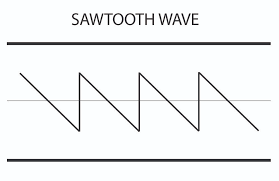
Image 1: Sawtooth wave form
Some migraineurs experience blind spots or temporary vision loss. (e.g. when I thought I was going blind during sports class). It often begins in the center or periphery of vision and spreads graduall, resembling a so-called “fortification spectrum” or wavy lines.
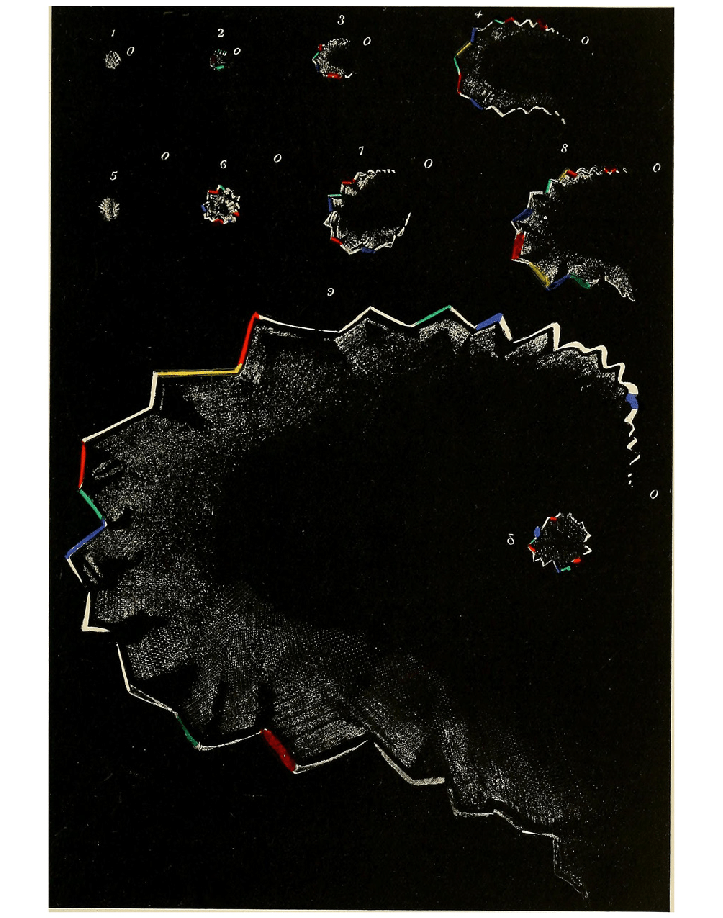
Example of a migraine aura: This picture illustrates the typical gradual expansion of a migraine aura along with the characteristic fortification spectrum.
The visualizing of aura
When I tried to look for images that depict a migraine’s aura I was a bit underwhelmed. Most of the edited images or drawings create a rather aesthetic looking effect.

The warm colors of this image combined with the pastel and colorful lines create a happy and warm mood. For me as someone who experiences visual aura regularly this image is rather irritating and I wouldn’t associate it with migraine.
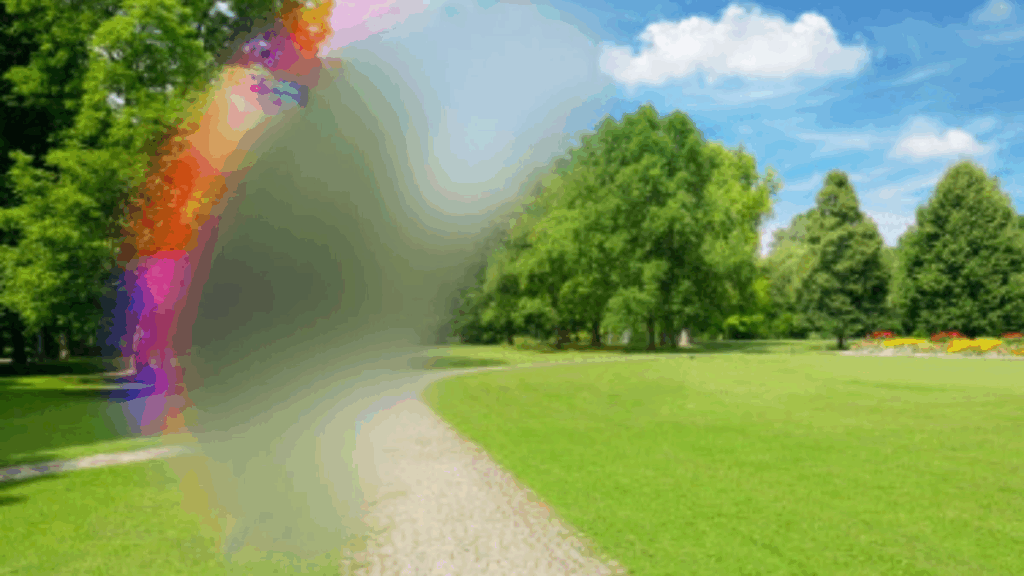
This image does illustrate a blind spot that is blocking the viewer’s sight but the colorful elements next to it again are more similar to a beautiful rainbow than an overwhelming sight loss.

It was a challenge to find a realistic depiction that didn’t leave me with a weird feeling while looking at it. A negative consequence could be that viewers might come to the conclusion that visual aura looks harmless and is actually aesthetic.
After reading more neuroscientific research articles I started searching with scientific keywords such as “fortification spectrum” and then found images that resembled my visual aura more.
Conclusion
When sharing experiences about migraine attacks I often struggle with explaining the visual part of it and how deeply it actually it hurts to see those flashing lights. Since you are the only person it is visible for it is hard to describe, especially since it is related to so much discomfort and pain. Now that I learned that migraineurs report different visual aura I feel intrigued to look more into this topic. It could be interesting to ask people that have perceived visual aura to describe it and have a look at aura simulations. As I am personally affected I could even try to visualize my aura myself and aim for a more realistic draft without embellishing it.
References
- Rose FC. The history of migraine from Mesopotamian to Medieval times. Cephalalgia. 1995 Oct;15 Suppl 15:1-3.
- Vollesen AL, Benemei S, Cortese F, et al. Migraine and cluster headache – the common link. J Headache Pain 2018; 19: 89.
- Stankewitz A, Aderjan D, Eippert F, et al. Trigeminal nociceptive transmission in migraineurs predicts migraine attacks. J Neurosci 2011; 31: 1937–1943.
- Dongen, Robin & Haan, Joost. (2019). Symptoms related to the visual system in migraine. F1000Research. 8. 1219. 10.12688/f1000research.18768.1.
Images
- https://www.thedawstudio.com/sawtooth-wave/
- https://www.wired.com/story/strange-visual-auras-could-hold-the-key-to-better-migraine-treatments
