Since my last update, I’ve noticed that my screen time has actually increased during December, even though I’ve still been implementing, staying off my phone in the morning, 30-min dedicated scroll time, and time limits on certain social media apps. At first, this felt frustrating, but looking closer, the increase makes sense when I consider what the past few weeks have looked like. (The picture shows my screentime from the week before i started the experiment, the first week of experiments, and last week)
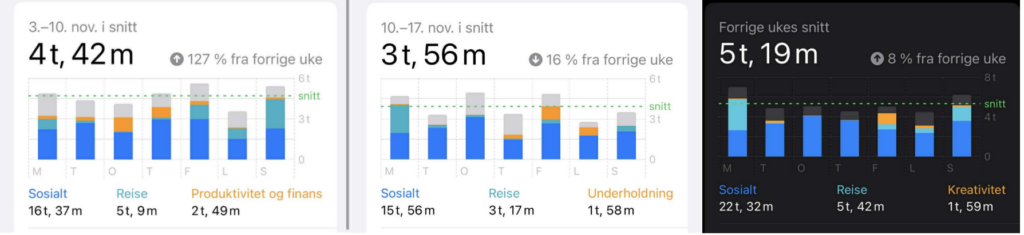
December has been dominated by exam stress, deadlines, and a heavy workload. Instead of using my phone less, I’ve often been using it more, particularly when I’m supposed to be working. Doomscrolling has become closely tied to procrastination. When schoolwork feels overwhelming, scrolling offers a quick way to avoid the discomfort of starting or continuing a task. The more pressure I feel, the easier it is to reach for my phone.
Time limit:
One week after setting time limits on my most-used social media apps, my average screen time initially went down by about 54 minutes. However, that change didn’t last. As stress increased, so did my tendency to ignore the limits. I would hit “ignore,” and keep scrolling, or switch to another entertainment app once I reached my limit. This was also reflected in my screen time categories, where “entertainment” replaced “productivity and finance” in the top three. Instead of reducing screen use, I was simply redirecting it.
30 min dedicated scroll time:
The 30-minute scroll time experiment has been especially difficult to follow during this period. When I’m calm and focused, setting boundaries feels manageable. But when I’m stressed or exhausted, doomscrolling shifts from being a habit to being a coping mechanism. In those moments, the goal isn’t entertainment or information, it’s distraction. That’s why the limits feel easy to ignore, the short-term relief of scrolling feels more important than long-term intentions.
Learnings:
This has made me realize that doomscrolling gets worse under pressure. Exam stress lowers my ability to regulate my behavior, and procrastination feeds into scrolling, which then increases stress even further. It becomes a cycle: stress leads to doomscrolling, doomscrolling leads to guilt and lost time, and that lost time creates even more stress.
Although my screen time going up feels like a setback, it has actually helped me understand my behavior and doomscrolling more clearly. These experiments haven’t failed, they’ve shown me that technical solutions like app limits aren’t enough on their own in all cases. To truly reduce doomscrolling, I also need to address the stress and avoidance that push me toward it in the first place.
I’m still not where I want to be with my screen time, but I’ll continue experimenting and reflecting on what works, especially once the exam period is over and my stress levels are lower. I’ll update again as I keep testing these tools and learning more about doomscrolling habits.
