The last weeks I was facing some struggles which is why this post was on-hold for a while. I felt a bit stuck and the reason is the size of this topic’s scope. While being unsure about the direction my research would take, I continued investigating about the neurological disorder and gathered more information. Although it made me feel like I could understand it better I felt a bit overwhelmed by the broadness of this topic and the lack of a cleary defined problem for my research.
Luckily I was able to organize a zoom meeting with a journalist that is diagnosed with migraine as well and dedicates their time to raise awareness about this disease. This conversation helped to identify core topics and possible themes i could look into.
These were some of the key takeaways from our meeting:
- when talking to them and hearing about their own individual experience with migraine I realized how many aspects I could relate to but there were still several differences in how migraine affects us e.g.
- the frequency of attacks (chronic migraine or episodical migraine)
- intensity of an attack
- aura
- they mentioned the importance of talking to other migraineurs to feel more seen and understood
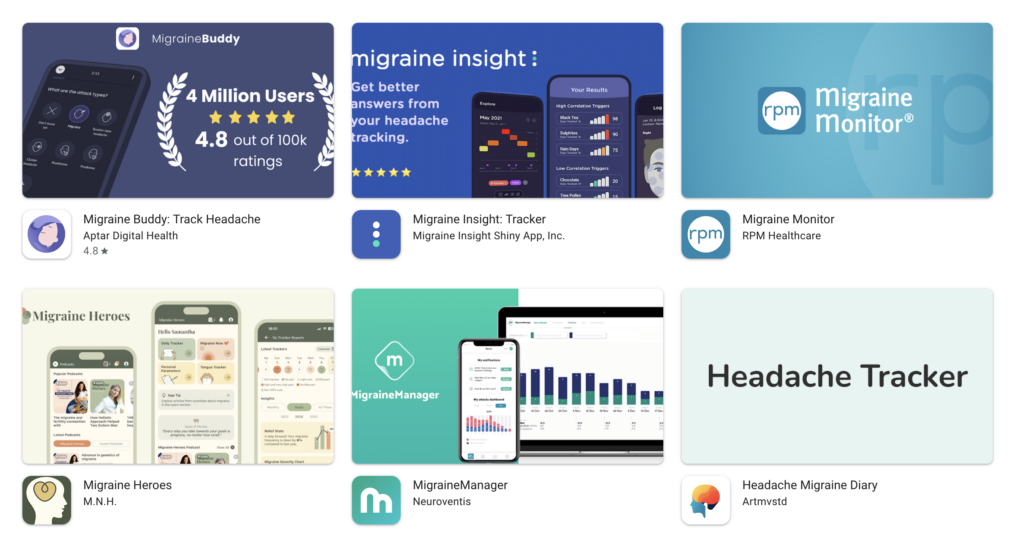
- we have both used migraine apps to track our triggers and pain days
- we agreed that awareness of this disease has increased over the last 20 years, but in our experience, it remains stigmatised and often misunderstood
- they have created a very interesting sound installation to let people have an experience with an overwhelming migraine attack
This interview was essential to realize that my research and reflections outside of the investigation had already progressed so much and taken one direction without me noticing. The reason being that I didn’t take enough notes and that most of my thoughts weren’t written down to organize them which led to me feeling overwhelmed. I felt like I was already several steps ahead but this research diary was still on page 3. Another reason may be that since I am affected by this disorder I feel like already have a strong foundation of this topic and personal experiences with digital tools like Apps but at the same time I am trying to look into this topic from a scientifical and design perspective. Combining those perspectives turned out to be harder than I imagined, however I still belive that it could be significant for this research. As I have to find a way to incorporate both takes to have a meaningful result.
What does this topic have to do with design?
You may wonder about the relation of migraine with design as I haven’t really elaborated my intention. Design helps to create solutions whenever there are problems and a Designer decides to dedicate their time to ideate a creative solution to minimize the problem. But where does the problem lie in this case?
First of all one essential problem is the fact that there is no awareness about this complex disorder. I have mentioned this in previous blog posts but I realized it’s connection to the other problems. As this disease is not talked about enough it remains a stigmatized topic in our society with no space to talk about pain and sufferment caused by it. This could be a reason for migraineurs not being able to recognize their condition in the first place. With poor awareness and knowledge about this neurological disorder how should you even understand what is happening to you? Another problem is the difficulty of being diagnosed correctly and receive care by a healthcare professional and the time to get attended at a neurological appointment to be examined. I was about 19 years old when I learned that I had migraine with aura during my first appointment at a neurological institution I had been waiting for a year. The WHO (2025) states that the main clinical barrier lies in the lack of knowledge among health care providers.
The lack of effective communication between healthcare providers and their patients as a reason for unawareness of ways to reduce migraine attacks by lifestyle changes and stress management. Since almost everything is considered a trigger and the list of triggers is long and confusing and varies in most migraineurs. Why an attack is triggered at a certain point or what triggers it are questions that still need further investigation according to the Medical University Vienna (2016). But the patient education is a significant part of improving their condition (WHO,2025).
One approach to reduce the frequency of migraine attacks is to use so called pain calendars. There are physical paper templates (see image below) to write down the times you experienced a migraine and some of its characteristics e.g.
- pain severity
- symptoms
- duration of pain
- triggers (sleep quality, stress, menstruation, weather, etc.)
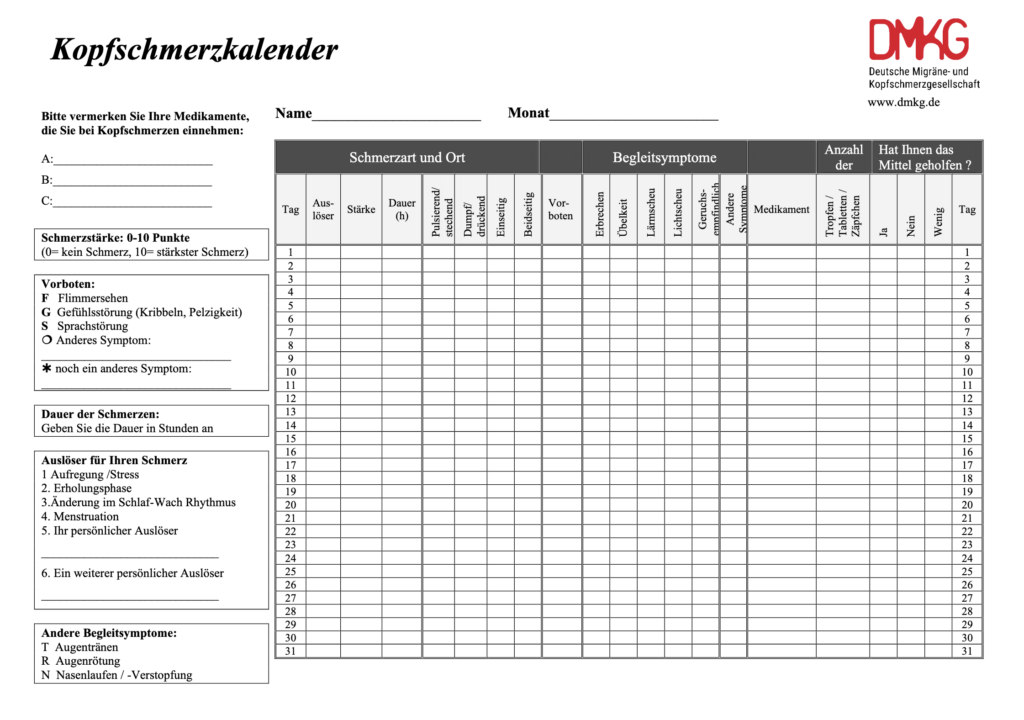
Personally I got tired of printing these templates my neurologist gave me and looked into digital solutions. Mobile apps have been developed for migraineurs to offer a fast and portable overview recognise triggers and warning signs and in the best case identify patterns (see image below). Currently, there are several apps that are either free or chargeable. My goal is to conduct a short evaluation of selected apps to analyze their design and effectiveness from a UX Design perspective. My hypothesis is that most of these apps are designed to track everything without even mentioning the risks on mental health and blame and controling self-management behaviour. From personal experience a few years ago when I used apps to track pain triggers I noticed a correlation in myself to developing a pesimistic and fearful mindset of sufferment. Therefore I am going to look into this issue and whether other patients also experience overanlalyzing and blaming oneself when an attack occurs although they made “healthy” choices.
My following approach
To distance myself a bit more from my own experiences and take the role of a User Researcher, i plan to create an online survey about migraine with and without aura. The goal will be to ask participants for the individual experience of aura and gather more insight into what migraineur’s struggles are. Besides, I would like to find out if they use any tools to track their pain days and if yes, which ones. Lastly, it could be interesting to ask them about a way to simulate an attack to raise awareness about migraine and if they can imagine it to be implemented in VR or with an App or an art installation?
Sources
- World Health Organization. (2025, October 25). Headache disorders. https://www.who.int/news-room/fact-sheets/detail/headache-disorders
- Elmazny, A., Magdy, R., Hussein, M., Ismaeel, A. Y., Essmat, A., Elbeltagy, K. E., Hussein, S. M. M., Hassan, N. S., Elbehiry, N. M., Osama, W., Abdelazeem, H. N., & Elshebawy, H. (2025). Migraine triggers and lifestyle modifications: An assessment of patients’ awareness and the role of healthcare providers in patient education. The Journal of Headache and Pain, 26(1), Article 189. https://doi.org/10.1186/s10194-025-02107-y
- Medical University of Vienna. (2016, February 8). Migraine: Light therapy may bring new hope. https://www.meduniwien.ac.at/web/en/about-us/news/detailsite/migraine-light-therapy-may-bring-new-hope/
