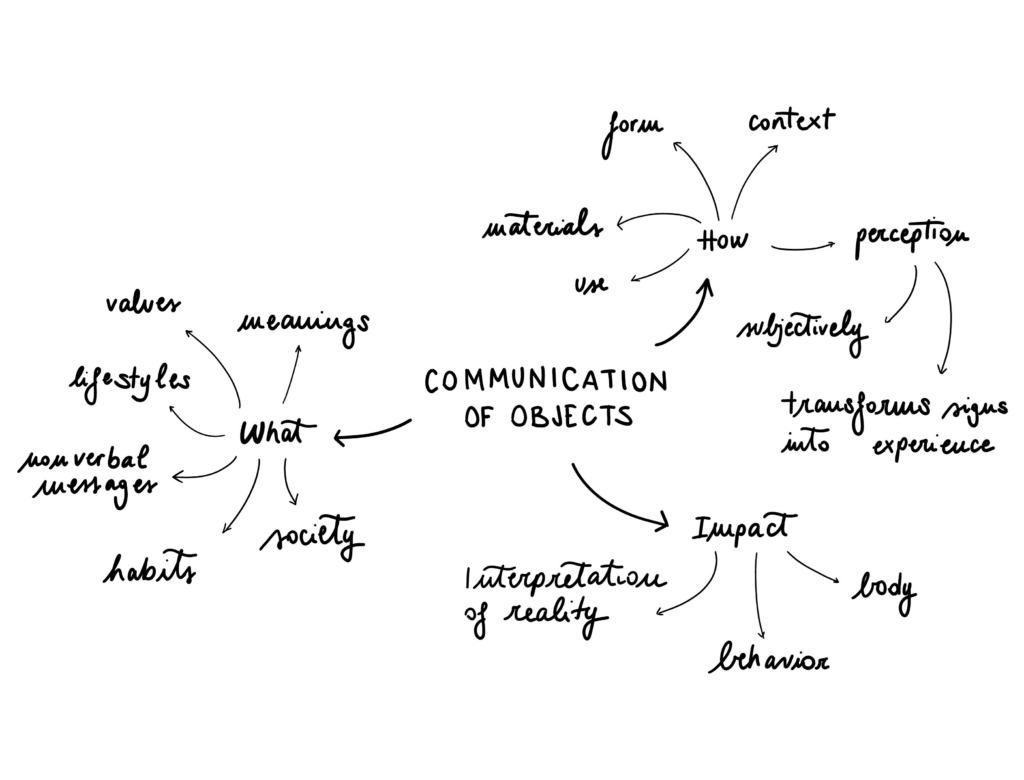
The theme I chose for this research concerns the communication of objects, that is, the way products convey meanings, values, and messages through their form, function, materials, and context of use. This communication is not only design-driven but also personal and subjective: each individual interprets objects based on their own experience.
Every product, in fact, functions as a medium: it establishes a relationship between designer, user, and context, and communicates even when we are not consciously aware of it.
I was struck by a phrase from the Italian designer Bruno Munari, who provocatively stated that there are “more chairs than butts in the world.” The statement is ironic and almost trivial, yet at the same time extremely insightful. The chair is probably one of the most designed objects in the history of design, particularly in product design, and over time it has become a true icon.
This abundance of chairs also says a lot about our society: a society that is increasingly sedentary, in which the body and posture are deeply influenced by work rhythms, technology, and lifestyles. Humans evolve, and along with them, the context, society, and the objects that surround us evolve as well.
In the past, for example, computers did not exist, and it was therefore unnecessary to design ergonomic chairs specifically for office work or gaming. Similarly, just a few decades ago, the available materials and industrial processes were very different from those today. We now live in a historical phase strongly marked by new technologies and an increasing attention to sustainability—factors that directly influence object design.
It is not just technology that has increased, but above all, our needs have changed. These conditions have pushed us to continuously redesign even a seemingly simple and everyday element like the chair. Discover a new material? Chairs are designed to experiment with it. Change habits? New solutions are developed to improve comfort, posture, and user experience.
Returning to Munari’s idea, it is true that there are more chairs than butts, but it is often forgotten that butts are mobile, while chairs are not. A single individual uses different chairs throughout the day, depending on the context and activity: work, study, relaxation, socializing. In this sense, every chair must somehow “attract” the body, welcome it, and communicate its function and value.
All of this has led me to reflect on how much objects say about us, our society, our habits, and our passions. This research has taken on an even more personal dimension since my move to a new city, a moment that made me observe more attentively the objects around me and how they influence my daily life.
Objects are not just functional tools; they are elements that communicate constantly, even when we are unaware of it. This awareness is the foundation of my decision to investigate the communication of objects: to understand how design, through seemingly silent forms, actually succeeds in creating relationships, meanings, and narratives.