Introduction
Why is pothos the best plant for starting to care for plants?
And why is pothos a simple and natural example of how good interaction works?
In recent years, more and more people are becoming interested in the world of plants, often living in cities, in small apartments, and with little time to spare. However, caring for a plant isn’t just about adding a decorative element to the home; it’s also about starting to observe how something can change over time.

Image1. A pothos plant, from Firah
Pothos is a very simple plant to care for, making it ideal for learning. Its changes are easy to notice: the leaves become softer when thirsty, the color changes depending on the light, and growth slows or accelerates. By observing these signals, we begin to understand what the plant needs and how to respond.
This mechanism helps us understand a key principle of interaction design: feedback. Our actions produce a result that modifies a feature of the interface and allows us to understand the next steps to take. In the natural world, feedback arrives slowly, over time. It is not as immediate as a digital interface, but for this very reason it requires attention and observation skills.
Pothos: a Great Plant for Beginners
Pothos (Epipremnum aureum) is often recommended as a first plant, and for good reason. It is a tropical climbing plant, capable of adapting to a wide range of conditions. It thrives in both bright light and partial shade, requires little watering, and survives even minor care mistakes. [1]
But its real strength is how easy it is to understand its needs.
When thirsty, the leaves lose vigor.
When too much light hits, the color changes.
When healthy, it grows rapidly.

Image 2. Screenshot from the video
Pothos Care Indoors: Yellow Leaves, Brown tips, Watering, Repotting, Pruning, Soil & Growth Tips
Looking at pothos, we learn that good feedback doesn’t have to be complicated. It just needs to be visible and consistent. This form of slow, natural interaction helps us understand how, even in the design of digital interfaces, feedback is essential for building intuitive, accessible, and learning-oriented experiences.
Slow Feedback and Interaction Design
In the field of interaction design, one of the fundamental principles is feedback. An interaction works when the system responds to the user’s actions in a legible and coherent way.
The pothos works exactly like this.
Humans act, the plant responds over time.
This relationship isn’t as immediate as the digital one, but for this very reason, it’s educational. It teaches us to recognize patterns and respect timing.
Nature-Based User Interfaces: The Makey Makey Example
In recent years, interaction design has begun to explore nature-based user interfaces, or interfaces that use natural elements as inputs, outputs, or communication mediums. Among the various examples is Makey Makey—a sensor that, like a keyboard or mouse, can become an input for the computer.
It is a system designed to create tangible interfaces simply and immediately, without the need for programming or building complex circuits. Its unique feature is that it does not require specific technological materials. It can also work with natural elements such as plants, leaves, soil, fruit, or simply the human body. [2]
Sensors, digital models, or nature-based interface platforms can therefore amplify existing signals, without replacing them.
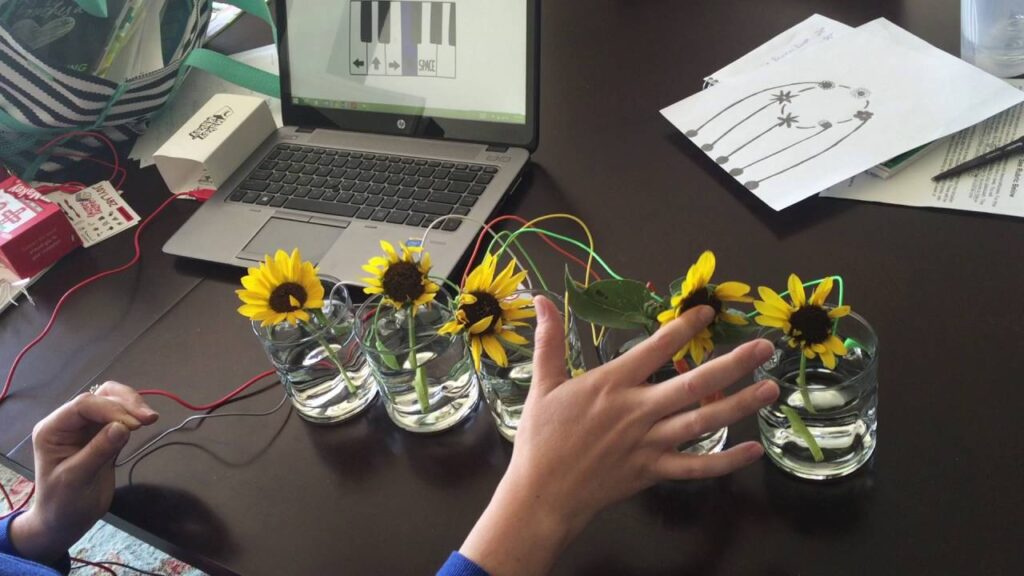
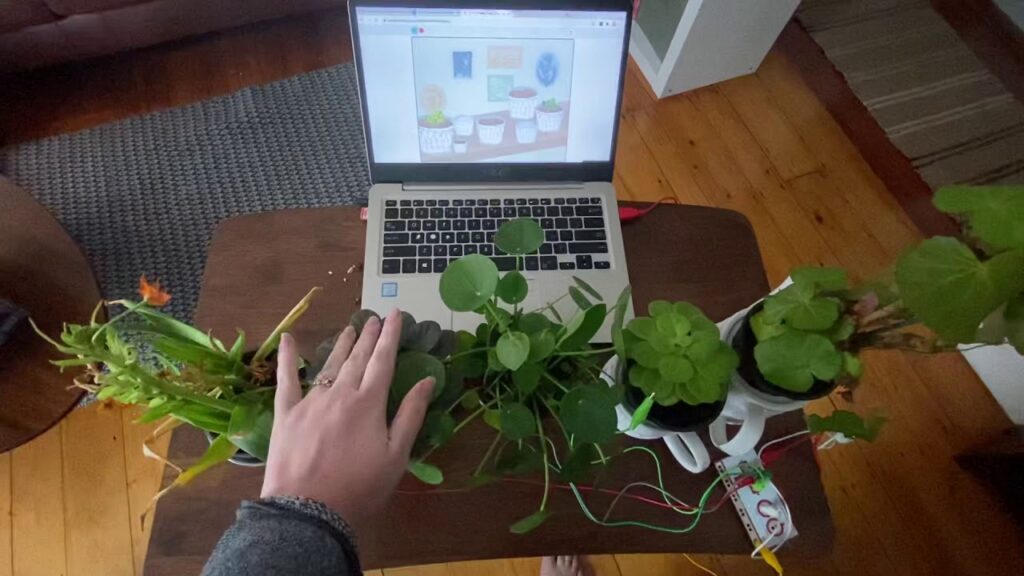
Image 3 & Image 4
Makey makey and scratch plant playgrounds
Reference
[1] “Epipremnum aureum,” Wikipedia. [Online]. Available: https://it.wikipedia.org/wiki/Epipremnum_aureum. Accessed: Jan. 21, 2025.
[2] J. Silver, E. Rosenbaum, and D. Shaw, “Makey Makey: Improvising Tangible and Nature-Based User Interfaces,” MIT Media Lab / Beginner’s Mind Collective, Cambridge, MA, USA. [Online]. Available: https://www.firah.org/upload/notices3/2012/makey-makey-improvising-tangible-and-nature-based-user-interfaces-notice-a-mettre-en-ligne.pdf. Accessed: Jan. 21, 2025.
[3] J. Silver, E. Rosenbaum, and D. Shaw, “Makey Makey: Improvising Tangible and Nature-Based User Interfaces,” MIT Media Lab / Beginner’s Mind Collective, Cambridge, MA, USA. [Online]. Available: https://www.firah.org/upload/notices3/2012/makey-makey-improvising-tangible-and-nature-based-user-interfaces-notice-a-mettre-en-ligne.pdf. Accessed: Jan. 21, 2025.
