In the last post I created a short survey with the goal to find out more about the different individual experiences of migraine and gather more information about struggles and possible tools and solutions.
Participants
After creating the survey with nine questions on SurveyMonkey I shared it with people I know that also suffer from migraine with or without aura. During the peer review in class a fellow student told me that they could share this survey with a friend as well. So in total, I collected answers from six participants.
Evaluation of results
Visual aura
Half of the participants experience an aura, while one person just experiences it sometimes and one particpant doesn’t.
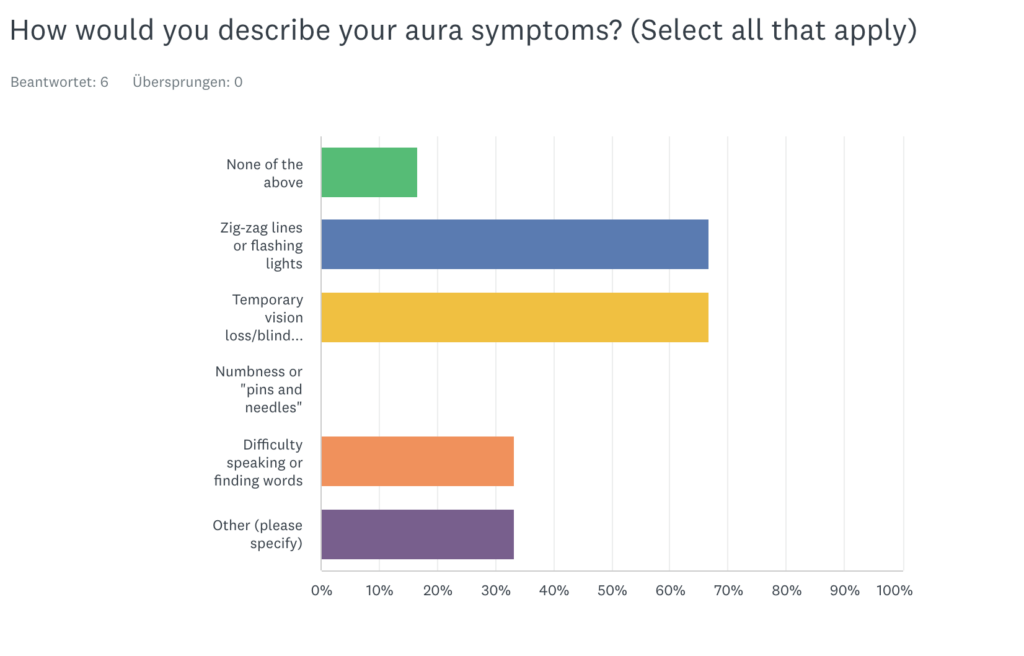
In this survey zig-zag lines or flashing lights and temporary vision loss e.g. blind spots are experienced by 67%. Difficulty speaking or and other symptoms were experienced by 33%. The two people responded with “Other” specified their answer in their own words. One of them mentionend that prior to their migraine led lights have a multiplier effect. If they see them during or after an tattack they see bright colors with something close to the shape of the tiny lights all over the place. Another response was they perceive a change of taste, a weird sensation in the mouth/saliva.
Biggest pain
The answers about the most difficult part of living with migraines show similiar topics. Some contestants stated that not being able to predict or control a migraine attack as the worst. Others mentioned the enduring headache pain or sufferment for two days. While other participants explained that feeling paralysed, uncapable physically and mentally and not being able to speak, think or work is their biggest pain point. One person also wrote that sleep is the only effective “medicine” for them although sleeping during an attack hurts.
Migraine prevention
Two people knew about the importance of regular meals and sleep routines. One person mentioned their diet. Two participants said that they try to drink lots of water and to take it slow and taking enough breaks. One also takes magnesium supplements. Another responded that they avoid strong lights such as cars at night while driving or the light of screens.
One person answered that they don’t do anything to prevent attacks anymore. They used to take pills especially for migraines as soon as they noticed the beginning of a migraine. But this wasn’t a guaranteed help.
Influenced life areas by migraine
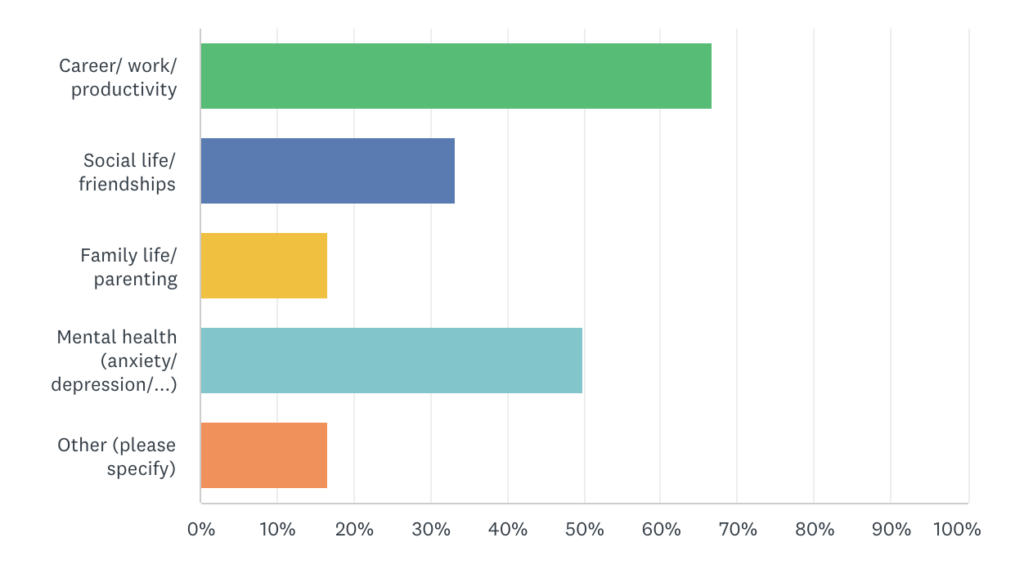
The area that was the majority of 66% of participants voted for is the career/ productivity. On second place is mental health, followed by social life and family life. One person specified their answer with “struggles and stress” although this could be generalized with the mental health area.
Migraine tracking
Four migraine patients don’t track any of their symtoms or pain days. One person answered that they used to but currently doesn’t and only one of the six participants actually uses an App called “Garmin connect”.
Feeling understood by non-migraineurs
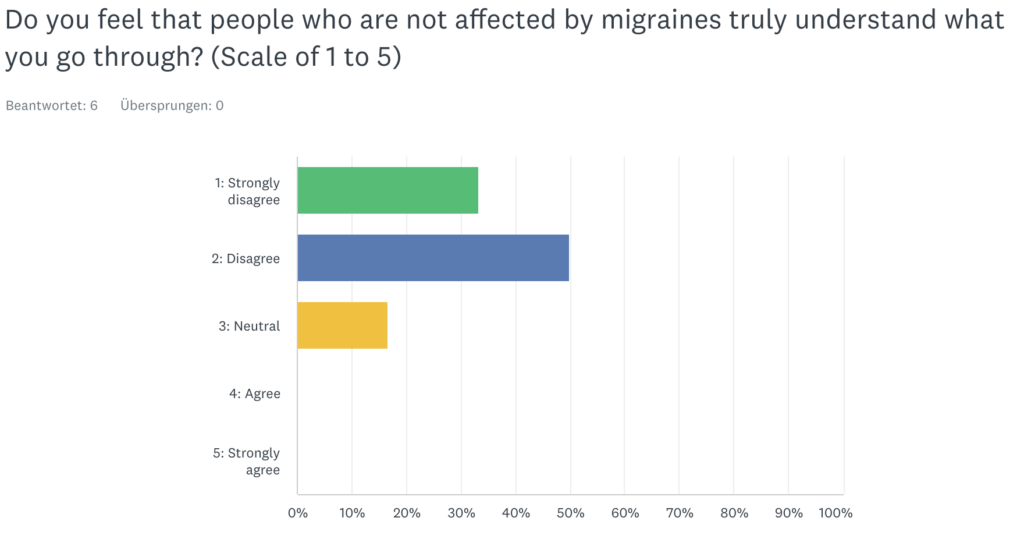
The majority doesn’t feel understood by people who don’t suffer from migraines. 50% answered with “disagree” and 33% with “strongly disagree”. One person gave a neutral rating.
However, 67% “strongly agreed” with the helpfulness of talking to migraineurs and 33% with “agree”. Showing that all of them appreciates sharing or listening to other people with migraine.
Preferred medium for a migraine aura simulation
The majority (83%) prefers an inmersive art installation for a simulation of migraine aura. Followed by VR on second place (50%).
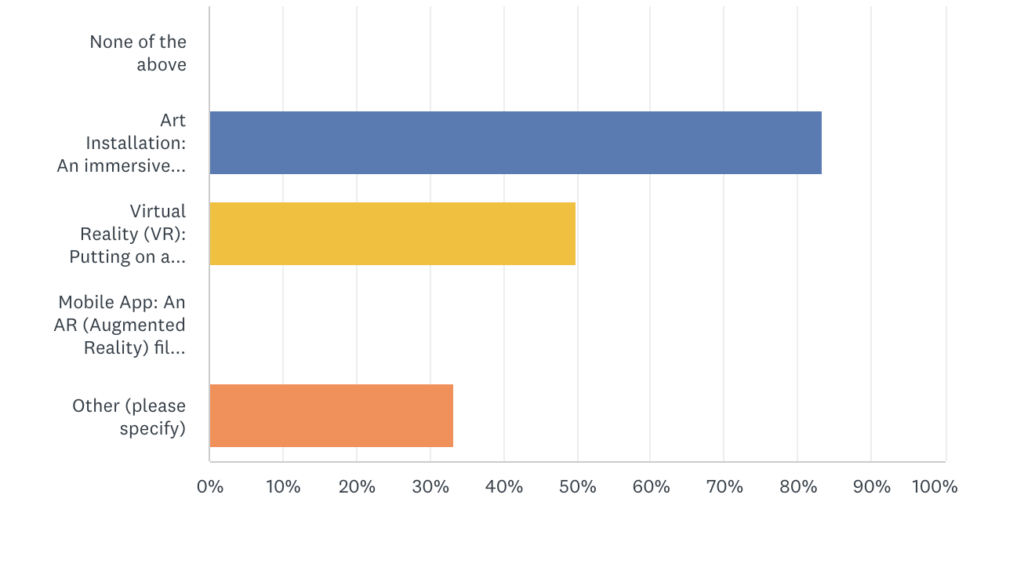
One person added a comment that they think it’s essential that the simulation could be experienced at random, unexpected moments like in a meeting, at school, at university, on a date or at an event.
And one migraine paitient responded that they would be afraid that these simulations would trigger an attack.
Interpretation of the results
The survey results highlight a significant “empathy gap” between migraineurs and society . While participants struggle most with the unpredictability and physical paralysis of attacks, they feel largely misunderstood by those around them who have never had an attack.
Besides, an interesting finding is that tracking methods (apps or Websites) are not used, suggesting a need for more seamless or rewarding monitoring.
All of the participants value peer-to-peer connection which could indicate that community-based solutions could be more effective than isolated self-management.
The high interest in an aura simulation, specifically one that mimics the unexpected timing of an attack, reflects a desire to communicate the loss of control that defines the condition.
Limitation of this survey
For future reserach more participants would have to answer the questions to offer significant quantitative results and to prove the mentioned findings.
Tool
I realized during the creation of the survey that the free version of the SurveyMonkey tool only offered nine questions and no questions with answers in Likert scale format. However, I found a way to work around these limitations and create a short version of my survey.
