Formulating a research question is not a neutral or universal act. Different disciplines propose different frameworks that reflect their underlying assumptions about knowledge, rigor and validity. This becomes especially visible when frameworks developed for scientific research are applied to creative or practice-based fields. In this post, I examine the stepwise approach to research question formulation by Ratan, Anand and Ratan, and critically compare it with Christopher Frayling’s concept of Research through Design.
Ratan et. al define a research question as a response to an existing uncertainty within a defined area of concern. Their framework emphasizes that a research question must be carefully evaluated before research begins, as it guides the entire investigative process. Central to their approach is the evaluative acronym FINERMAPS, which defines the characteristics of a good research question: feasible, interesting, novel, ethical, relevant, manageable, appropriate, potential value, publishability and systematic. Rather than focusing on how a question emerges, the framework primarily addresses how a question can be justified, validated and assessed for quality.
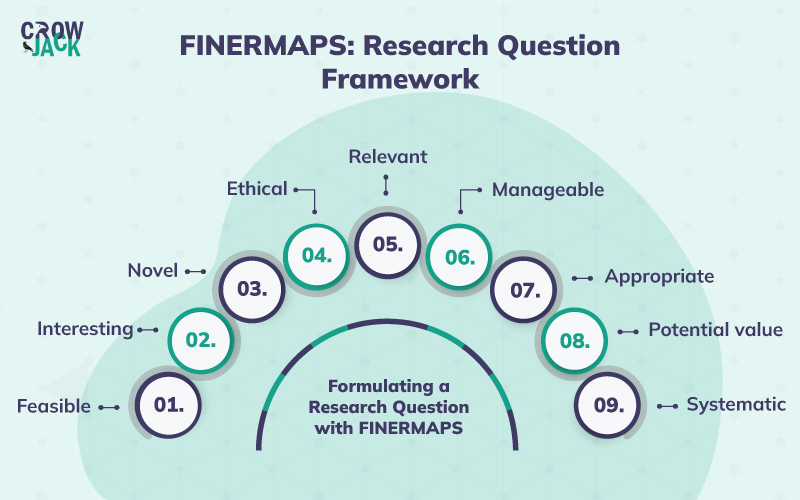
From a methodological standpoint, this approach offers several strengths. FINERMAPS provides a clear checklist that helps prevent overly broad, vague or impractical questions. It foregrounds feasibility and manageability, encouraging researchers to align ambition with available resources and constraints. The framework also emphasizes relevance and potential value, ensuring that research questions are not formulated in isolation but contribute meaningfully to an existing field of knowledge. In this sense, the approach supports accountability and clarity, qualities that are often expected in academic research contexts.
However, the framework also reflects assumptions rooted in positivist and applied research traditions. The classification of research questions into types such as descriptive, relational, comparative or causal reveals a preference for questions that aim to explain, measure or establish relationships. While this is appropriate for many forms of scientific inquiry, it becomes limiting when applied to design research, where questions often address experience, interpretation and meaning rather than causality or classification. Additionally, the emphasis on systematic formulation and early evaluation assumes a level of stability that does not always exist in exploratory or practice-led research.
This contrasts strongly with Christopher Frayling’s model of Research through Design. Frayling distinguishes between research into, for and through design, with the latter positioning practice itself as a mode of inquiry.
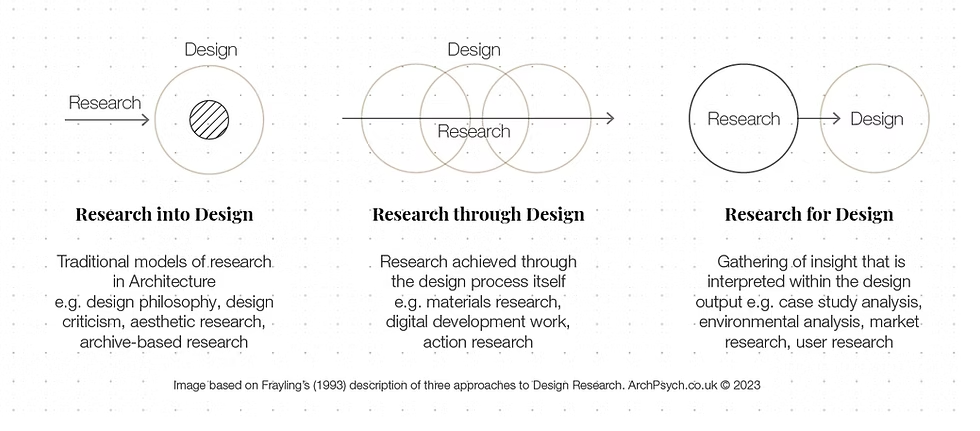
In this framework, research questions are not necessarily fully formed at the outset. Instead, they may emerge, shift or even dissolve through making, testing and reflecting. Knowledge is generated not only through analysis but through the act of designing, with artifacts functioning as sites of investigation rather than final answers.
Where Ratan et al. emphasize evaluation and validation prior to research, Frayling emphasizes emergence and iteration within research. Ambiguity is not treated as a flaw but as a productive condition. Research questions in a research through design context may remain open-ended or provisional for extended periods, allowing insights to surface through practice rather than through predefined structures. This approach aligns closely with creative disciplines, where understanding often develops through material engagement rather than linear problem-solving.
The tension between these frameworks reveals a deeper epistemological difference. Ratan et al. prioritize questions that can be systematically assessed and potentially generalized, whereas Frayling accepts situated, subjective and practice-specific knowledge as valid research outcomes. The inclusion of criteria such as “publishability” within FINERMAPS further highlights this divide, as design research may generate value through process, experience or localized insight rather than through traditional publication metrics.
Rather than viewing these frameworks as incompatible, their comparison highlights the need for adaptation. The stepwise approach by Ratan et al. can function as a valuable evaluative lens, helping to test whether a research question is feasible, relevant and appropriately scoped. Frayling’s framework, on the other hand, offers a conceptual foundation for embracing uncertainty, iteration and making as legitimate forms of inquiry. When combined critically, these frameworks allow research questions to be both reflective and rigorous, structured yet open to transformation.
Sources:
Frayling, C. (1993). Research in art and design. Royal College of Art Research Papers, 1(1), 1–5.
Ratan, S. K., Anand, T., & Ratan, J. (2019). Formulation of research question – stepwise approach. Journal of Indian Association of Pediatric Surgeons, 24(1), 15–20.
