A system map is a visual tool used to understand complex environments by illustrating how different actors, elements, and relationships are connected. Within a research process, it helps designers move beyond isolated touchpoints and instead grasp the bigger picture: how users, organizations, and external influences interact with one another. By mapping these relationships, dependencies and opportunities for improvement become more visible, enabling more informed, holistic, and connected design decisions.
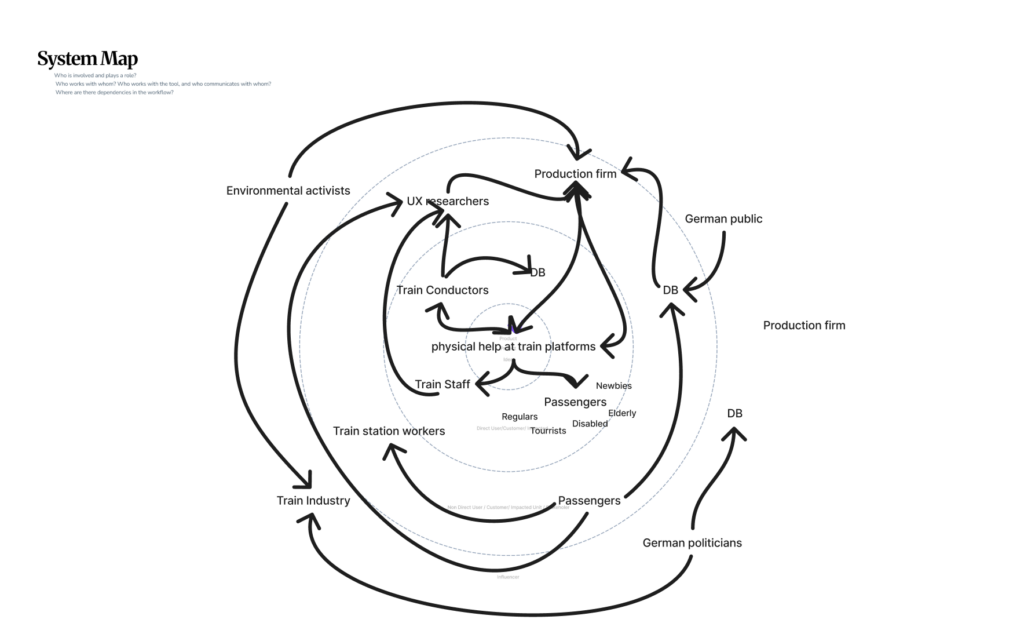
The project I am currently working on focuses on German train stations and explores how physical UX and UI design can improve the user experience on train platforms. At the center of my system map is the intended product: a form of physical assistance at train platforms. This core element is surrounded by the direct users, customers, and those most immediately impacted. In this case, these include train conductors, train staff, Deutsche Bahn (DB), and most importantly, passengers. These passengers represent a diverse group, ranging from regular commuters and tourists to elderly individuals and people with disabilities. Each bringing different needs and challenges to the experience.
Beyond this inner circle are indirect users and stakeholders, such as train station workers, UX researchers, and production teams responsible for developing and implementing solutions. Larger institutional actors, including DB and associated organizations, also play a key role in shaping the system.
The outer layers capture broader societal influences, such as the German public and environmental activists, who indirectly affect priorities and decision-making processes.
The connections between all these actors are visualized through arrows, representing communication and interaction within the system. The density and direction of these connections highlight the dynamic, interconnected, and often circular nature of influence, revealing the complexity of the system as a whole.
Overall, this system map demonstrates that improving a seemingly simple experience requires understanding a complex network of stakeholders, making it a valuable tool for gaining deeper insight and a clearer overview of all relevant factors.
