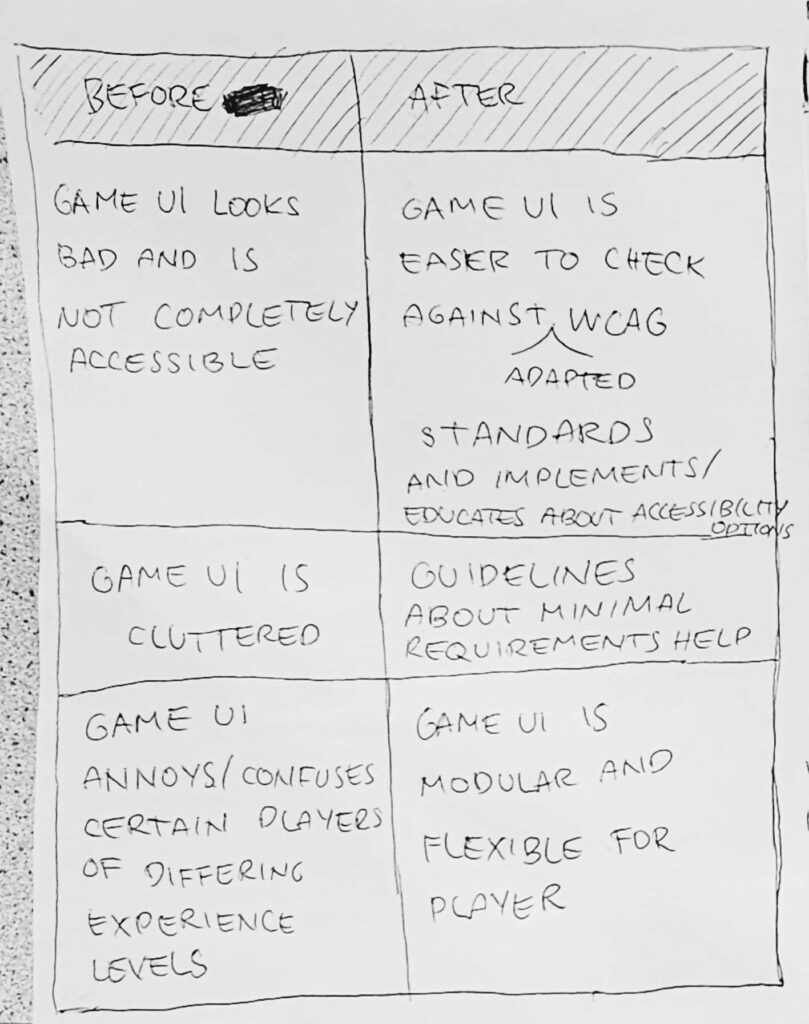
In the “before” scenario, Game UI is often static, cluttered, and not completely accessible. Design decisions are frequently made without a standardized framework, resulting in interfaces that annoy or confuse players of differing experience levels. These “standard” UIs look “bad” in the sense that they fail to meet the functional needs of everyone, leading to a disconnected and frustrating user experience.
In contrast, the “after” scenario highlights a shift toward a more scientific and flexible approach. By adapting and checking designs against WCAG (Web Content Accessibility Guidelines), the UI becomes a tool for education as well as interaction. The impact is a “Modular and Flexible” UI that uses minimal requirement guidelines to reduce clutter. This shift ensures the player is no longer fighting the interface but is instead empowered by a system that adapts to their specific level of experience and physical needs.
