New semester – new me. More or less, at least. While I was extremely confident about my chosen research topic last semester “Creating User-Centered Strategies that align with Business and IT Goals in an innovative Agile Environment. Use Case: Self Checkout Terminals in Supermarkets” the tables have turned.
Rewind – initial idea
Reason No. 1: I initially chose this topic because ever since my internship at Bosch last year I’ve realized how important it is to keep all three feasibility, viability and desirability in mind .
Reason No. 2: The specific use cases of Self Checkout terminals in supermarket seemed like a reasonable extension to the topic, since it aligns with my tasks at my student job. On top, my company would’ve be interested in a collaboration for the thesis.
Long story short: I have gotten to realize that theses matters are already researched through and through.
Motivation – Focusing on employees and/or consumer protection
Instead I would like to contribute something that’s actually innovative and has a social and ethical impact on top. Over the past few years topics such as protection of employees and consumer protection have been on my mind frequently.
Possible idea + 1st Prototype
About two years ago I had the opportunity to participate in an interdisciplinary project called Legal Design Sprint endorsed by the Chambor of Labour Vienna. The project of my team (topic “Mobility”) was even awarded by a team of experts.
Topic Mobility – How do people commute to work?
Two thirds of Austrian employees commute to work by car. [1]
To guarantee a sustainable future this must change. There is a set of alternatives, such as riding the bike to work or using public transport. Nevertheless, these options are limited and raise a few pain points:
- How much responsibility should be carried upon employers?
- Which obstacles are people on the countryside facing?
- How do we convince car drivers to let go of their habits?
- Are possible alternatives tangible?
Our Solution
With our concept “Business Mobility Strategy” employers must be made responsible for the possibilities of commute that are being offered to their employees. To do this a dialog between both sides – employers and employees – needs to happen.
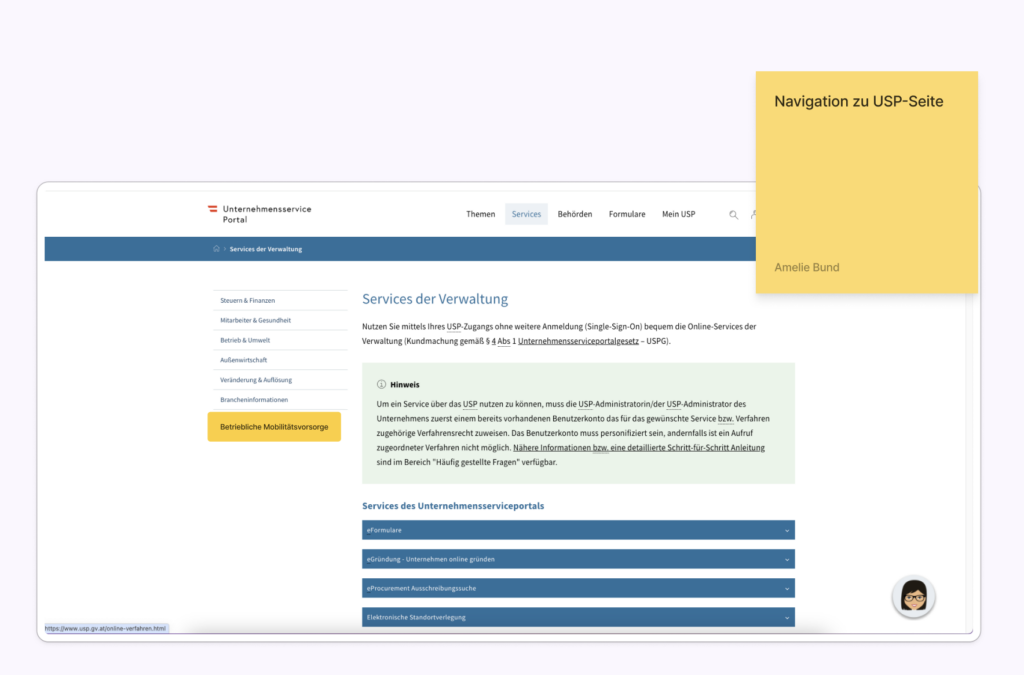
- Interface: The service will be implemented in the “USP – Unternehmensserviceportal” (= the major online service for Austrian businesses).
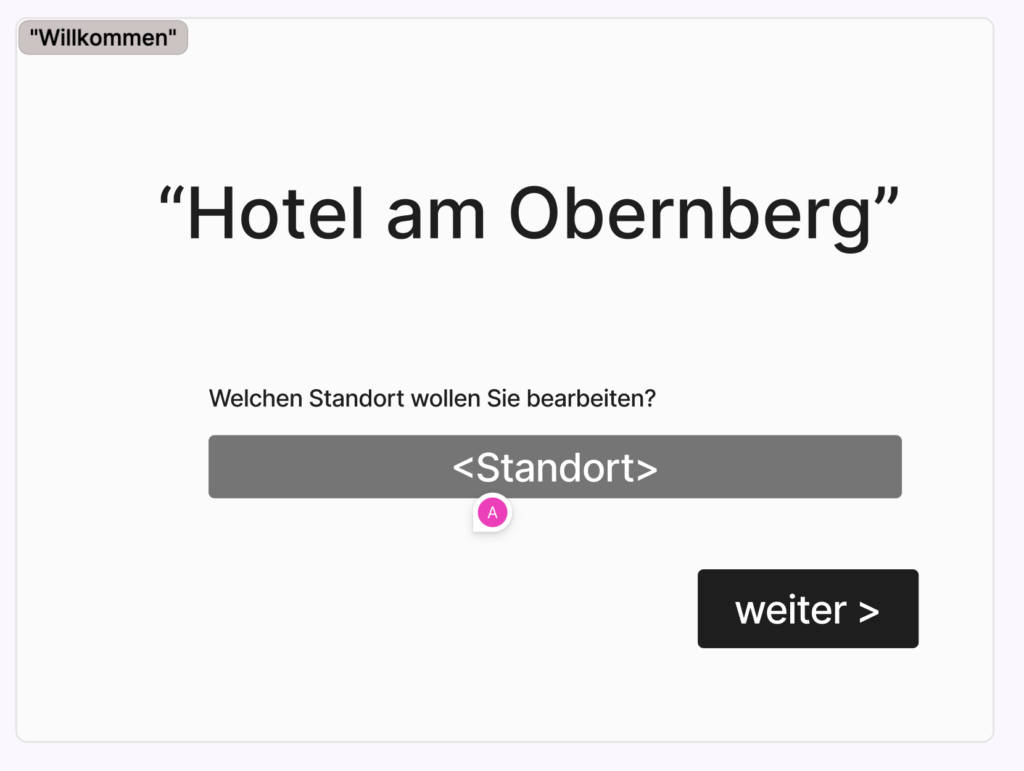
- Data collection: Employers must enter data such as the distance to the nearest bus station or the amount of parking space available for employees.
- Less Red Tape: Business owners are constantly exposed to endless and redundant paperwork. Usability Tests will assure a seamless and viable end-to-end experience.
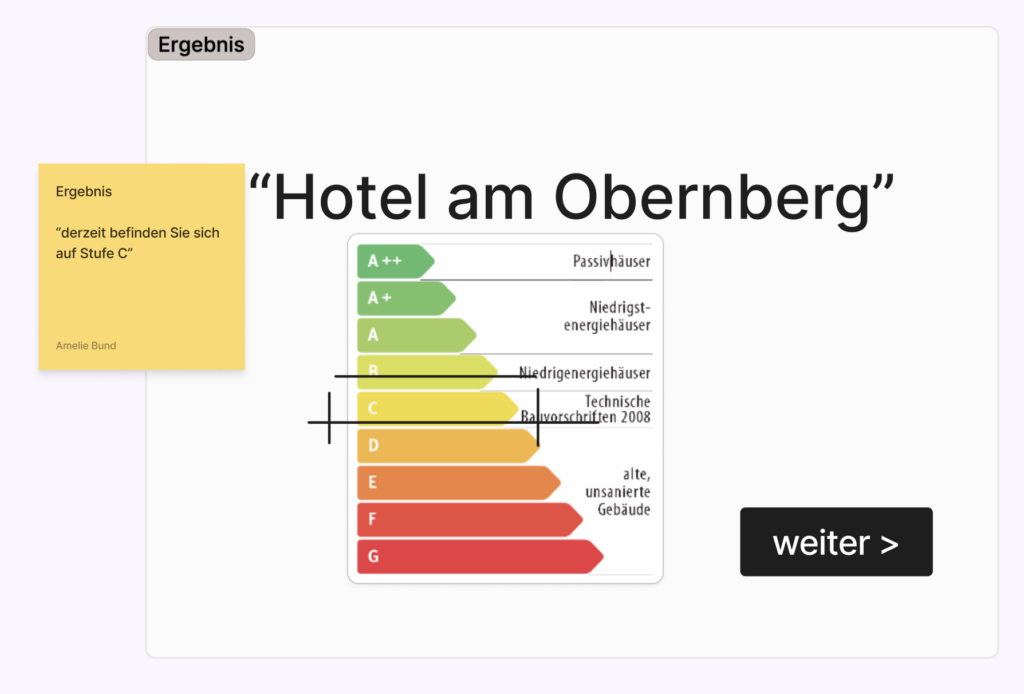
- Data Evaluation: Once all the information is submitted the businesses approach and actions towards sustainability in mobility will be graded. This assessment scheme will be defined by experts to guarantee transparency.
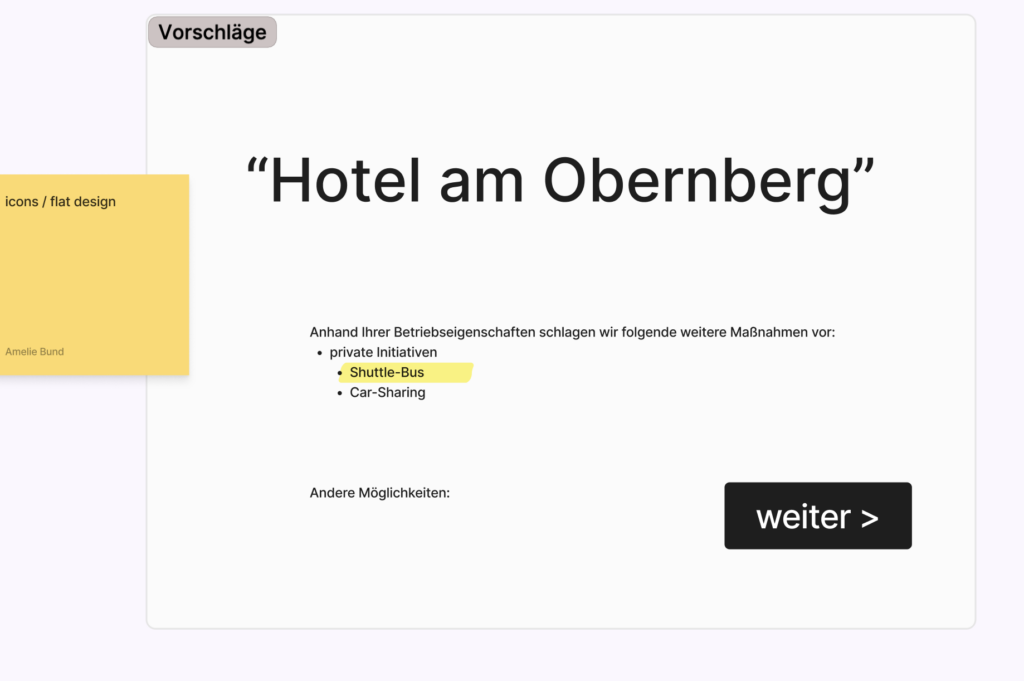
- Recommended Actions: The evaluation also provides businesses with an answer on how to improve in the topic of sustainable mobility. Employers can set these recommendations as goals to improve rating and help their employees with commuting to work.
- Spot Checks: An independent institution will make sure the businesses have submitted their mobility data correctly.
Alternative options:
- dark patterns in fast fashion e-commerce (e.g. SHEIN)
- user centered interaction of the “Arbeitnehmer:innenveranlagung”
Reference
[1] G. Kovacic, Cristian Andronic, and S. Kirchmayr-Novak, ÖV-Erreichbarkeit großer Arbeitsplatzstandorte in Österreich. 2022.
