Storyboards are not limited to internal design processes or early concept development. In many fields, they exist as finished, published artifacts created to guide action without explanation, dialogue, or supervision. In these cases, the storyboard functions as a public interface, a condensed visual language designed to be understood across cultures, ages, and levels of experience.
Instruction-Based Storyboards in Everyday Life
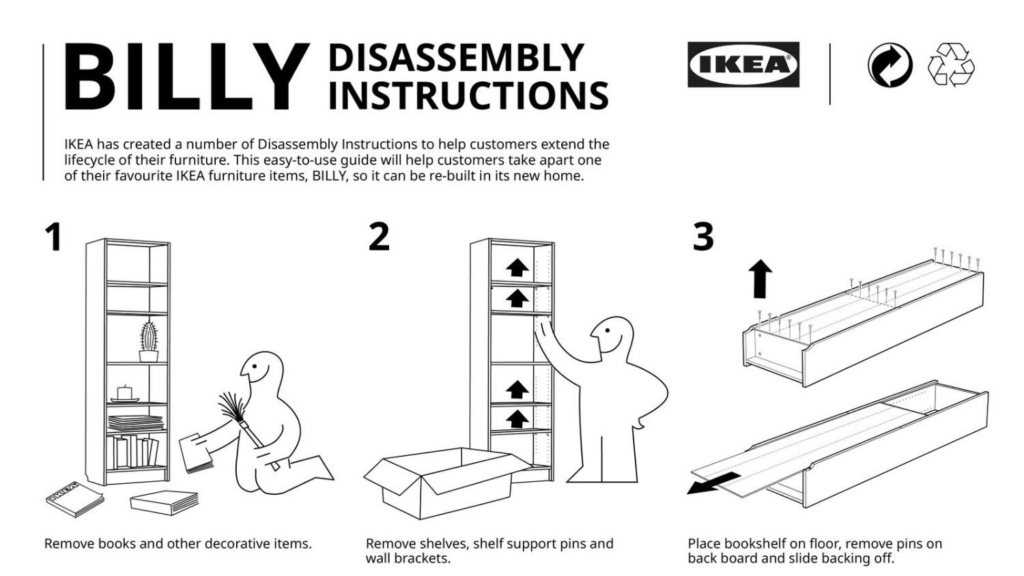
Common examples are IKEA and LEGO instructions. These are not narrative illustrations, but sequential frames that anticipate human action. They describe how a body moves, how hands orient objects, and in which order decisions should occur. The storyboard does not guarantee correct use, but it establishes a preferred sequence of interaction. Its effectiveness is measured by how well it reduces confusion, errors, and hesitation.
A similar logic applies to airline safety cards. These storyboards must work under stress, language barriers, and limited attention. They rely on simplified figures, clear gestures, and strict sequencing. Accuracy of representation is less important than legibility of action. What matters is not realism, but clarity. These examples underline that storyboards do not describe what will happen, but propose what should happen.

Instructional Storyboards in Public Space
In public environments, storyboards appear as evacuation diagrams, emergency instructions, or public transport guidance. These systems assume users who may be unfamiliar with the space and possibly emotionally affected. Here, the storyboard replaces verbal instruction entirely. Sequence, orientation, and visual hierarchy become critical.
Exhibitions and museums also rely on storyboard-like instruction systems. Interaction diagrams explaining where to stand, what to touch, or how to activate an installation are often communicated through short visual sequences rather than text. In participatory or hands-on exhibitions, these storyboards shape visitor behavior before architectural or graphic elements take effect. They define the rules of engagement with the space.
Participatory art installations push this further. In many cases, the artwork only exists through visitor action. The storyboard becomes a minimal visual script that explains how the work is completed through participation.
Storyboards Beyond Design Disciplines
Storyboard logic is also present in medicine leaflets, which use pictograms to explain dosage, order, and restrictions. These visuals must be unambiguous and culturally neutral, prioritizing comprehension over expression.
Children’s books without text rely entirely on visual sequencing to construct meaning. The reader learns how to interpret cause and effect, rhythm, and progression through images alone. Similarly, cookbooks focused on technique use step-by-step visuals to translate abstract instructions into embodied action.

Storyboards as Designed Expectations
Across these examples, a shared principle emerges. Storyboards are tools for aligning expectation and behavior. They reduce complexity by abstracting actions into readable sequences. Rather than predicting reality, they frame intention. This makes storyboards particularly relevant for exhibition and spatial design, where behavior cannot be controlled but can be anticipated.
