During a recent workshop in the university, I was introduced to consumer EEG devices and had the opportunity to experiment with them in a hands-on setting. The focus was not on clinical accuracy, but on understanding how basic brainwave signals can be captured using lightweight devices such as Muse. While the setup was clearly far from laboratory-grade neuroscience equipment, the experience raised an important question for me as an interaction designer: what happens when interfaces respond not only to explicit user input, but also to signals that reflect the user’s internal state?
I started doing more about these devices and this question led me to something called “closed-loop biocybernetic systems”. At a basic level, these systems continuously monitor physiological signals from the user, interpret them in real time and adapt system behavior accordingly. Unlike traditional interfaces, where interaction flows in one direction (from user action to system response) closed-loop systems operate through constant feedback. The system observes the user, adapts its behavior and then observes again, forming an ongoing loop rather than a sequence of separate interactions.
What makes this idea particularly relevant for interaction design (and also my research) is not it’s scientific precision, but it’s interaction logic. Closed-loop systems treat the user as a dynamic participant whose cognitive state changes over time, rather than as a stable user performing isolated actions. This aligns closely with earlier discussions in my research around interruption, cognitive load and recovery, where the timing and context of interaction matter as much as the interaction itself.
In existing UX and HCI practice, adaptation is usually based on explicit signals such as clicks, taps, scrolling behavior or settings chosen in advance. Closed-loop systems introduce a different layer of interaction, where adaptation can be driven by indirect signals like workload, engagement or stress. EEG becomes one possible alternative among others, not because it offers direct access to mental states but because it provides a continuous stream of data that reflects change over time. For interaction design, this continuity is more valuable than accuracy, especially when the goal is to sense transitions rather than define precise cognitive states.
Research I have found on adaptive automation has explored closed-loop systems in high-stakes contexts such as aviation and safety-critical environments. For example, work conducted by NASA examined how EEG-based indicators of engagement could be used to dynamically adjust task allocation between human operators and automated systems. While these studies are far removed from everyday digital products, I think they demonstrate that closed-loop interaction is not just theoretical. It has been operationalized in environments where managing attention and workload is critical and where poorly timed interaction can have serious consequences.
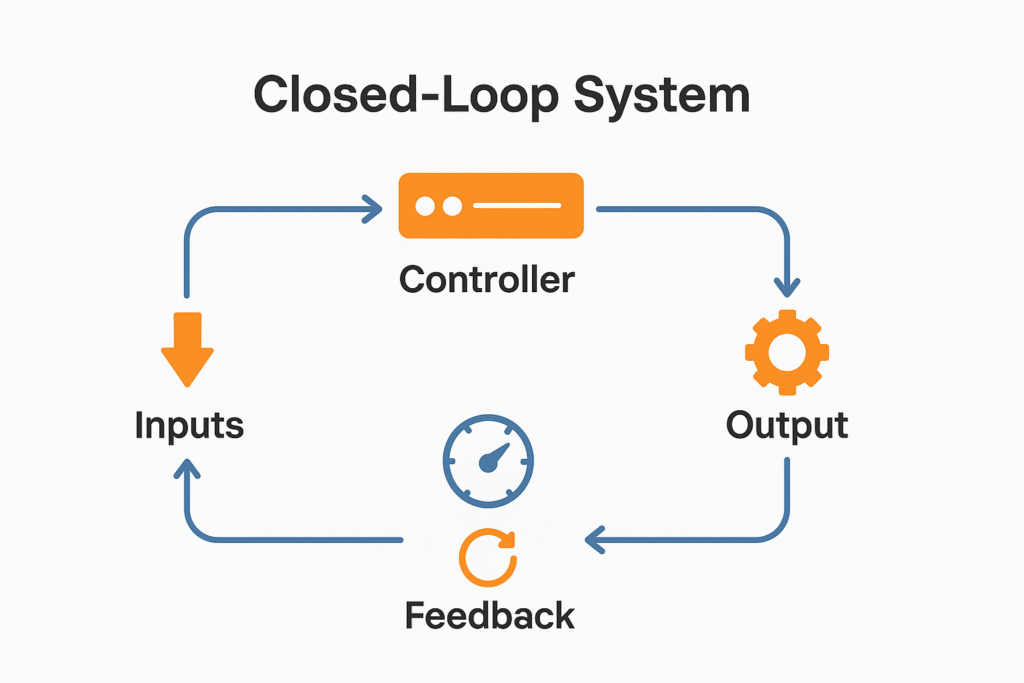
From an interaction design perspective, the most compelling aspect of closed-loop systems is not automation, but responsiveness. A system that becomes quieter when cognitive demand increases, delays non-urgent information during moments of strain or supports recovery after disruption behaves very differently from one that treats all moments as equal. This resonates strongly with earlier discussions in my research about interruptions and emotional side of it. Instead of optimizing for constant engagement, such systems acknowledge that users have unpredictable capacity.
This ideas also connects closely to something called “polite or neuroadaptive interfaces”. These interfaces aim to adapt subtly and respectfully, without drawing attention to the adaptation itself. Rather than aggressively pushing notifications or optimizing for responsiveness, polite interfaces adjust their behavior quietly, often by waiting rather than acting. Framed this way, politeness is not a metaphor but a design stance that prioritizes cognitive boundaries and timing.
At the same time, there are clear limitations. Consumer EEG devices (like the one we experienced, Muse) do not provide reliable or countable measurements of complex mental states such as attention or flow. Brain signals are noisy, highly context-dependent and difficult to understand even under controlled conditions. Treating EEG data as ground truth would be misleading. However, closed-loop interaction design does not require perfect measurement.
References
- Freeman, F. G., & Mikulka, P. J. (1993). Effects of a psychophysiological system for adaptive automation on performance, workload, and situation awareness. Human Factors, 35(3), 413–434. https://doi.org/10.1177/001872089303500302
- Gevins, A., & Smith, M. E. (2003). Neurophysiological measures of cognitive workload during human–computer interaction. Theoretical Issues in Ergonomics Science, 4(1–2), 113–131. https://doi.org/10.1080/14639220210159717
- NASA. (n.d.). Biocybernetic adaptation and mental workload assessment. National Aeronautics and Space Administration.
- Polite Interface Research. (n.d.). Neuroadaptive interfaces.
- Pope, A. T., Bogart, E. H., & Bartolome, D. S. (1995). Biocybernetic system evaluates indices of operator engagement in automated task. Biological Psychology, 40(1–2), 187–195. https://doi.org/10.1016/0301-0511(95)05116-3
AI Assistance Disclaimer:
AI tools were used at certain stages of the research process, primarily for source exploration, grammar refinement and structural editing. All conceptual development, analysis and final writing were made by the author.
