This article presented a novel approach to sound integration in the aerial arts through SALTO (Sonic Aerialist eLecTrOacoustic system), a MaxMSP-based system that translates movement data from the Myo Armband sent via Bluetooth and OSC [1]. Christiana Rose, the author of the paper, worked with Katharine Geber, an aerial artist and choreographer, and together they created a hybrid visual and sound piece called “Splinter” as a proof of concept of SALTO [1].
Rose uses the MAX objects of click~ (an impulse generator), a resonant filter, and a spectral delay to translate emg signals into short percussion sounds. She also uses the accelerometer values to control the MAX grainstretch~ object’s grain size, speed, and pitch. Furthermore, she uses iosc~ and cascade~ MAX objects to sonify the gyroscope data, which controls the frequency and gain of recordings loaded into the oscillator bank.
What’s interesting about this article, in the technical sense, is that both the aerialist and the author worked together in mapping each arm movement (medial or lateral rotation; flextion, extension, and abduction; circumduction; and grasping or holding on) into a different sonic idea, as shown in the table below [1].
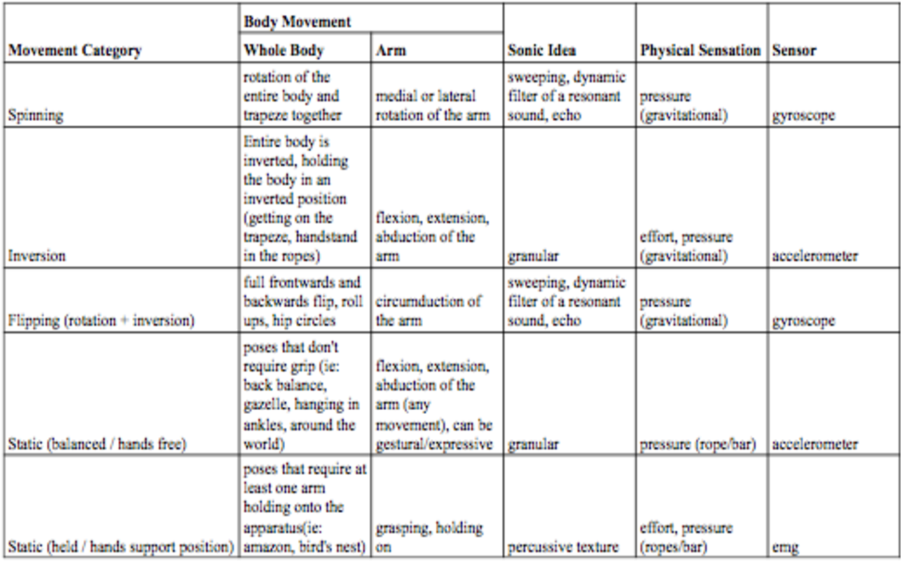
What’s interesting about this article, in the conceptual sense and relating to my own topic of investigation, is how they were able to translate internal bodily sensations into sound, so that the audience could get a modicum of understanding what it feels like to be up on the apparatus (in the paper’s case, trapeze) [1].
Rose even states that “An aerialist’s perception of sound during performance is unique in the way it is filtered by the body. (…) Often viewers have limited, if any, embodied idea of this kinesonic experience. Geber and I aimed to blend movement and music using the internal kinesonic experience of the performer to sonify those elements.” [1].
My specific area of research aims to do just that, figure out how to communicate the tacit knowledge of a performer’s physical bodily experience on the aerial silk. However, the SALTO tool proposed by Rose is limited in its scope as it was specifically designed for the trapeze and, not only that, but for this specific performance with this specific aerialist. SALTO might be a useful tool for capturing the audience’s interest, but I believe that, rather than being a potential solution to my research question, it is a valuable proof of concept showing how to implement an auditory interface into aerial dance.
—
Source:
[1] C. Rose, “SALTO: A System for Musical Expression in the Aerial Arts,” Proceedings of the International Conference on New Interfaces for Musical Expression, pp. 302-306, 2017, doi: 10.5281/zenodo.1176260
