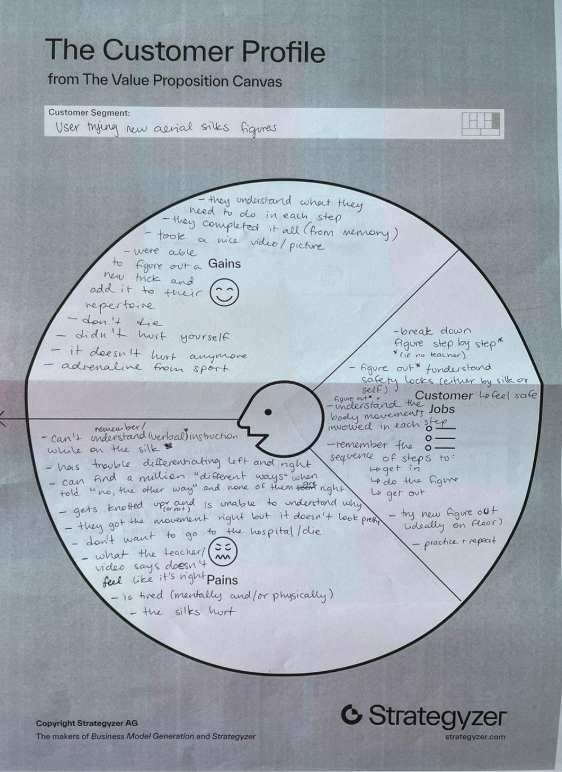
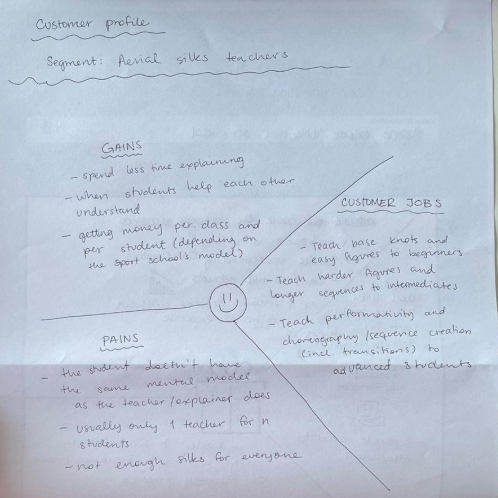
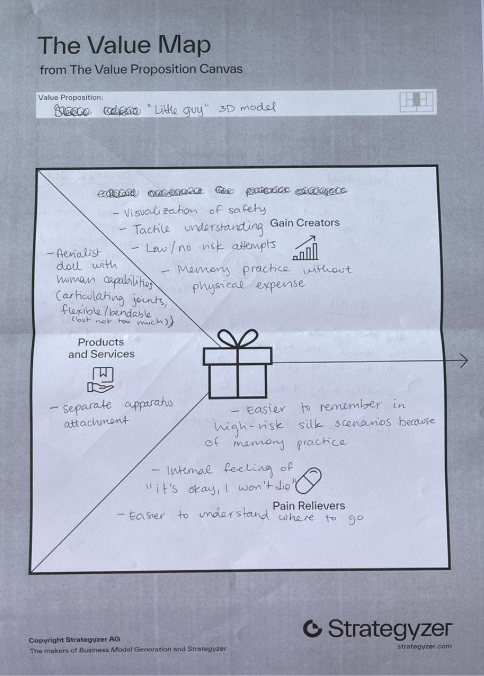
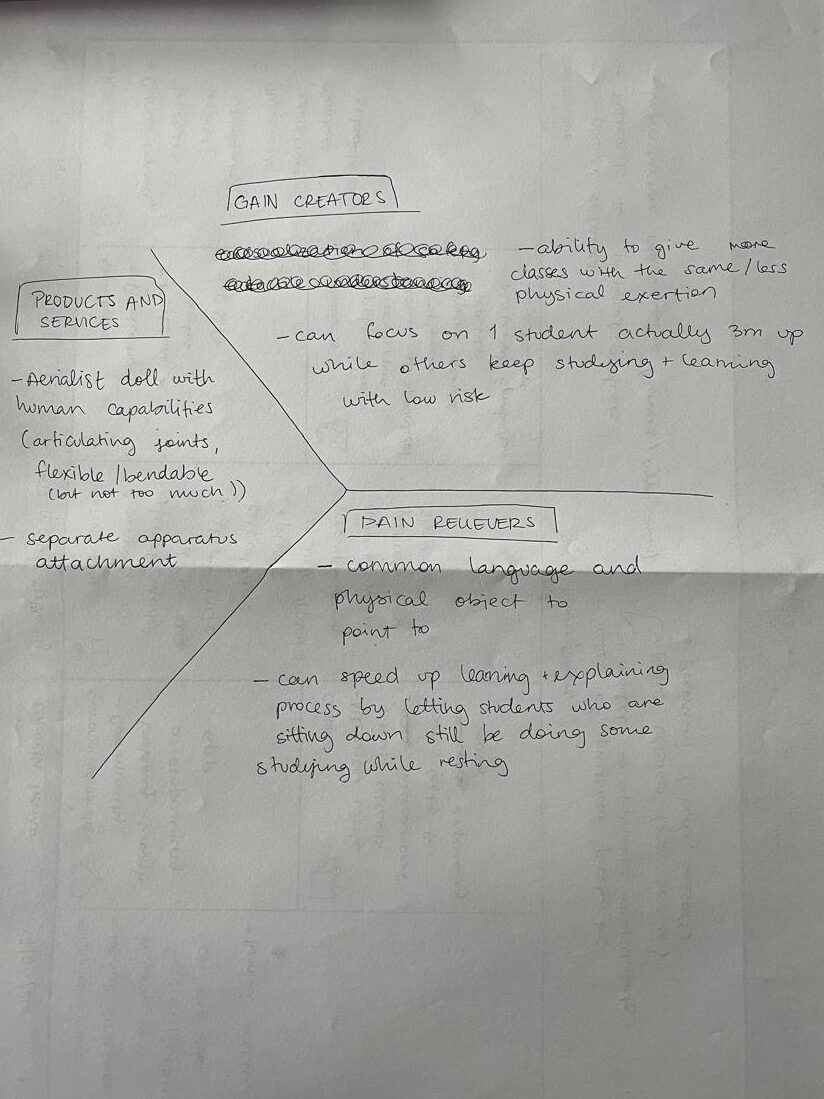
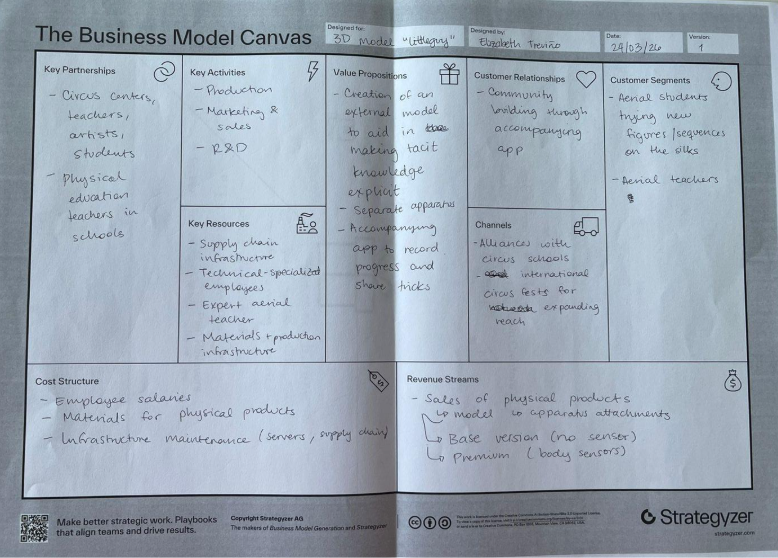
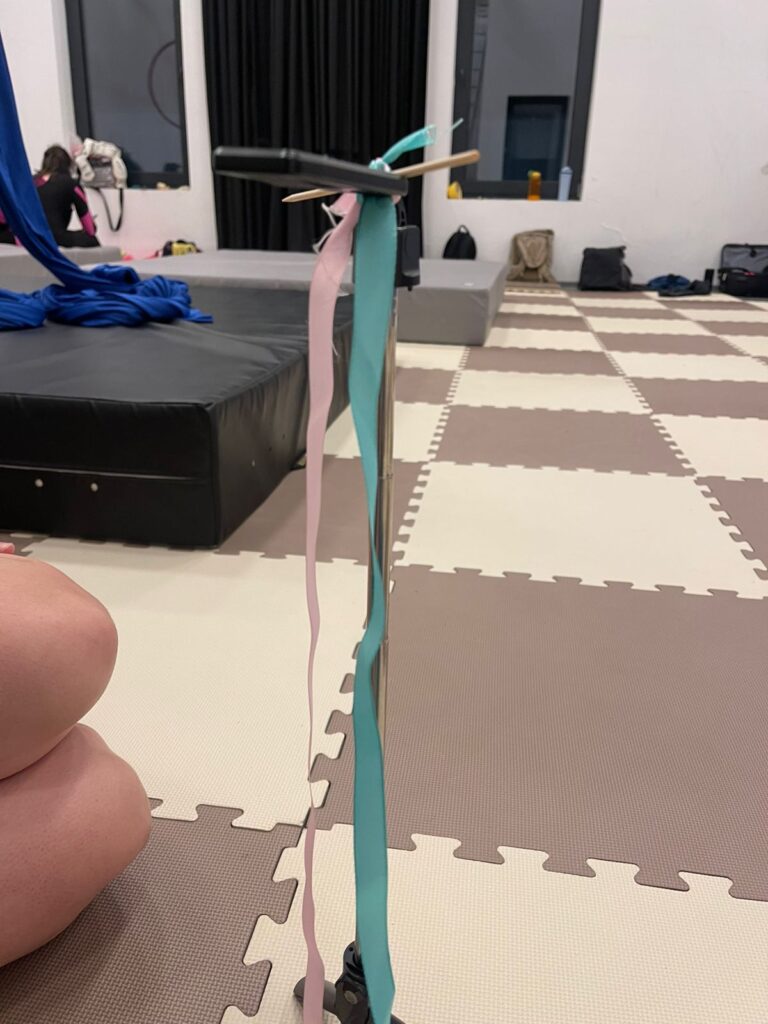
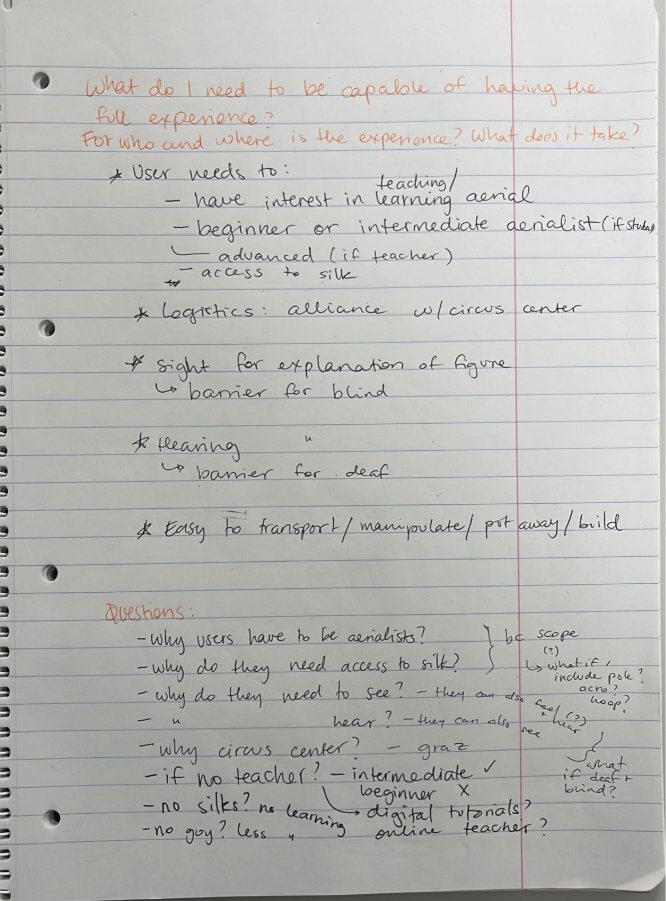
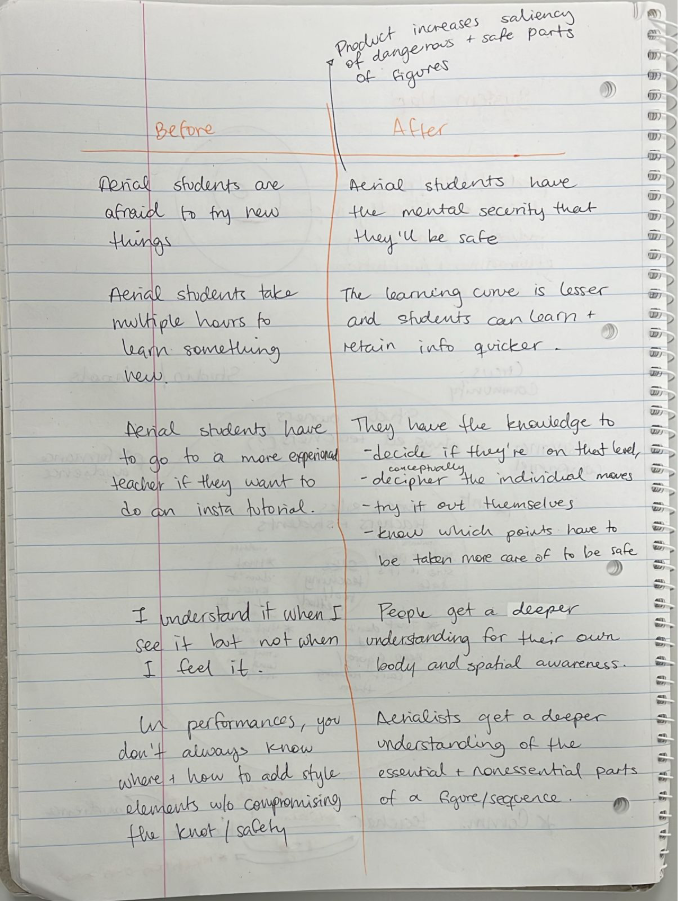
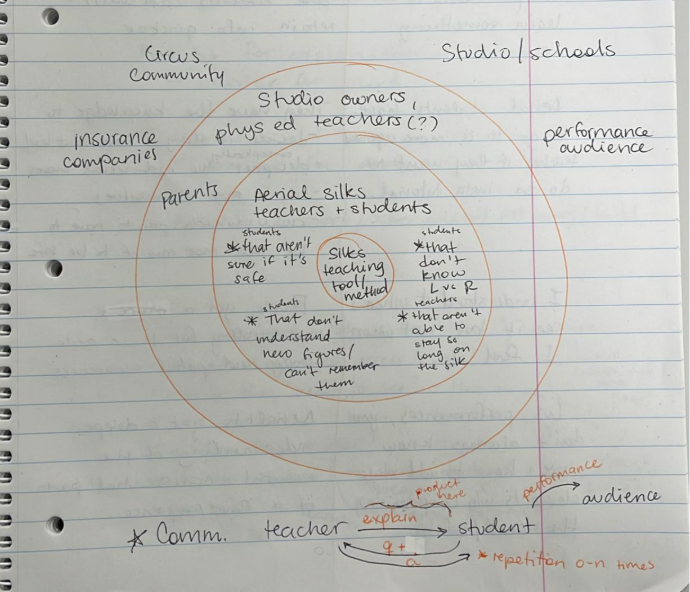
From the 6 readings we did in class, 4 stood out to me as really insightful food for thought regarding my own research project about aerial silks.
[1]’s main argument is that the goal of research through design is not to make a single artefact; rather, the goal is to generate new knowledge and understanding. This is especially relevant to my topic in the sense that it helped me to redirect my focus and let go of the erroneous idea that everything has to be perfect.
[1] also defines language as “all means of communications [sic] (oral or not) and terms used by a professional community”. This is definitely one of the quotes that I would like to include in my thesis, as it directly relates to my topic – teaching aerial silks is, at its core, a language and communication problem.
[2]’s main argument is that the scientific approach to experiments and irrefutable statements are directly in conflict with research through design; rather, these generalizations should be used for inspiration, not as definite facts. Similarly to [1], this article helped me reframe my thought process and let go of the hard grasp on scientific rigidity that my previous studies had instilled in me.
[3]’s main objective was to present the different schools of thought regarding research through design. When talking about knowledge, [3] defines and differentiates tacit vs explicit knowledge. Tacit knowledge, according to [3], “cannot be communicated by mere words. Material artifacts and experiences are deemed to be part of this communicating.” This is also relevant to my own research due to the fact that proprioception and body awareness can be deemed tacit knowledge – how do you communicate how your body feels? How do you communicate what your muscles are doing? Furthermore, I expand on this point to ask, how do you even know what your muscles are doing? With my thesis, I aim to answer these questions with research through design in the context of aerial silks.
“Ingold (2013) explains the distinction of tacit knowledge as a difference between knowing and telling, describing how a maker’s ways of knowing and doing are told ‘by hand’. The artifacts, especially prototypes, are said to be carriers of such knowledge. Aligned with this position, some state that the prototype itself is the knowledge, but few will agree that ‘this apple’ by itself will be able to tell that it is ‘a body’. Such a framing has to be added explicitly.” – Extract from [3]
Finally, [4] shows a practical example as to how to actually apply research through design in a real-life project. In their case, they used a physical abstraction to represent the internal bodily process of digestion, which is very similar to what I aim to achieve in my project. However, [4] rightfully states that “When we use abstractions, we hide the complexity of the actual processes and introduce new complexity. Hence, abstraction creates a challenge that users may not understand what each module represents for the first couple of interactions. However, previous works suggest that understanding of abstract physical visualisations improve over time.” This is a very important thing to keep in mind for me, since the abstract nature of my prototypes may (and has, as I will write about in the next blog post) introduce a second kind of complexity in the fact that users have to externalize their internal tacit knowledge.
—
Sources:
[1] D. Godin and M. Zahedi, “Aspects of Research through Design: A Literature Review,” Design’s Big Debates – DRS International Conference, 2014, doi:10.21606/drs.2014.85.
[2] W. Gaver, “What should we expect from research through design?,” Conference on Human Factors in Computing Systems – Proceedings, pp. 937 – 946, doi:10.1145/2207676.2208538.
[3] P. Stappers. and E. Giaccardi, “Research through Design” IxDF – Interaction Design Foundation. https://ixdf.org/literature/book/the-encyclopedia-of-human-computer-interaction-2nd-ed/research-through-design (accessed Mar. 19, 2026).
[4] R. A. Khot, J. Ng, and D. Aggarwal, “Crafting Tangible Interfaces for Human Digestion: Unpacking the Research through Design Prototyping Journey”, Proceedings of the Sixteenth International Conference on Tangible, Embedded, and Embodied Interaction, pp. 1 – 15, doi:10.1145/3490149.3502252.