In traditional performing arts and circus arts (dance, acrobatics, gymnastics, etc.), people’s bodies move relative to the ground; however, in aerial silks, people are suspended in the air – making this an art in which the natural, ground-based restrictions aren’t present [1]. Additionally, in silks, artists must understand their own body not in relation to a fixed position, but rather in relation to themselves and the moving silks. Head orientation, limb placement, and proprioception play a key role in mastering different figures or sequences [1].
In order to successfully perform a figure or individual movement, teachers must explain to students what both their body and the silk must do. This differs from other circus arts like hoop or pole and even from other, more defined sports like gymnastics, since in these areas the apparatus is heavily limited by gravity and statically positioned. In contrast, silks explanations have to take into account also how the apparatus must be placed.
According to [2], “The silk can be viewed as an extension of the body so that the aerialists can tacitly learn how to execute the movements without analyzing the exact distance between their body, silk tail, and ground.” As such, embodied learning is paramount to silks, using somatic methods in combination with verbal language to transfer information, especially regarding one’s physical safety [2].
In my own experience as an aerial silks student, especially since I have been a student of many different teachers with different teaching styles, most of the new figures I (and my classmates) learn have to be explained in at least 2 ways: both shown in the air by the teacher, and with verbal step-by-step instructions given while the figure is made. Usually, this means that a student (specifically beginners, as in my class) must see a figure 2 or 3 times in order to finally understand what he or she needs to do (through observational learning).
However, observational learning is not the only thing at play here. Some students, even when understanding the technical theory of what they need to do, still struggle with their own body awareness and silk awareness while off the ground. Currently, according to 3 different teachers I talked to, the only way to overcome this is through practice. But, I wonder, have there been experimental tests to try to overcome this in a different way? (The short answer is yes, but the long answer will be explored in the next blog post)
Furthermore, this week’s class observation I conducted yielded interesting results: in gymnastics class, instead of learning how to do a Running Front Tuck directly on the apparatus it should be performed on and trying to complete it on the first try, the teacher first instructed the gymnasts to run and jump straight up on a mini trampoline. Then, the next step was running, jumping, and doing a normal forward roll. Next, it was a handless forward roll, finally resembling the proper move. However, none of the gymnasts were able to land on their feet, and instead, the teacher was happy with them understanding the movement and landing on the mat, even if it was still in the tuck position (step 4 of the image) [3].
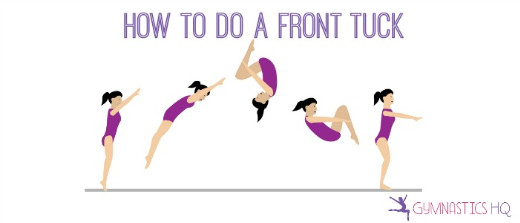
Image from Gymnastics HQ, 2024 [3].
In contrast, in the silks class, the teacher explained a Metronome Drop (unstandardized name, but it’s what this teacher called it) by showing it, giving some verbal instructions and trusting the student to understand. Then, the student tried it out unsuccessfully twice, and finally was able to understand the knots on the third try. There was no gradual incrementation of steps as in gymnastics, rather the aerial student had to grasp the full movement from the beginning, without any progressions.
–
[1] L. Froehlich, “Enhancing Aerial Circus Training Practices using a Synthesis of Traditional Coaching, Laban Movement Analysis, and Alexander Technique Frameworks,” B.A. dissertation, Dept. Dance, Scripps College, Claremont, CA, 2020.
[2] M. Kosma, N. Erickson, C.J. Savoie, and M. Gibson, “Skill Development Versus Performativity Among Beginners in Aerial Practice: An Embodied and Meaningful Learning Experience,” International Quarterly of Community Health Education, vol. 41, pp. 173-187, January 2021.
[3] “How to Do a Front Tuck: Drills and Exercises to learn a Front Flip in Gymnastics,” Gymnastics HQ. Accessed: Nov. 19, 2025. [Online.] Available: https://gymnasticshq.com/how-to-do-a-front-tuck/
