It has been a difficult task to do research and write weekly blog posts. I have previously been more used to a scientific paper based approach to research, where you take your time to lay out a plan first before worrying about producing an output. As I am used to this process taking time, I now felt more rushed to figure out the direction of where I am going, how I would do it etc. each week. This often left me feeling paralyzed, procrastinating, leaving the work to the last minute. I found myself not producing anything helpful, neither for me or others reading the blog posts later.
Coming from a university with less modules and lectures to focus on also made this shift difficult in balancing and managing the workload of the different modules. This in turn affected the blog post, which often fell at the back of my head. With this in mind I take with me the importance of laying out a temporary plan for what research methods one thinks would be fitting for the topic and focusing on one thing at the time. Swapping topics also led me to having to start all over and it was limited what I was able to do with the short amount of time with each, although I could definitely have dug a little deeper.
I believe I could have done research using more varied methods than simply looking at previous research, surveys, analysing and some of my own thoughts and experiences. For example some interviews, user testing, maybe try to create some user journeys to see where changes could’ve been made.
Recap
To summarize what the previous blog posts consisted of, we know that EBSN connects people through activities rather than direct matchmaking. This we can see in Meetup, an EBSN that prioritizes events and groups over individual connections and has limited personalization of your profile. With the previously mentioned loneliness epidemic I see EBSN or matchmaking applications being a potential helper in battling this epidemic. However, it feels as if the matchmaking applications are often not encouraging real meetups, but just there to offer another game to play. While the EBSN has a more community and event focus, rather than individual connections. I believe one needs to work on bridging the gap between the offline and online world, and by lowering the stress and tempo of the individual connection to let people connect on a deeper level.
This topic of designing for better connections has also been studied in relation to videogames. Johnson and Mitchell (2016) reviewed different kinds of matchmaking systems in videogames that go beyond matchmaking based on skills. Overdog was a matchmaking service for Xbox One that matched players based on their interest, although it seems as though its activity was low. They also found that matchmaking based on location was important for the gaming community (Johnson & Mitchell, 2016). Most matchmaking applications do follow the location principle either restricting users to see people in their area based on their location data or a location picked by their choice. Although the latter makes it possible for users to choose locations in which they are actually not in, losing some of its purpose.
In one way matchmaking apps that are available today are not that different from a game. The swiping almost feels like a game in the way that one is making rapid decisions based on brief and direct information, and receiving celebratory animations once there is a match. From some interviews about Bumble and Bumble BF some found this rapid swiping positive in order to find compatible people based on interests, and “eliminating” those who do not share the same interests, while others felt like there is too little information. Although the function already existed, some wished it would be possible to filter who you see based on their interest tags. This comes to show that this function has not been designed to be visible enough for users to easily find in the app (Capelli, 2025).
This rapid swiping and having to send a message 72 hours after matching made the participant feel stressed while using the app. Participants felt like they did not take the time to get to know people properly as one would in real life. Based on this, and more, Capelli suggests that this suggests that the participants wished for the interactions of the app to be closer to what one would normally do in real life settings. Some participants that were interviewed tried to meet as early as possible offline and move the connection from being digital to more real (Capelli, 2025). Perhaps these applications should get better in pushing and supporting meetings quicker, than simply opening up a chat and letting the people themselves take it from there. As taking this next step is not as easy for everyone.
Bumble does actually offer a function that allows for offline meetups. Here users can create and join events. Some participants said they enjoyed this function as it allowed for meeting a more varied group of people, instead of just getting stuck on swiping people with the same interest. Leaving people more open to meet more people beyond their own hobbies, and doing so in real life (Capelli, 2025). Such functions should definitely be more included in matchmaking apps in order to bridge the offline and online connection better. What is also something that should be more looked into is how to design the matchmaking to feel more like how you meet people in the offline world to make it feel less like a game and another task to do.
Horton, E., Johnson, D., & Mitchell, J. (2016, November). Finding and building connections: moving beyond skill-based matchmaking in videogames. In Proceedings of the 28th Australian Conference on Computer-Human Interaction (pp. 656-658). https://doi.org/10.1145/3010915.3011857
I have myself attempted to use matchmaking apps for meeting people, primarily in the sense of friendships. Here I have been able to connect with people in the city I live in, or a city I might be visiting. These apps allow you to share your interests and write about yourself so that you can find other, likeminded people. The most famous apps are primarily made for dating, however, since they first became known to me I have seen them gradually implementing features to help you look just for friends as well. There are also complete separate apps focused on making friends.
The Meet-up-problem
The problem with regular matchmaking apps is that you have to arrange the meetup yourself. There are limited functions that “force” this activity. What can happen then is that people will chat and get to know each other online before deciding if this is someone you would like to meet. In such, people are able to create online connections from their homes, without having to put the time and effort into arranging a meetup. This can seem positive, but it also has the negative effect that you might not get to know the person fully. You might be thrown off by certain text messages, without properly understanding what they meant. This way you might stop keeping up contact without someone and never actually meet. In order to actually meet it requires effort, at least one person needs to take the initiative and ask. Whether or not a person initiates this is very individual, some may not feel fully secure, others might feel not that interested anymore after talking, timing & schedules might be a problem, and so on.
The picture problem
All apps allow for some sort of image sharing, often about 6 images. This is an opportunity to show more of your identity, what you usually get up to, etc. The problem, like with any other social media, is that one often risks portraying life better, more interesting, and picture perfect than it actually is. Just like messages, images can also easily be misinterpreted and can throw people off. When it comes to dating, where looks might be important for some, images where people portray their best side might give higher expectations than reality. However, images can create a little sense of safety as you can see more of who this person is. Although in today’s day and age, this sense of safety does not reach far, as one is never guaranteed to not get catfished. Seeing the progress of AI these days, it will definitely become even easier to create false images.
A term for such an app discussed in the previous blogpost has been named as “Event-based social networks” (EBSN) in a paper written by Xingjie Liu et. al. in 2012. They are here defined as a service that offers both online and offline social interactions.
One of the social networks mentioned was meetup. On meetup you can join events created by event hosts or individuals. I decided to look around a little on the website by creating an account. Similar to other dating or “befriending” apps, you enter your intentions of usage, picking a minimum of three interests, personal information such as birthday and gender.
Events
There is a wide variety of events, ranging from conference talks by companies to small local book clubs hosted by individuals. Users are able to create and look for events based on a long list of event types, such as dancing, games, support & coaching, science & education, etc. What Liu et. al. discusses in their paper is the cold-start problem. This means how events are in a limited timeframe and one can only show interest from when the event is added to when it is finished (Liu et. al., 2012). In meetup I see that it is possible to create events that happen weekly and one can choose which date you would like to participate in, which in a way helps battle this problem. However, I can see the cold-start problem being a relevant problem if you wish to find people to go to an event with you at the last minute.
Personalisation & Connection
The personalisation of your profile is slightly limited. You have the opportunity to add a bio, display your selected interests, your groups, relationship status, which industry you work in, and add your social media. You are also able to pick which lifestage you are currently in, although they are slightly limited. The website does not focus on showing who you are through images as it only allows for one picture, your profile picture. Although I could see this being slightly positive in the sense that it does not lead to an unrealistic display of peoples lives, I believe images can help users to show their personality better.
What I noticed on meetup is that its primary function is on the creation of events and groups. There is no function to find people and make friends. So instead of looking for people you look for an event that suits you. You are however able to click on event hosts names, and chat. When joining a group you also see a list of group members which you can also chat with, but this is, however, behind a paywall. Which leads us to privacy and security,
Privacy & Security
Putting certain features behind a paywall forces users to give up information, such as your bank or credit card, which will then be linked to your account leading to a possible indirect identification. This makes it slightly more difficult to be anonymous and creates a barrier for people who would like to misuse the application.
Although, as mentioned, the paywall can be an indirect identificator meetup offers no verification process when signing up to use it for free. I believe this makes it harder for users to be able to trust others as creating a fake account is extremely simple. As a privacy setting you are also able to choose who can contact you (users, group members, organizers). Which all in all does protect one much as it is, for example, quite easy to join groups with a new account.
References
Liu, X., He, Q., Tian, Y., Lee, W. C., McPherson, J., & Han, J. (2012, August). Event-based social networks: linking the online and offline social worlds. In Proceedings of the 18th ACM SIGKDD international conference on Knowledge discovery and data mining (pp. 1032-1040).
After the first four previous blog posts I reached a point where I was unsure of how to move forward. Personally I found it difficult to see where I could contribute through interaction design – although there are plenty of possibilities. I struggled mostly with finding a direction that I felt comfortable with and doable for me to go through with for my thesis, given my current motivation, knowledge and interest. Therefore I have decided to go back to scratch.
Through a conversation with a professor from my home university, NTNU, I aired the idea of an application and/or website that would gather events into one platform, making the search for the weekend plans a bit easier. She further added the thought of looking at it from a student perspective, for example also as an erasmus student. This reminded me of the talk about a “loneliness” epidemic, and the hostel app where you can join activities of other solo travellers.
There are many questions that could be asked around this “topic” or idea. How big is the need for a system that gathers events and happenings into one app, from the users perspective? As all kinds of events would be available for all kinds of people, how would the event hosts feel about this in regards to the target group they are trying to reach? And for the environment they are trying to create? Would it work well practically? How could one ensure safety for the users wanting to join an event with strangers?
In a publication by the Joint Research Center it was written that loneliness was more common among students compared to working people (Berlingieri, Colagrossi & Mauri, 2023). A survey done on students in the US in spring in 2025 by NCHA found that 46.7% scored positive on the UCLA loneliness scale (American College Health Association, 2025). A press release from the UK government stated that almost all participating students had felt lonely at least once during their academic year. 52% of the participants also said loneliness was one of their concerns at university, 48% were concerned with “fitting in” (UK Department for Culture, Media and Sport, 2023). In a study done at the Carinthia University of Applied Sciences (CUAS) in Austria 31.7% reported moderate loneliness, while 4.8% were severely lonely. Where most felt socially lonely (29.4%) (Limarutti, Maier & Mir, 2023).
These statistics show that loneliness is a concern and problem amongst students, and specifically socially. When starting university, especially when moving cities it can be difficult to integrate and find people who share your interests. Currently there exists apps like Bumble BFF and Hostelworld’s features for meeting people while travelling, whether or not these can help battle the feeling of loneliness would be something to further look into.
A problem with such “meeting” apps is related to privacy and safety. Dating apps are a similar way to meet people, however people are concerned whether or not this is a safe way to meet. Pew Research center found that 46% of US adults saw dating apps as “not too safe or not at all safe way to meet people” (Anderson, Vogels & Turner, 2020). Some “meeting” apps have implemented ways of making users feel more secure in meeting through their apps by adding ID verification. Although it can create a sense of safety for others, many seem to be skeptical about giving these app companies their personal information through ID verification (Hendrickson, 2025). There are various other features these apps offer to prevent unsafe situations. The dating app Hinge offers users a way to report users if they experience discomfort or find a fake profile. Finding a balance between safety and privacy is an important goal.
Of course there exists ticketing apps that offer tickets to events of all kinds in one, such as Ticketmaster and Eventim. But how well these work and if there is a need for an improvement of these can be looked further into. Although they have no particular target group in itself other than a high focus on concert goers. If there is a need for these features to merge and to target students, could be questioned and researched further through the use of surveys.
Limarutti, A., Maier, M. J., & Mir, E. (2023). Exploring loneliness and students’ sense of coherence (S-SoC) in the university setting. Current Psychology, 42(11), 9270-9281.https://doi.org/10.1037/xge0000528.
Hostile design is design meant to prevent various kinds of usage/interaction with objects, usually by vulnerable groups of people (Rosenberger, 2023). It is perhaps most commonly discussed about designs that prevent the usage of benches etc by the homeless. Robert Rosenberger (2023) presents a classification scheme which talks about the different types of Hostile Design one might come across.
Physical Imposition
When a design physically prevents certain interactions or engagements with an object. A common example in relation to Hostile Design against homelessness is creating barriers on benches to prevent anyone from laying down on the bench (Rosenberger, 2023), it can be “seats” where one lean against the seat rather than fully sit down, and so on.
Sensory Interference
Sensory interference includes the use of generating sensory stimuli that is annoying or unpleasant, for example through various usage of light and/or sound. Rosenberger (2023) comes with examples such as playing annoying sounds or loud music in parks and other public spaces have been used to drive away the unhoused. He also writes about the usage of unflattering lights, in the context of driving young people away from underpasses. However, I can also imagine lighting being used to create uncomfortable public spaces to take shelter at.
Concealment
This is when a certain usage or amenity is available in the public space, just that it is concealed in such a way one must know where it is or how to use it. Rosenberger (2023) brings up the example with public toilets being placed in unusual places and/or having no signage to guide the public to its location.
Confederacy
This includes the control of a public space, usually through the usage of security guards, police officers, cameras, or others placed to control a public space. For example some public spaces might have a receptionist and a sign in sheet in order to use the space (Rosenberger, 2023), or public rest rooms may have on-site staff controlling the payment gates to enter and exit the rest rooms. Rosenberger (2023) reflects on how the unhoused might not appreciate the monitoring where one needs to sign themselves into the public space, and how camera monitoring can trigger a fear of attracting attention to the authorities.
Self-coercion
Self-coercion is when design makes the public themselves avoid certain behaviour in a public space or refrain from a certain usage of an object. The most straightforward example is signage targeted at certain groups, for example signs that says “No Camping” targets the unhoused to try and prevent them from taking shelter in the area of said sign. Rosenberger (2023) also gives the examples of spikes on surfaces where one perhaps could lie, which is not only a physical imposition, but also an example of self-coercion. It shows the unhoused that they are not welcomed here, which could perhaps lead them away from the area.
Absence
Hostile design in the form of absence is that instead of simply limiting usage in the other ways mentioned, one removes the object altogether. This impacts the unhoused in the ways of leaving no place to rest once benches are fully removed, or lack of public restrooms in public areas (Rosenberger, 2023).
How these hostile designs could be turned to the more positive is something that could be researched further in the next post.
Last week we looked at interviews from street magazine sellers, identifying their experience with selling the magazine, their habits, location and interactions. This week we will look at possible customer behaviours. In order to investigate this I created a survey that I spread on platforms such as discord and WhatsApp, and the survey was open for a time period of five days. The survey only had one demographic question (nation), and consisted of only multiple choice, but with the option of answering “other” where it was deemed natural.
The survey involved the following questions:
Where are you based/located?
Have you bought one or more Street newspapers where you are located?
(If yes)
Why did you buy it/them?
Where did you buy it/them?
Did you read the magazine(s)?
Did you enjoy its/their content?
(if yes) What did you enjoy about them?
(If no)
Why not?
Where do you mostly pass Street Newspaper sellers+
What would you like to see and read about in a Street Newspaper?
Does the design of the cover impact whether or not you consider buying a magazine? (any magazine)
Have you ever bought a magazine purely because of the cover? (any magazine)
Limitations
One limitation with the survey were the few demographic questions.
Results
There were a total of 13 submissions. The participants were located in Norway (n=6) and Austria (n=7). Out of the 13 submissions, only one participant had bought at least one Street Newspaper where they are located, this participant is currently located in Norway. The participant bought the magazine(s) due to two reasons; “I wanted to help/support” and “The seller was friendly”, but the participant did not read the magazine(s). The magazine(s) were bought “Outside the metro/trainstation/etc.”, “Outside a grocery store” and “On a busy street”.
As for the rest of the participants who have yet not bought a Street Newspaper, the number one reason was that “I am not interested in reading magazines” (n=6). Reasons number two were “Don’t know” (n=3) and “The magazines do not look interesting” (n=3). Following up is the answers “I never have time to stop” (n=2) and two replies to “Other” were that they had not noticed or been approached by a seller, “I am not sure who gets the money” (n=2), and “I felt annoyed” (n=2). Lastly we have “I am not sure what they will use the money on” (n=1), and one answer to “Other” being that they were scared by the people selling them “especially the drug addicts”. Most of these participants pass Street Newspaper sellers “Outside the metro/trainstation/etc.” (n=7) or “Outside a grocery store” (n=4). Others were “Outside a mall” (n=3), “On a busy street” (n=2), “Near a tourist attraction” (n=2), “outside of university” (n=1), and “Don’t remember” (n=2).
Getting to the results of the participants’ thoughts we will first look at what they would like to see and read about. Most would like to read about “Art & Culture” (n=6), following up with “Hobbies” (n=4) and “Posters to rip out” (n=4). Others were “The people selling the magazines” (n=3), “Nature” (n=2), “News & Politics” (n=2), “All of the above” (n=2), “Sports” (n=1), and one participant said they “wouldn’t”. Nine of the participants said the design impacts whether or not they consider buying a magazine, while eight also said they have bought a magazine purely because of its cover.
Discussion
The results of the participant who bought the magazine aligns with some of what was said in one of the interviews that were discussed last week. This comes to show that some people do in fact buy magazines purely to support the seller, but do not actually read the magazines themselves.
When it comes to participants’ reasons to not buy a Street Newspaper, the primary reason was that they were not interested in reading magazines. What the reason for this is is not clear, there could be many reasons, for example general uninterest or a reflection of the decline in reading for fun (Lee, 2025). Some weren’t sure who gets the money, which displays a general lack of knowledge about the Street Magazines. A few also mentioned some uncertainty about where the money would be spent or fear from the sellers, which could have a connection to the lack of knowledge discussed in previous blog posts that can be associated with homeless and drug users (Barse, 2017). Two participants also felt annoyed, which could be a result of sales tactics, or personal frustration. An interviewee from the previous blogpost mentioned the importance of not nagging the potential customers (Skyrud, 2025b). One interesting answer was that the magazine did not look interesting, assuming they did not take the time to do more than look at the cover. We could link this to the last two questions regarding the thoughts around magazine buying behaviour. Over half of the participants said the cover impacted their consideration of buying a magazine or directly made them purchase a magazine. In the previous blogpost it was also mentioned how one seller noticed a magazine with a hand drawn cover sold better than the others (Skyrud, 2025a).
The participants of this survey would preferably like to read about art and culture in Street Newspapers, with hobbies following closely and some would also like some posters to rip out. Only three participants would like to read about the people who actually sell the magazines, which may differ from the experience of one of the interviewees in the previous blogpost who had received feedback that people enjoyed reading about the sellers of the magazine (Skyrud, 2025a).
Most participants would pass Street Newspaper sellers outside of public transport, hotspots and grocery stores. These are typically crowded places or where there are a lot of passerbys, aligning with the different location tactics mentioned in the previous blogpost.
In short, to conclude, there does not seem to be much interest in reading magazines and if they were to read one it would be preferred for it to be about arts and culture. We see some similar observations from the interviews from last week and this week’s survey. One example being that it seems like the design of the magazine itself could have an impact on the number of sales. This tells us that the part of the service that could be focused on is the design of the magazine itself. There also seems to be a little lack of awareness behind the lack of interest in buying, which could also possibly be improved by focusing on creating awareness of what the service is and who the sellers are through other communication channels.
A method in the research phase of Service design is conducting interviews with the target group(s). Due to the short time period, I’ve tried to look for interviews online to gather information. What I wish to figure out is the perspective of the sellers and buyers. How is the experience for the sellers, do they enjoy their job? How do they sell? Are they comfortable and confident in what they are doing? Is it helping them earn money? And how is it for the buyers? Where and why did they buy the newspaper? Did they read it? How did they find the content? and so on.
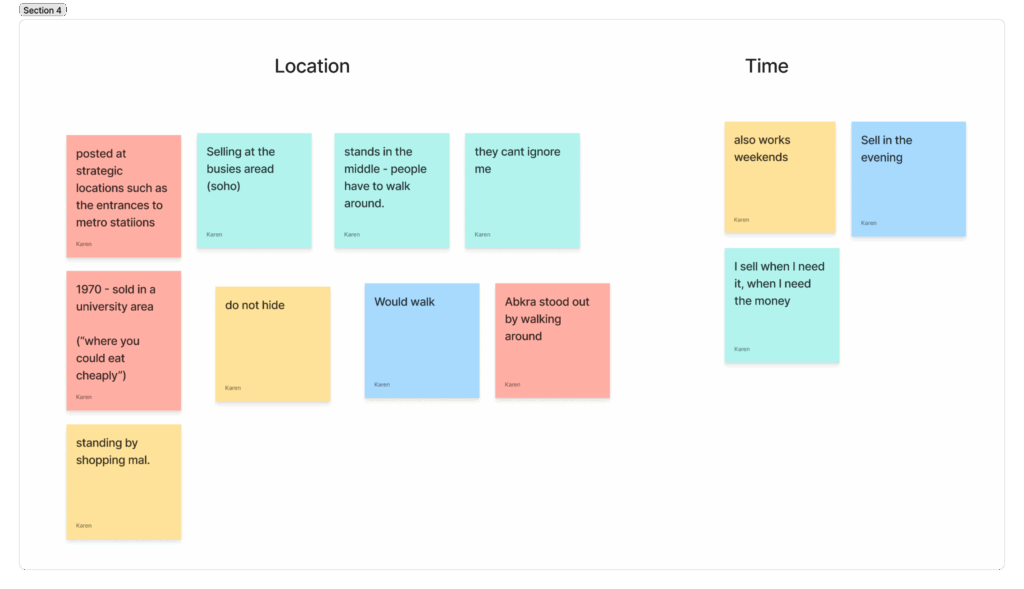
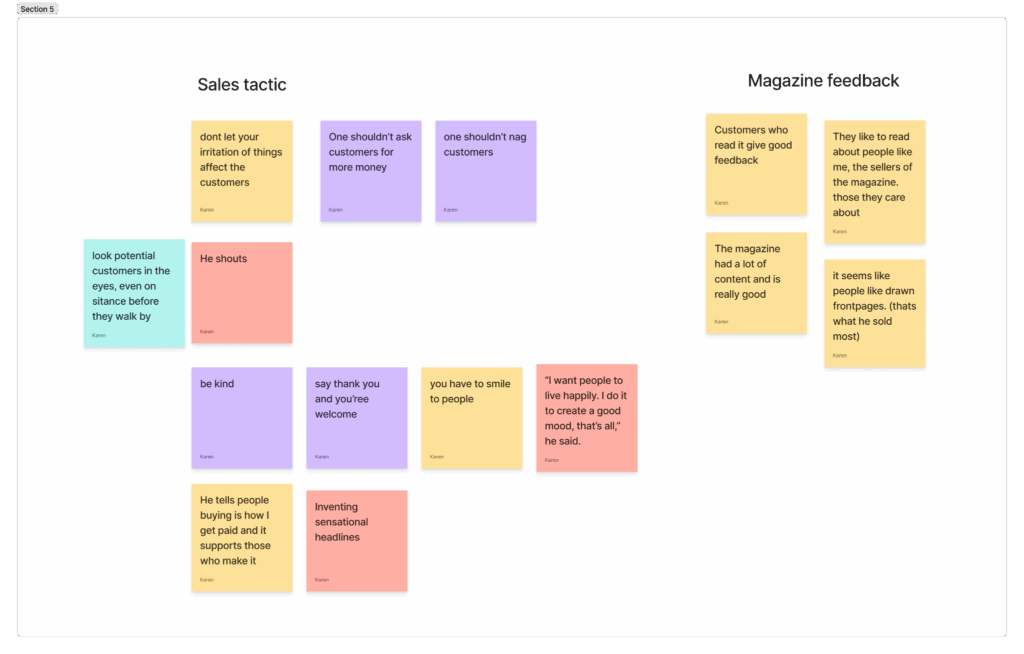
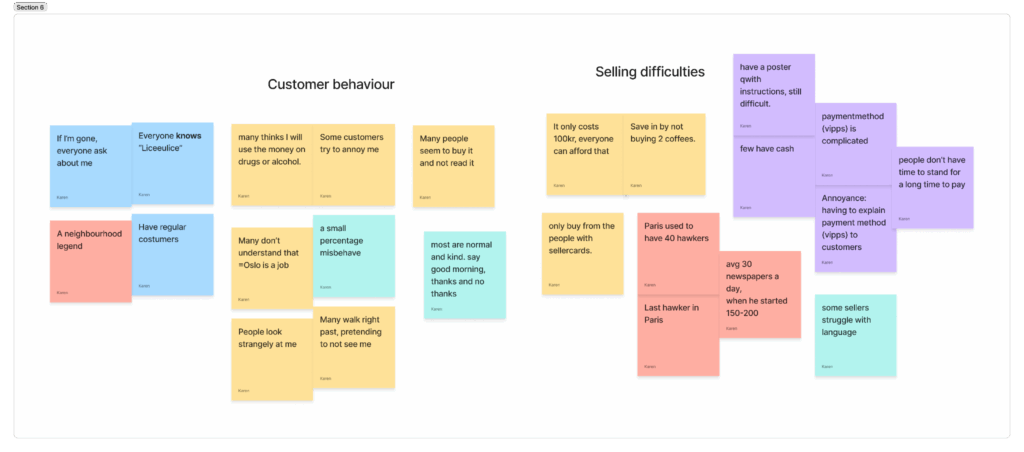
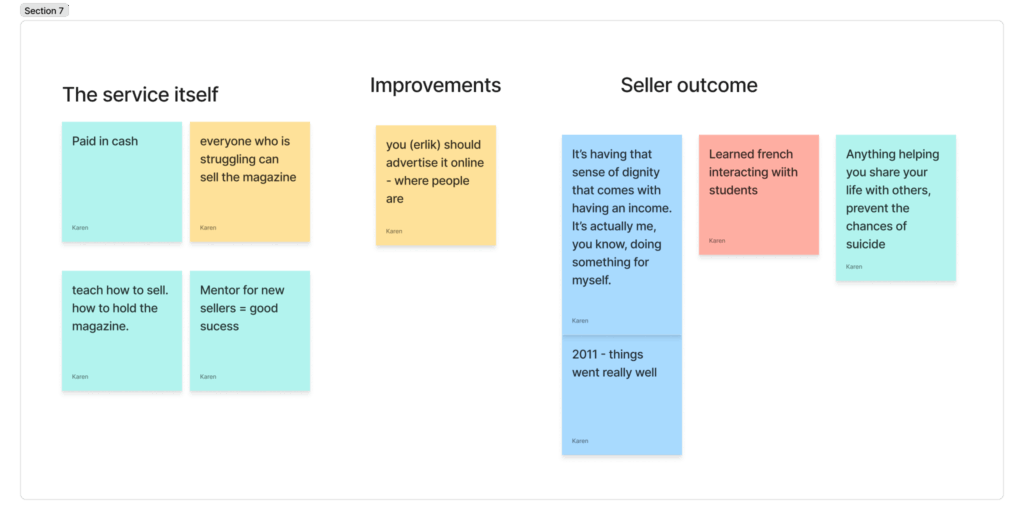
In this blogpost I will focus on the sellers. I looked through a few Norwegian seller interviews I found on Erliks website as well as a couple of other global interviews from big issues websites and arab news. None of the interviews included the same questions. I copied the interviews into a document and marked “codes” of what I thought was important to the questions I would like to answer. After that I took the codes into post-its on FigJam and used affinity mapping to group the codes. The groups I created were location, time, sales tactic, magazine feedback, customer behaviour, selling difficulties, seller outcome, suggestions for improvements, and sellers experience with the service itself.
Let’s start with location, where the sellers would tend to locate themselves while selling. The sellers would choose strategic locations that are busy, such as metro stations, near a university, a touristy neighbourhood and shopping malls (Arab News, 2025; Skyrud, 2025a; Bu, 2025). Two of the people also spoke about their tactic in walking around instead of simply standing still, this was how one of them stood out (Arab News, 2025; Hetherington, Lu & Terzić, 2021). Another would stand in the middle of the crowd so that people had to pass by and would be unable to “ignore” them (Bu, 2025). When it comes to the time the sellers would sell, it wasn’t much mentioned in the interviews. One would say they sold when they needed the money (Bu, 2025). As the street newspaper service functions by letting the sellers choose where to sell and their working hours (INSP, n.d.).
Sales tactics were also quite often mentioned. Being kind and spreading a good mood through smiling and thanking and not letting your own irritations affect customers were mentioned (Arab News, 2025; Skyrud, 2025a, 2025b). One mentioned how he would let customers know that buying it is supporting them and the makers of the paper. The importance of not asking for more money or nagging the customers was also mentioned. As for the feedback of the magazine, one mentioned they would receive positive feedback and that people liked to read about the sellers of the magazine, but that some also buy it and seem to not read it. The same person also commented on how a magazine with a drawing on the frontpage sold really well and thought that people might like drawn frontpages.
As for the customer behaviour the sellers tend to experience, it seemed mostly positive, but some would experience poor behaviour (Bu, 2025; Skyrud, 2025). Two also talked about how they had put a mark on the area they were selling and how people would be well aware of who they are (Arab News, 2025; Hetherington, Lu & Terzić, 2021). Regular customers was also a point that was mentioned. As for difficulties when selling, one had a problem with people struggling with the digital payment method (Vipps) which seemed to cause stress as they seem to not have time to go through the payment method (Skyrud, 2025b). Another commented on the price that people should be able to afford it as it’s only the price of two coffees (Skyrud, 2025a). The interviewee from Paris had also experienced a big drop in sales over his long career as a newspaper seller (Arab News, 2025).
As for the sellers’ experience with the street newspaper service, one talked about how they were a mentor for new sellers and that the mentor program had great success (Bu, 2025). As a mentor they would teach new sellers how to sell the magazines, giving tips on small things such as how to hold it, or help with language. In one of the interviews one came with tips for improving the service as a whole by promoting the magazine more online – since that’s where the people are (Skyrud, 2025a). For sellers, getting a sense of dignity, interacting with others and doing something that helped them share their story with others were positive outcomes mentioned (Arab News, 2025; Bu, 2025; Hetherington, Lu & Terzić, 2021).
What could we take with us from these interviews? Well it seems as though figuring out how and where the sellers should position themselves for best sales could be interesting to look at, for example they tend to place themselves in busy areas, while one mentioned that they felt like customers were in a rush and did not feel like they had time to figure out the payment method. The payment process is also important, as people tend to carry less cash, other payment methods might be more time-consuming or impractical for street newspaper sales. Further we have the design of the magazine and its content itself. Some people like reading the stories of the sellers in the magazine, while people seem to buy it to support, yet they do not seem to read the magazine. Then there is the aspect of the design of the magazine itself if that could help start a talking point or promote sales. Which leads to the marketing of the magazines and its exposure online in order to promote more sales and open up another channel to support and communicate.
The obvious problems that exist when it comes to homelessness is the need for a roof over their head, food, and access to basic hygiene and healthcare. Another problem is how to prevent homelessness, what to do when someone is at risk of ending up on the street or couch surfing between friends and family. The homeless also face a lot of stigma, where they can often be seen as lazy or dirty (Unity Parenting, n.d.). Some are also worried that the money the homeless are given or earned will be used on drug misuse (Forskning.no, 2017). This creates a barrier that prevents others from helping entirely, or creates a barrier which makes it difficult to know how to best help without indirectly inflicting more harm. Which is the last problem I’ve decided to bring up; the lack of awareness or knowledge on how to help the homeless or people in need. In Norway only 10% said that they understand the current situation regarding homelessness in Norway (Frelsesarmeen, n.d.).
Limitations
In order to limit the scope of the coming research I have looked at what demographics I wish to focus on. Demographics to consider is location, which environment/group, and age. My interest primarily lies in looking at Norway and/or Austria with a primary focus on looking at the homeless and those of us who are lucky to have a roof over our heads.
Moving forward I would like to focus on the topic of service design and look at how the services that the homeless are a part of creating help contribute to bringing them back to society and the local community. While also exploring the possible combination of existing design or the design of new services that can make it easier for the local community to help and/or to meet and create connections with those who are in need.
Todays solutions
Stigma and not knowing how to help are two problems that go hand-in-hand, where people are worried where the money will go and not sure what to do instead. In an article from forskining.no Allan Andersen advised one could simply give food instead. Which is a good thing to do, but it does not help them out of the situation more than their current hunger. In some areas there are also food services provided by organizations where the homeless can come in for meals or pick up groceries. Another service that contributes to food distribution is Billas donating scheme where they donate food to partner organizations (Billa, n.d.). In some stores it is also possible for customers to buy and donate food by leaving it in the donation containers in the stores.
However, what I believe could be a possible downside to this food distribution is that it takes away some of their independence. Perhaps they would like to be able to go to a store and buy groceries like everyone else and cook their own meal as any other would do. SNAP in the US allows for this where they are given an electronic card, similar to a credit card, that can for example be used to get food from soup kitchens or to buy groceries (United States Department of Agriculture, n.d.). This is a service that in a way is designed to help people in need to be able to have the freedom and independence to go buy what they need when they need it. However, without a kitchen to cook in, one is limited to buying pre-prepped meals even in the stores. Adding the availability for open community kitchens, where one can come to cook or learn how to cook, would be a good addition to the service as a whole.
There are also services provided by organizations that allow for homeless or people in need to gain work experience and money. Most commonly is the selling of newspapers on the street. This is a service that is offered to those in need where they can buy magazines for a small price, and sell it for more. This allows those in need to also provide a service for others. In an article Claudia Magallanes-Blanco & Juan Antonio Pérez-Bermúdez (2009) discuss how such a service can help to empower the homeless. It does so through the employment itself, being able to share their story with others, and by creating networks. From the interviews it is brought forward how the selling of the magazines offers a space where they can talk to and meet others, becoming a part of society and integrating with the community surrounding them. Unfortunately for the street magazines in Norway, there has been a decline in the amount of sellers since they first started. Although they are unsure of the cause, the editor of Erlik, who produces the magazine =Oslo, saw that a lot of sellers who weren’t returning were those actively taking drugs (NTB, 2024).
The organization Erlik also runs a coffee shop where the staff primarily consists of people with a background of drug use. In an interview from 2017 the environmental therapist and barista at =Kaffe, Gunvor Hægstad, said that people would usually be quite social and talk with strangers while having a coffee at =Kaffe (Tanase, 2017). In the same interview Hæstag also mentions that they have more employees working at the same time as it might run a little slower than most coffee shops. These are good examples of how they have adjusted their process in order to keep up with demand, and how they have managed to create a welcoming and safe atmosphere.
Magallanes-Blanco, C., & Pérez-Bermúdez, J. A. (2009). Citizens’ publications that empower: social change for the homeless. Development in practice, 19(4-5), 654-664. https://doi.org/10.1080/09614520902866306
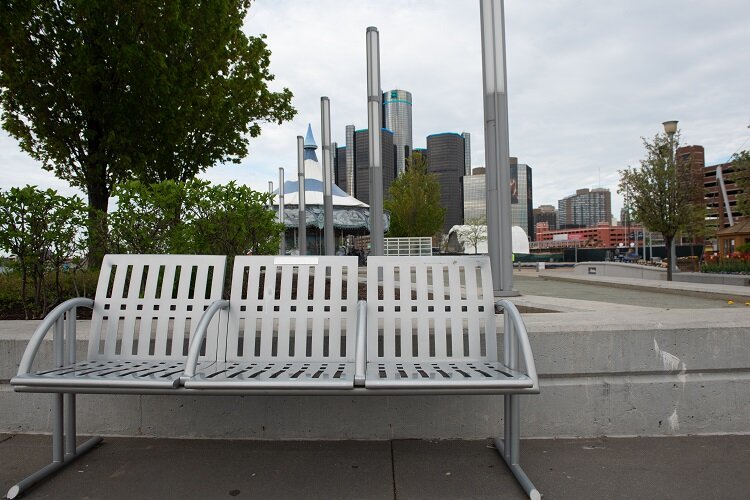
Growing up I noticed how people saw homeless as an annoyance and inconvenience where they were asking for help outside grocery stores or train stations. I grew up with discussions on the ban of begging and sleeping in public spaces. Movies displayed homelessness as a dystopian, dirty world, fueled with narcotics. In my later years I learned about Hostile Design – where benches are designed in such a way where one can’t comfortably sleep on them. Everywhere homelessness would be seen as a problem. A distance between “us” and “them” was created, a divided community.
This summer I travelled across the ocean to enjoy Irish folk music, while Cillian sang his heart out on the street to earn enough for today’s meal. I paid to watch a sheepherding demonstration in the Irish countryside, while Molly was begging for money on O’Connell Street to feed her dog. I paid well over a hundred euro to sleep in the dorms of Trinity College, while Dublin is undergoing a shelter crisis. As I am learning to think on my own I am also learning to see everyone for who they are, simply humans trying to get by. I would like to help those that are less privileged, those who make themselves so vulnerable because they have no other option.
What I wish to focus on in my research is how design can help tighten the local communities – the relationship between the homeless and those who are not, which then also can result in a stronger feeling of dignity and independence for the homeless. Research questions could include:
How can Positive Design and Interaction Design be used to create/improve a service/product that …
strengthens the local community?
creates a stronger sense of dignity and independence for the homeless?
Existing Design
Several services and products exist or are being developed today to make the days pass by more easily for those who are sleeping rough. Help stations provide services like food stations where meals are prepared or groceries can be picked up. In the United States there is a program called SNAP where homeless are given a card that can be used to buy their own groceries, while also providing other helpful services (United States Department of Agriculture, n.d.).
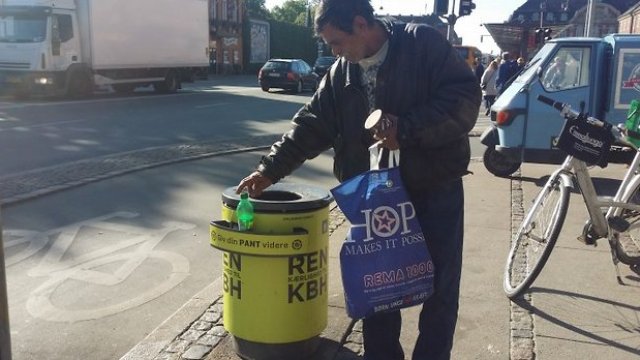
Previous research includes researching and creating UX design for applications aiding the homeless (Burrows et al., 2019) and those working for organizations providing shelters to the homeless (Pratt, 2024). Other various designs that can aid the homeless in their daily life that have been researched are small shelters and lockers to keep them and their belongings safe (Makris, 2024). Maps have been distributed that include an overview of important resources (Kennedy, 2016), and in some countries one can find trash bins with spaces for cans to be placed so that they can more easily collect “pfand” to earn some money to get by.
Figure 1: Example image of Hostile Design (Davison, 2023)
Figure 2: Example image of trash can with space for “pfand” (KBH Pant, 2015)
Relevance for the Design Fields
Positive design has a goal to increase the happiness and well being of individuals. It’s about designing for pleasure – to design comforting and joyful experiences, to design for personal significance – to design for goals and aspirations, and design for virtue – to design for good behaviour (Desmet & Pohlmeyer, 2013). These are all qualities that are important to keep in mind when you are designing a service or product for a community that is meant to bring joy, to inspire and promote good behaviour.
When it comes to focusing on the particular target group of the ones sleeping rough I find it important to design fields as one to this day still finds hostile design in our infrastructure, and it can be hard to know where and how to provide the best help. In the light of the topic of inclusivity, the homeless, alongside other groups, have their own specific needs that should be put into consideration when designing for the general population.
Future research process
In the first phase of the research I will have to go deeper into exploring the topic, I will need to gain a better understanding of the different problems and needs of the target groups (both the homeless, and those who are not) and to look at and categorise various approaches. From here I can try to narrow down the problems, and choose an approach to focus on. This might include some changes to the research question and sub-questions. A literature review could also be helpful thereafter to find relevant papers. Eventually I will have a more clear goal and can move to the phase of the research process where I can gather some data.
When gathering data both qualitative and quantitative information gathering may be useful in order to understand perspectives and outlooks on the problem within a community. This could be done with one to one interviews or surveys with open ended questions (qualitative) or a typical survey with close ended questions (quantitative). As I aim to look at the problem from a community based outlook the target groups include both the homeless and those who are not.
When researching and gathering data there are several institutions that could be helpful to use or get in contact with. Besides looking for research papers through Google Scholar, there are various organizations both in Austria and Norway that could be contact points. Caritas, Red Cross/Røde Kors, Erlik, Asfalt and International Network of Street Papers, could be some.
Research Challenges
As I see it the first challenge will be to limit the research scope and questions. Later comes problems related to data gathering. Here the main challenge will be communication with the target group, the homeless. First of all I do not speak German well which can cause communication barriers. Secondly, it’s a vulnerable group that lacks the safety most of us take for granted and are always exposed to various kinds of exploitation, communication should therefore be done in a space in which they feel safe and comfortable.
Sources
Burrows, R., Mendoza, A., Sterling, L., Miller, T., & Pedell, S. (2019). Evaluating ask izzy: A mobile web app for people experiencing homelessness. In Proceedings of 17th European conference on computer-supported cooperative work. European Society for Socially Embedded Technologies (EUSSET). DOI: https://doi.org/10.18420/ecscw2019_ep17
Kennedy, C. M. (2016). Designing for equality: how a social design approach can make a difference. International Journal of Arts and Technology, 9(3), 187-198. DOI: https://doi.org/10.1504/IJART.2016.078608
Pratt, C. (2024). Technology and Homelessness: How Website Design and Blockchain Technology Could Impact the Unhoused. (Undergraduate Theses, Capstones, and Recitals. 38.) https://digitalcommons.du.edu/undergraduate_theses/38