The City as a Designed System: Architecture, Space, and Pace 8/10

Calm Tech Institute Awards – Part I

As I started researching product examples that demonstrate how interactions could be designed in a calm and respectful way, I came across the Calm Tech Institute Awards. Through this initiative, the Calm Tech Institute recognizes products, services, and technologies that are designed according to the principles of calm technology. Products are evaluated through a 81-point criteria covering categories such as:

  • attention: Products are evaluated on how they work with (or against) human attention.
  • periphery: How does the product engage other senses through peripheral attention?
  • durability: How does the product break down? Does it offer support to customers in some way?
  • light: Does the product use warm lighting or harsh, blue lights?
  • sound: How does the product sound? For products with moving parts, what actions have been taken to prevent excess noise?
  • materials: What kinds of materials are used?

The award spans a wide range of product and service domains, including:

  • Smart Appliances
  • Transportation
  • Electronics
  • Artificial Intelligence
  • Automotive
  • Health
  • Homes
  • Vacation Rentals
  • Museums
  • Education
  • Websites and Apps

This framework shifts the focus away from novelty and constant engagement, instead emphasizing thoughtful, human-centered design.

In this and the next blog entry, I want to take a closer look at some of the products that have received this award and explore how they translate calm technology principles into real-world design.

“Dreamie” by Hello Ambient

Last year’s highest certified product is a bedside sleep companion called Dreamie. The device is designed to reduce phone usage in the bedroom. A space that should ideally be reserved for rest and recovery. Looking at sleep behavior research from the American Academy of Sleep Medicine (AASM), it quickly becomes clear why this is such a relevant use case for calm technology.

ccording to the AASM, 87% of adults keep a phone in their bedroom, and the majority of them report not getting enough sleep due to phone usage. Other studies show that just one hour of screen time after going to bed increases the likelihood of insomnia symptoms by more than 50%. Screen use at night is also associated with an average loss of 24 minutes of sleep. These numbers highlight a clear opportunity for a device that keeps technology present, but firmly in the background—supportive rather than disruptive.

Based on their research, the AASM recommends several habits to improve sleep quality:

  • Disconnect from devices at night
  • Leave your phone in another room
  • Follow a relaxing nighttime routine
  • Have a sleep schedule
  • Turn off push notifications

Dreamie, developed by Hello Ambient, directly addresses these recommendations and turns them into design requirements. Instead of asking users to rely on willpower alone, the device offers an alternative that fits naturally into existing bedtime routines.

At its core, Dreamie is more than a smart alarm clock—it is a carefully considered design solution. Recognizing how hard it can be to resist media consumption before sleep, the device provides calm, sleep-focused audio content. This creates a gentle alternative to scrolling through a bright, distraction-filled phone screen, helping users wind down rather than stay engaged.

In addition, Dreamie tracks sleep patterns without requiring wearable devices, reducing friction and discomfort. It also features a daylight-based alarm, which is widely considered to be a more natural and less jarring way to wake up compared to traditional sound alarms. Interactions are handled through tactile, physical controls, allowing for eyes-free adjustments in the dark—an intentional design choice that avoids bright screens and supports a calm, sleep-friendly environment.

Taken together, these features strongly align with calm technology principles. Dreamie avoids competing for attention, supports healthy sleep habits, and stays in the background when not needed—showing how research-driven insights and calm interaction design can address a widespread problem.

References:

AI Assistance Disclaimer:

AI tools were used to improve grammar and phrasing. The ideas, examples, and content remain entirely the author’s own.

Embodied Interaction: How the Body Influences Our Perception of Slowness 7/10

Some focus and writing tools deliberately avoid real-time notifications or visual noise, allowing users to remain physically settled for longer periods.

Good example is iA Writer, which minimizes interface elements to reduce physical and cognitive agitation.

Who is in Control? The Battle for Agency

Design & Research | Master Thesis Log 06

For the last few weeks, I have analyzed photography through the lens of philosophy. But as an Interaction Designer, I need to understand the user.

This week, I interviewed two distinct photographers. My goal was to investigate a core design problem: When the machine (AI) takes control of the image, do we lose the art?

The data I collected was surprising. One photographer sees a new evolution of tools, while the other sees a moral battle for truth.

The first subject is a working digital photographer who uses modern tools. In our discussion, we talked about features like Generative Expand—where AI creates the background for you.

For him, this isn’t about “faking” reality; it’s about utility. He explained that sometimes you don’t have the budget for a studio or the right location, so the AI helps you “fix” the background. He is willing to give up control of those pixels to solve a problem.

I pushed him on the question of Agency: If the camera is digital, is the computer doing the work?

He clarified a crucial distinction across several of his answers. For him, the human is absolutely still in control, provided one condition is met: Manual Settings.

He emphasized that as long as the photographer is manually managing the technical variables—White Balance, Shutter Speed, Aperture, ISO—the human is the “Pilot.” Even if the image is digital, the decisions are human.

This is a vital finding for my thesis. It suggests that for digital natives, “Agency” is located in the Settings Menu, not the film roll.

However, he admitted that as AI improves, this balance might shift. He expressed a real uncertainty about where the line will be drawn in the future:

“I don’t think it will ever die honestly it’s a form of art that’s been around forever I think it may change in ways I hope it doesn’t get so reliant on AI but who truly knows.”

Then, he offered a profound prediction. He believes that the definition of “Authenticity” is about to shift. Just as Film became the “vintage” alternative to Digital, he believes standard Digital cameras will become the “Authentic” alternative to AI:

I think you will always have it around even if one day ai takes over you will have those who will still shoot film and those who will use digital as the new form of film vs AI which scary to think about but true

This suggests that “Agency” is relative. In 2030, holding a digital camera and manually setting the White Balance might be seen as the ultimate act of human control, because it proves a human was there.

On the other side, I interviewed a legend in the New York film photography scene. He is known for capturing the “Madness” of NYC—raw, unedited, and chaotic.

I asked him if the perfection of AI images offends him. His answer ignored the utility argument entirely. He focused strictly on Value.

“I ignore it. Work done by a human will always be worth more”

He believes that the “Apparatus” (the machine) cannot create value. Only human labor creates value. When I asked if the public will eventually be fooled by the shiny look of AI, he gave a final verdict:

“The truth always prevails”

For the Purist, “Control” is binary. You either have it, or you don’t. He refuses to let the AI fix his backgrounds or clean up his noise, because those imperfections are where the “Truth” lives.

This field research has clarified the conflict I am studying. We have two user groups with opposing definitions of “Control”:

  • Group A (Evolution): Believes in Selective Control. As long as they control the technical settings (Manual Mode), they feel like the artist—even if AI helps generate the background.
  • Group B (Resistance):  Believes in Total Control. They reject machine intervention entirely because they believe value comes from physical truth and human labor.

Refining the Question:
If we allow AI to take over parts of the process (as Group A accepts), do we eventually destroy the “Value” that Group B cherishes? Or is controlling the “Settings” enough to keep the human soul alive?

Next Steps

To answer this, I need to find the middle ground. Next week, I am interviewing “Hybrid” creators—people who use both manual film cameras AND high-tech Cameras. To see how they navigate the balance between Control and Automation.

Temporal Experience in UX: How Interfaces Shape Our Sense of Time 6/10

A short survey on consumers experience and thoughts on Street Newspapers

Last week we looked at interviews from street magazine sellers, identifying their experience with selling the magazine, their habits, location and interactions. This week we will look at possible customer behaviours. In order to investigate this I created a survey that I spread on platforms such as discord and WhatsApp, and the survey was open for a time period of five days. The survey only had one demographic question (nation), and consisted of only multiple choice, but with the option of answering “other” where it was deemed natural.

The survey involved the following questions:

  • Where are you based/located?
  • Have you bought one or more Street newspapers where you are located?
  • (If yes)
    • Why did you buy it/them?
    • Where did you buy it/them?
    • Did you read the magazine(s)?
    • Did you enjoy its/their content?
      • (if yes) What did you enjoy about them?
  • (If no)
    • Why not?
    • Where do you mostly pass Street Newspaper sellers+
  • What would you like to see and read about in a Street Newspaper?
  • Does the design of the cover impact whether or not you consider buying a magazine? (any magazine)
  • Have you ever bought a magazine purely because of the cover? (any magazine)

Limitations

One limitation with the survey were the few demographic questions.

Results

There were a total of 13 submissions. The participants were located in Norway (n=6) and Austria (n=7). Out of the 13 submissions, only one participant had bought at least one Street Newspaper where they are located, this participant is currently located in Norway. The participant bought the magazine(s) due to two reasons; “I wanted to help/support” and “The seller was friendly”, but the participant did not read the magazine(s). The magazine(s) were bought “Outside the metro/trainstation/etc.”, “Outside a grocery store” and “On a busy street”.

As for the rest of the participants who have yet not bought a Street Newspaper, the number one reason was that “I am not interested in reading magazines” (n=6). Reasons number two were “Don’t know” (n=3) and “The magazines do not look interesting” (n=3). Following up is the answers “I never have time to stop” (n=2) and two replies to “Other” were that they had not noticed or been approached by a seller, “I am not sure who gets the money” (n=2), and “I felt annoyed” (n=2). Lastly we have “I am not sure what they will use the money on” (n=1), and one answer to “Other” being that they were scared by the people selling them “especially the drug addicts”. Most of these participants pass Street Newspaper sellers “Outside the metro/trainstation/etc.” (n=7) or “Outside a grocery store” (n=4). Others were “Outside a mall” (n=3), “On a busy street” (n=2), “Near a tourist attraction” (n=2), “outside of university” (n=1), and “Don’t remember” (n=2). 

Getting to the results of the participants’ thoughts we will first look at what they would like to see and read about. Most would like to read about “Art & Culture” (n=6), following up with “Hobbies” (n=4) and “Posters to rip out” (n=4). Others were “The people selling the magazines” (n=3), “Nature” (n=2), “News & Politics” (n=2), “All of the above” (n=2), “Sports” (n=1), and one participant said they “wouldn’t”. Nine of the participants said the design impacts whether or not they consider buying a magazine, while eight also said they have bought a magazine purely because of its cover.

Discussion

The results of the participant who bought the magazine aligns with some of what was said in one of the interviews that were discussed last week. This comes to show that some people do in fact buy magazines purely to support the seller, but do not actually read the magazines themselves. 

When it comes to participants’ reasons to not buy a Street Newspaper, the primary reason was that they were not interested in reading magazines. What the reason for this is is not clear, there could be many reasons, for example general uninterest or a reflection of the decline in reading for fun (Lee, 2025). Some weren’t sure who gets the money, which displays a general lack of knowledge about the Street Magazines. A few also mentioned some uncertainty about where the money would be spent or fear from the sellers, which could have a connection to the lack of knowledge discussed in previous blog posts that can be associated with homeless and drug users (Barse, 2017). Two participants also felt annoyed, which could be a result of sales tactics, or personal frustration. An interviewee from the previous blogpost mentioned the importance of not nagging the potential customers (Skyrud, 2025b). One interesting answer was that the magazine did not look interesting, assuming they did not take the time to do more than look at the cover. We could link this to the last two questions regarding the thoughts around magazine buying behaviour. Over half of the participants said the cover impacted their consideration of buying a magazine or directly made them purchase a magazine. In the previous blogpost it was also mentioned how one seller noticed a magazine with a hand drawn cover sold better than the others (Skyrud, 2025a). 

The participants of this survey would preferably like to read about art and culture in Street Newspapers, with hobbies following closely and some would also like some posters to rip out. Only three participants would like to read about the people who actually sell the magazines, which may differ from the experience of one of the interviewees in the previous blogpost who had received feedback that people enjoyed reading about the sellers of the magazine (Skyrud, 2025a). 

Most participants would pass Street Newspaper sellers outside of public transport, hotspots and grocery stores. These are typically crowded places or where there are a lot of passerbys, aligning with the different location tactics mentioned in the previous blogpost. 

In short, to conclude, there does not seem to be much interest in reading magazines and if they were to read one it would be preferred for it to be about arts and culture. We see some similar observations from the interviews from last week and this week’s survey. One example being that it seems like the design of the magazine itself could have an impact on the number of sales. This tells us that the part of the service that could be focused on is the design of the magazine itself. There also seems to be a little lack of awareness behind the lack of interest in buying, which could also possibly be improved by focusing on creating awareness of what the service is and who the sellers are through other communication channels.

References

Interview coding: The sellers view

A method in the research phase of Service design is conducting interviews with the target group(s). Due to the short time period, I’ve tried to look for interviews online to gather information. What I wish to figure out is the perspective of the sellers and buyers. How is the experience for the sellers, do they enjoy their job? How do they sell? Are they comfortable and confident in what they are doing? Is it helping them earn money? And how is it for the buyers? Where and why did they buy the newspaper? Did they read it? How did they find the content? and so on.

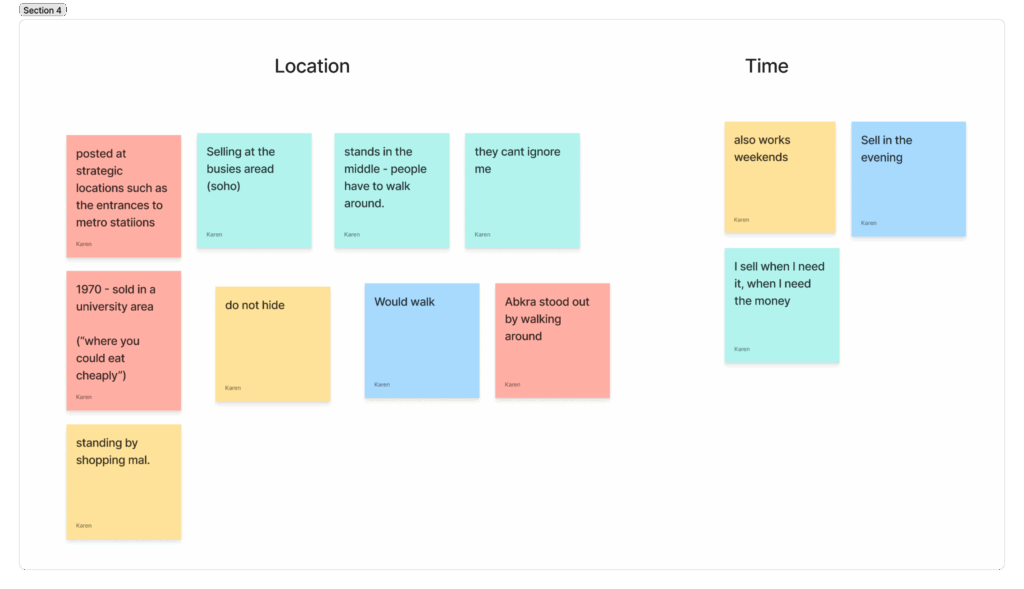
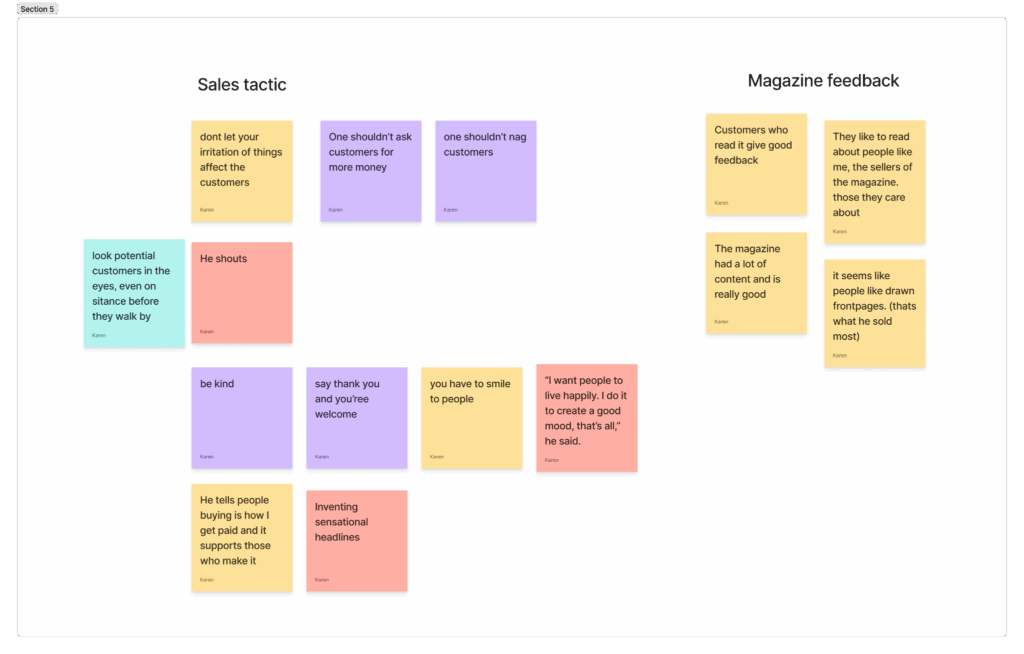
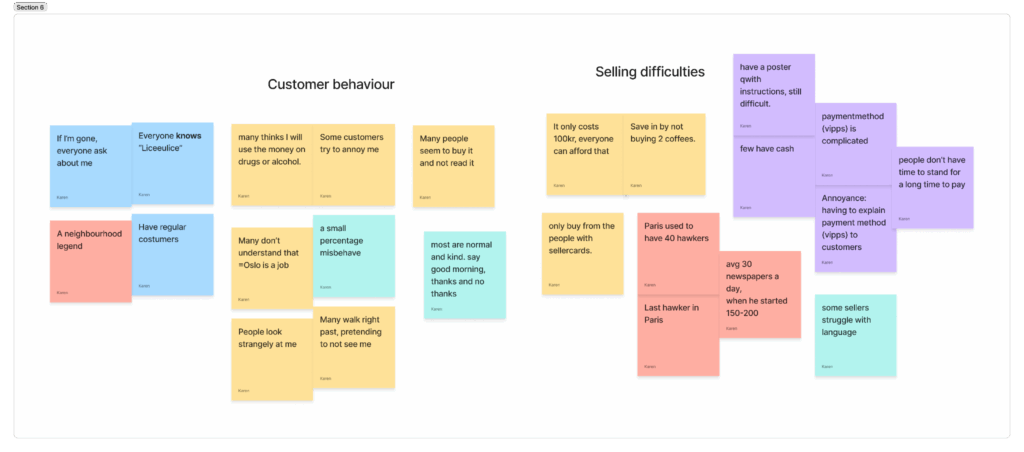
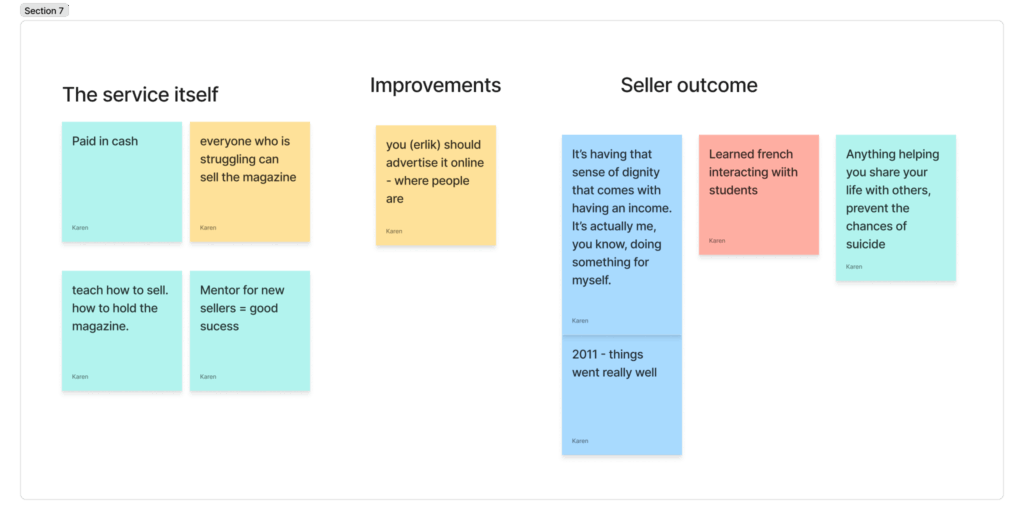
In this blogpost I will focus on the sellers. I looked through a few Norwegian seller interviews I found on Erliks website as well as a couple of other global interviews from big issues websites and arab news. None of the interviews included the same questions. I copied the interviews into a document and marked “codes” of what I thought was important to the questions I would like to answer. After that I took the codes into post-its on FigJam and used affinity mapping to group the codes. The groups I created were location, time, sales tactic, magazine feedback, customer behaviour, selling difficulties, seller outcome, suggestions for improvements, and sellers experience with the service itself.

Let’s start with location, where the sellers would tend to locate themselves while selling. The sellers would choose strategic locations that are busy, such as metro stations, near a university, a touristy neighbourhood and shopping malls (Arab News, 2025; Skyrud, 2025a; Bu, 2025). Two of the people also spoke about their tactic in walking around instead of simply standing still, this was how one of them stood out (Arab News, 2025; Hetherington, Lu & Terzić, 2021). Another would stand in the middle of the crowd so that people had to pass by and would be unable to “ignore” them (Bu, 2025). When it comes to the time the sellers would sell, it wasn’t much mentioned in the interviews. One would say they sold when they needed the money (Bu, 2025). As the street newspaper service functions by letting the sellers choose where to sell and their working hours (INSP, n.d.). 

Sales tactics were also quite often mentioned. Being kind and spreading a good mood through smiling and thanking and not letting your own irritations affect customers were mentioned (Arab News, 2025; Skyrud, 2025a, 2025b). One mentioned how he would let customers know that buying it is supporting them and the makers of the paper. The importance of not asking for more money or nagging the customers was also mentioned. As for the feedback of the magazine, one mentioned they would receive positive feedback and that people liked to read about the sellers of the magazine, but that some also buy it and seem to not read it. The same person also commented on how a magazine with a drawing on the frontpage sold really well and thought that people might like drawn frontpages.

As for the customer behaviour the sellers tend to experience, it seemed mostly positive, but some would experience poor behaviour (Bu, 2025; Skyrud, 2025). Two also talked about how they had put a mark on the area they were selling and how people would be well aware of who they are (Arab News, 2025; Hetherington, Lu & Terzić, 2021). Regular customers was also a point that was mentioned. As for difficulties when selling, one had a problem with people struggling with the digital payment method (Vipps) which seemed to cause stress as they seem to not have time to go through the payment method (Skyrud, 2025b). Another commented on the price that people should be able to afford it as it’s only the price of two coffees (Skyrud, 2025a). The interviewee from Paris had also experienced a big drop in sales over his long career as a newspaper seller (Arab News, 2025). 

As for the sellers’ experience with the street newspaper service, one talked about how they were a mentor for new sellers and that the mentor program had great success (Bu, 2025). As a mentor they would teach new sellers how to sell the magazines, giving tips on small things such as how to hold it, or help with language. In one of the interviews one came with tips for improving the service as a whole by promoting the magazine more online – since that’s where the people are (Skyrud, 2025a). For sellers, getting a sense of dignity, interacting with others and doing something that helped them share their story with others were positive outcomes mentioned (Arab News, 2025;  Bu, 2025; Hetherington, Lu & Terzić, 2021).

What could we take with us from these interviews? Well it seems as though figuring out how and where the sellers should position themselves for best sales could be interesting to look at, for example they tend to place themselves in busy areas, while one mentioned that they felt like customers were in a rush and did not feel like they had time to figure out the payment method. The payment process is also important, as people tend to carry less cash, other payment methods might be more time-consuming or impractical for street newspaper sales. Further we have the design of the magazine and its content itself. Some people like reading the stories of the sellers in the magazine, while people seem to buy it to support, yet they do not seem to read the magazine. Then there is the aspect of the design of the magazine itself if that could help start a talking point or promote sales. Which leads to the marketing of the magazines and its exposure online in order to promote more sales and open up another channel to support and communicate.

References

Is Photography Dead? Rethinking Creative Authenticity in the Age of AI

Design & Research | Master Thesis Log 01

The mechanical eye vs. the digital brain. (Source: Unsplash)

I still remember the first time I developed a roll of film. There was a specific anxiety in waiting to see if the shot came out right—the grain, the slightly missed focus, the “happy accidents.”

Today, that anxiety is gone. We are witnessing the death of the “snapshot” and the birth of the “computed image.” With the release of tools like Google’s Magic Editor and Adobe’s Generative Fill, the definition of photography has shifted from capturing light to processing data.

As an Interaction Design student coming from a background where photography was about documenting reality, this shift fascinates and terrifies me. If an algorithm frames the shot, adjusts the lighting, and even generates missing details, who is the creator? The user or the system? My Master’s research topic, â€œRethinking Creative Authenticity,” investigates this exact tension.

The Visual Conflict

This image has “noise.” It has grain. It captures a fleeting moment that might never happen again. It feels human because it is flawed. (Source: Unsplash)
Computed Perfection
Clean, optimized, and statistically average. AI tools push us toward this aesthetic—images that look “correct” but feel empty. (Source: Unsplash)

The Research Framework

Central Research Question

How can interaction design redefine or preserve creativity within automated camera systems and AI-enhanced photography tools?

To answer this, I am breaking the problem down into three sub-areas:

  1. Perception: Do users perceive a “technically perfect” AI image as less authentic than a flawed human image? Where is the threshold?
  2. Agency: Can we design interfaces that force the user to make creative decisions rather than relying on auto-pilot?
  3. Collaboration: How can AI act as a “Creative Coach” (guiding composition) rather than a “Servant” (fixing mistakes)?

Why This Matters for Design

In Interaction Design, we often talk about removing “friction.” We want apps to be easy, fast, and seamless. However, in creative tools, friction is often where the art happens. The struggle to get the focus right, or the decision to underexpose a shot for mood—that is creative intent.

If we design cameras that remove all struggle, we risk atrophying human creativity. We create a “Push Button, Get Art” culture [1]. My goal is to find the “sweet spot” where automation supports the user without replacing them.

My Approach: Research through Design

I don’t just want to write about this; I want to build a solution. My approach involves “Speculative Prototyping.” I intend to design a camera interface that resists total automation—a tool that asks you â€œWhy?” before you shoot, rather than just fixing the â€œHow.”

Early phase: Sketching interfaces that bring the human back into the loop. (Source: Unsplash)
  1. Literature Review: Deep dive into “Computational Photography” ethics.
  2. Interviews: Conducting qualitative sessions with photographers to understand their fears regarding AI.

References (IEEE)

[1] L. Manovich, “AI Aesthetics,” Manovich.net, 2018. [Online]. Available: http://manovich.net/index.php/projects/ai-aesthetics

[2] A. Agarwala et al., “Photographic stills from video,” ACM Transactions on Graphics (TOG), vol. 23, no. 3, pp. 585-594, 2004.

[3] H. Steyerl, “In Defense of the Poor Image,” e-flux journal, no. 10, 2009.

AI Declaration: This blog post was drafted with the assistance of an LLM to structure my initial thoughts and ensure academic formatting. The personal motivation, image selection, and research direction are entirely my own.

Exploring Problems & Solutions

Problems

The obvious problems that exist when it comes to homelessness is the need for a roof over their head, food, and access to basic hygiene and healthcare. Another problem is how to prevent homelessness, what to do when someone is at risk of ending up on the street or couch surfing between friends and family. The homeless also face a lot of stigma, where they can often be seen as lazy or dirty (Unity Parenting, n.d.). Some are also worried that the money the homeless are given or earned will be used on drug misuse (Forskning.no, 2017). This creates a barrier that prevents others from helping entirely, or creates a barrier which makes it difficult to know how to best help without indirectly inflicting more harm. Which is the last problem I’ve decided to bring up; the lack of awareness or knowledge on how to help the homeless or people in need. In Norway only 10% said that they understand the current situation regarding homelessness in Norway (Frelsesarmeen, n.d.). 

Limitations

In order to limit the scope of the coming research I have looked at what demographics I wish to focus on. Demographics to consider is location, which environment/group, and age. My interest primarily lies in looking at Norway and/or Austria with a primary focus on looking at the homeless and those of us who are lucky to have a roof over our heads.  

Moving forward I would like to focus on the topic of service design and look at how the services that the homeless are a part of creating help contribute to bringing them back to society and the local community. While also exploring the possible combination of existing design or the design of new services that can make it easier for the local community to help and/or to meet and create connections with those who are in need.

Todays solutions

Stigma and not knowing how to help are two problems that go hand-in-hand, where people are worried where the money will go and not sure what to do instead. In an article from forskining.no Allan Andersen advised one could simply give food instead. Which is a good thing to do, but it does not help them out of the situation more than their current hunger. In some areas there are also food services provided by organizations where the homeless can come in for meals or pick up groceries. Another service that contributes to food distribution is Billas donating scheme where they donate food to partner organizations (Billa, n.d.). In some stores it is also possible for customers to buy and donate food by leaving it in the donation containers in the stores.

However, what I believe could be a possible downside to this food distribution is that it takes away some of their independence. Perhaps they would like to be able to go to a store and buy groceries like everyone else and cook their own meal as any other would do. SNAP in the US allows for this where they are given an electronic card, similar to a credit card, that can for example be used to get food from soup kitchens or to buy groceries (United States Department of Agriculture, n.d.). This is a service that in a way is designed to help people in need to be able to have the freedom and independence to go buy what they need when they need it. However, without a kitchen to cook in, one is limited to buying pre-prepped meals even in the stores. Adding the availability for open community kitchens, where one can come to cook or learn how to cook, would be a good addition to the service as a whole. 

There are also services provided by organizations that allow for homeless or people in need to gain work experience and money. Most commonly is the selling of newspapers on the street. This is a service that is offered to those in need where they can buy magazines for a small price, and sell it for more. This allows those in need to also provide a service for others. In an article Claudia Magallanes-Blanco & Juan Antonio Pérez-Bermúdez (2009) discuss how such a service can help to empower the homeless. It does so through the employment itself, being able to share their story with others, and by creating networks. From the interviews it is brought forward how the selling of the magazines offers a space where they can talk to and meet others, becoming a part of society and integrating with the community surrounding them. Unfortunately for the street magazines in Norway, there has been a decline in the amount of sellers since they first started. Although they are unsure of the cause, the editor of Erlik, who produces the magazine =Oslo, saw that a lot of sellers who weren’t returning were those actively taking drugs (NTB, 2024).

The organization Erlik also runs a coffee shop where the staff primarily consists of people with a background of drug use. In an interview from 2017 the environmental therapist and barista at =Kaffe, Gunvor HĂŚgstad, said that people would usually be quite social and talk with strangers while having a coffee at =Kaffe (Tanase, 2017). In the same interview HĂŚstag also mentions that they have more employees working at the same time as it might run a little slower than most coffee shops. These are good examples of how they have adjusted their process in order to keep up with demand, and how they have managed to create a welcoming and safe atmosphere. 

References