#aerial #learning #proprioception #communication
Aerial silks are pieces of fabric hung from the ceiling and used as an apparatus for dance. In this practice, people are suspended in the air, and students must be able to figure out how their own body must move in order to successfully complete a figure or sequence, while not falling to the ground in the process.
This blend of proprioception, spatial awareness, and observational learning is sometimes difficult for some students, even when their physical ability is at the level they need.
As such, I ask, is there a way to blend the digital and physical world to help in the learning of new aerial silks figures? What can we as interaction designers do to help design the transfer of information of each movement in a figure or sequence? Can we use digital and/or analog methods to enhance people’s proprioception to make it easier to learn new figures?
All of these subquestions culminate in the research question:
How can we use interaction design to assist in the training of aerial silks, especially in enhancing people’s proprioception?
For example, one of the first skills you need to learn is how to do a basic foot lock. [1] explains it with the following image:
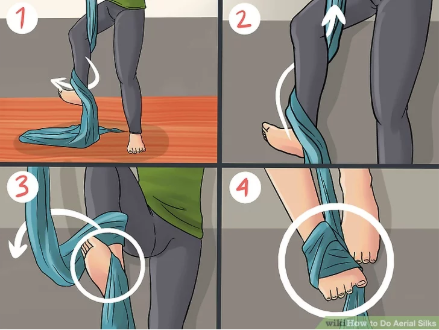
Image from [1]
My personal motivation for this topic is the fact that I’ve been learning aerial silks for about a year and a half, in 4 different studios with 12 different teachers. Throughout this process, both the teacher and I have had to adapt to each other’s learning and teaching styles, respectively, and I have observed how different strategies help different students. Even with advanced students and teachers, the vocabulary used is not always the same, and the memory processes involved oftentimes affect the time it takes to learn a new sequence.
This is relevant for design fields especially when thinking about full-body experiences. As we move to a more technologically integrated future, fully immersive interaction will become even more common. In this, one of the most important senses to study is proprioception – how do we teach people to be aware of their body? Besides that, this research is also relevant for the sports science field, as its findings can be used to help in the teaching of not just aerial silks, but also other non-standardized acrobatic sports. Design could help these fields through using user research and prototyping methods to reduce uncertainty in the unstandardized teaching methods and providing a good approach to help people with a less developed proprioceptive sense.
Some of the challenges I expect are encountering little or no previous research exactly regarding this topic. I expect to find research about proprioception, maybe some research about silks, but not too many scientific papers combining the two. I also expect to find a challenge in the fact that everyone learns differently, and not only each individual country but also each individual aerial studio and teacher has its own internal language to define specific movements. In other, more studied fields, the best practice is to have a international committee where the rules are standardized for the profession worldwide. For example, gymnastics has the International Federation of Gymnastics, which is responsible for the language dictating every move. [2]
Moving forward, I plan to:
- start talking with different aerial teachers and students in informal interviews to gather some background about how they deal with this problem
- delve deeper into shared resources to gain more knowledge
- ideate and list possible solutions depending on the findings
[1] B. Borzillo. “How to Do Aerial Silks.” WikiHow. Accessed: Nov. 4, 2025. [Online]. Available: https://www.wikihow.com/Do-Aerial-Silks
[2] “Mission and values”. Federation Internationale de Gymnastique. Accessed: Nov. 11, 2025. [Online]. Available: https://www.gymnastics.sport/site/pages/about-missionValue.php