Design & Research | Master Thesis Log 01
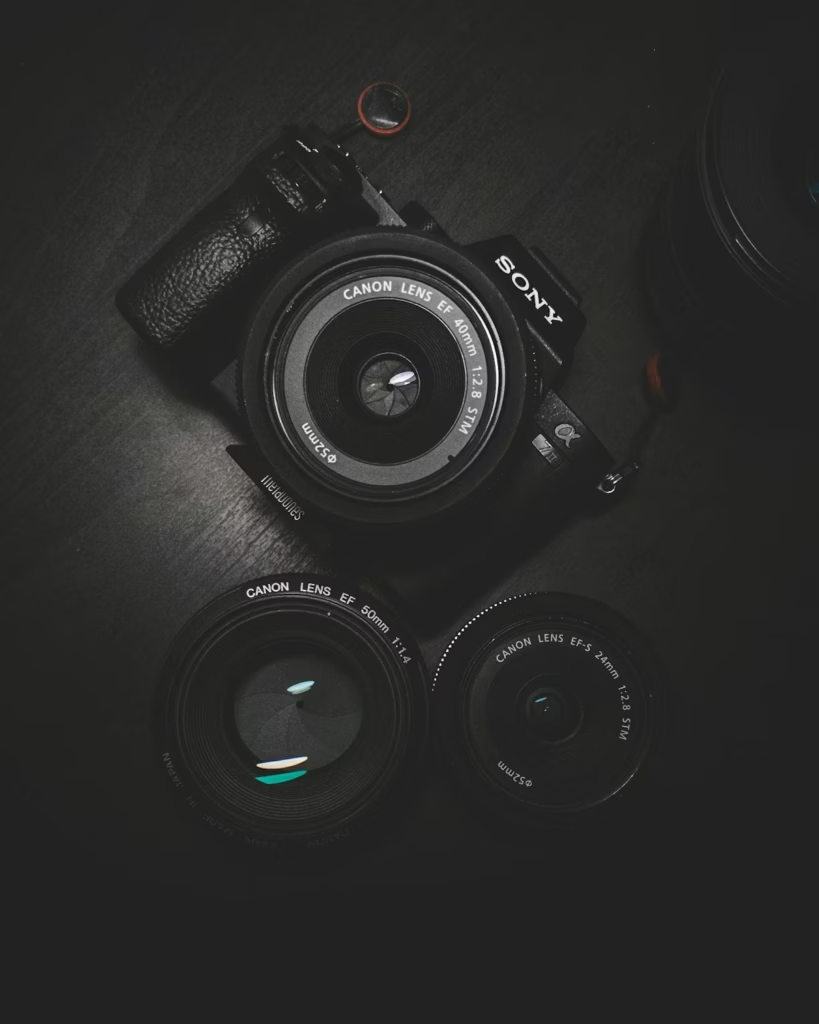
I still remember the first time I developed a roll of film. There was a specific anxiety in waiting to see if the shot came out right—the grain, the slightly missed focus, the “happy accidents.”
Today, that anxiety is gone. We are witnessing the death of the “snapshot” and the birth of the “computed image.” With the release of tools like Google’s Magic Editor and Adobe’s Generative Fill, the definition of photography has shifted from capturing light to processing data.
As an Interaction Design student coming from a background where photography was about documenting reality, this shift fascinates and terrifies me. If an algorithm frames the shot, adjusts the lighting, and even generates missing details, who is the creator? The user or the system? My Master’s research topic, “Rethinking Creative Authenticity,” investigates this exact tension.
The Visual Conflict
Clean, optimized, and statistically average. AI tools push us toward this aesthetic—images that look “correct” but feel empty. (Source: Unsplash)
The Research Framework
Central Research Question
How can interaction design redefine or preserve creativity within automated camera systems and AI-enhanced photography tools?
To answer this, I am breaking the problem down into three sub-areas:
- Perception: Do users perceive a “technically perfect” AI image as less authentic than a flawed human image? Where is the threshold?
- Agency: Can we design interfaces that force the user to make creative decisions rather than relying on auto-pilot?
- Collaboration: How can AI act as a “Creative Coach” (guiding composition) rather than a “Servant” (fixing mistakes)?
Why This Matters for Design
In Interaction Design, we often talk about removing “friction.” We want apps to be easy, fast, and seamless. However, in creative tools, friction is often where the art happens. The struggle to get the focus right, or the decision to underexpose a shot for mood—that is creative intent.
If we design cameras that remove all struggle, we risk atrophying human creativity. We create a “Push Button, Get Art” culture [1]. My goal is to find the “sweet spot” where automation supports the user without replacing them.
My Approach: Research through Design
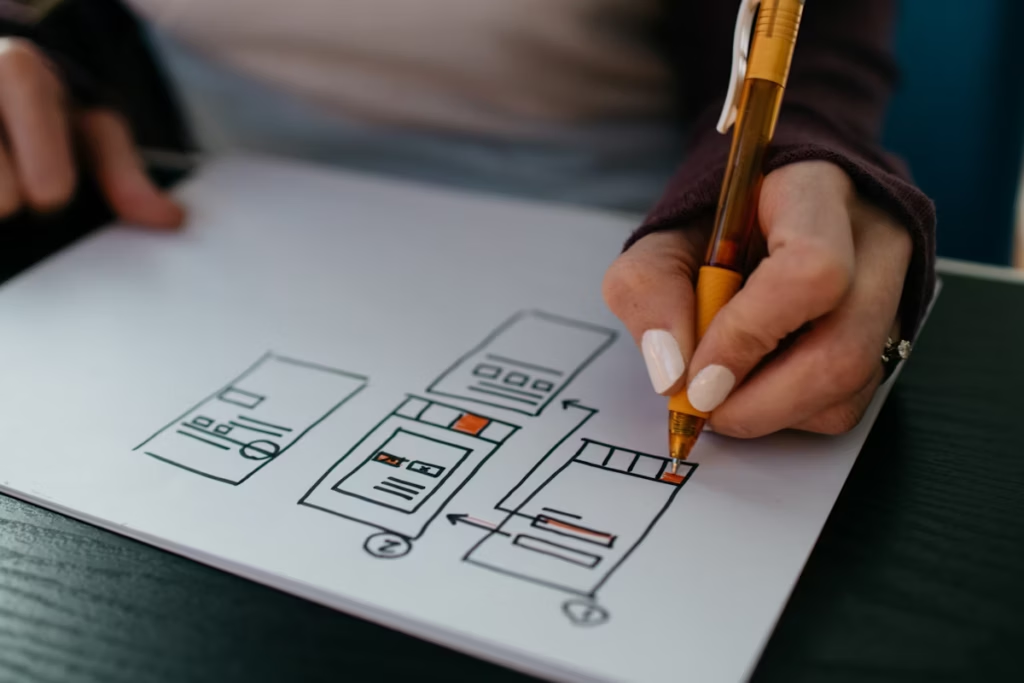
I don’t just want to write about this; I want to build a solution. My approach involves “Speculative Prototyping.” I intend to design a camera interface that resists total automation—a tool that asks you “Why?” before you shoot, rather than just fixing the “How.”
Challenges & The Road Ahead
The biggest challenge I expect is the subjectivity of “Authenticity.” What feels authentic to a Boomer might feel outdated to Gen Z. To tackle this, I am grounding my definition in the works of Hito Steyerl [3] and Susan Sontag.
My Next Steps:
- Literature Review: Deep dive into “Computational Photography” ethics.
- Visual Audit: I will analyze the UI of the Pixel 9 and iPhone 15 to map exactly where the “Magic Buttons” are hidden.
- Interviews: Conducting qualitative sessions with photographers to understand their fears regarding AI.
References (IEEE)
[1] L. Manovich, “AI Aesthetics,” Manovich.net, 2018. [Online]. Available: http://manovich.net/index.php/projects/ai-aesthetics
[2] A. Agarwala et al., “Photographic stills from video,” ACM Transactions on Graphics (TOG), vol. 23, no. 3, pp. 585-594, 2004.
[3] H. Steyerl, “In Defense of the Poor Image,” e-flux journal, no. 10, 2009.
AI Declaration: This blog post was drafted with the assistance of an LLM to structure my initial thoughts and ensure academic formatting. The personal motivation, image selection, and research direction are entirely my own.
