Playgrounds have long been recognized as essential environments supporting children’s physical, cognitive, and social development. In the academic literature, playgrounds are commonly categorized into three main types: traditional playgrounds, adventure playgrounds, and contemporary playgrounds (Barbour, 1999; Campbell & Frost, 1985; Hayward et al., 1974). Each category reflects distinct design philosophies, material choices, and forms of play engagement.
1. Traditional Playgrounds
Traditional playgrounds typically consist of standardized, manufactured equipment such as metal swings, seesaws, climbing ladders, and slides. Because these structures are usually mass-produced and selected from catalogues, their design tends to be predictable and uniform.
Although they support fundamental motor activities, research shows that these fixed structures offer limited flexibility and often constrain children’s play to predefined movements. Coffin & Williams (1989), for instance, found that children spent very short periods in areas where equipment lacked complexity and plasticity, suggesting that static structures may not sustain long-term engagement or imaginative play.
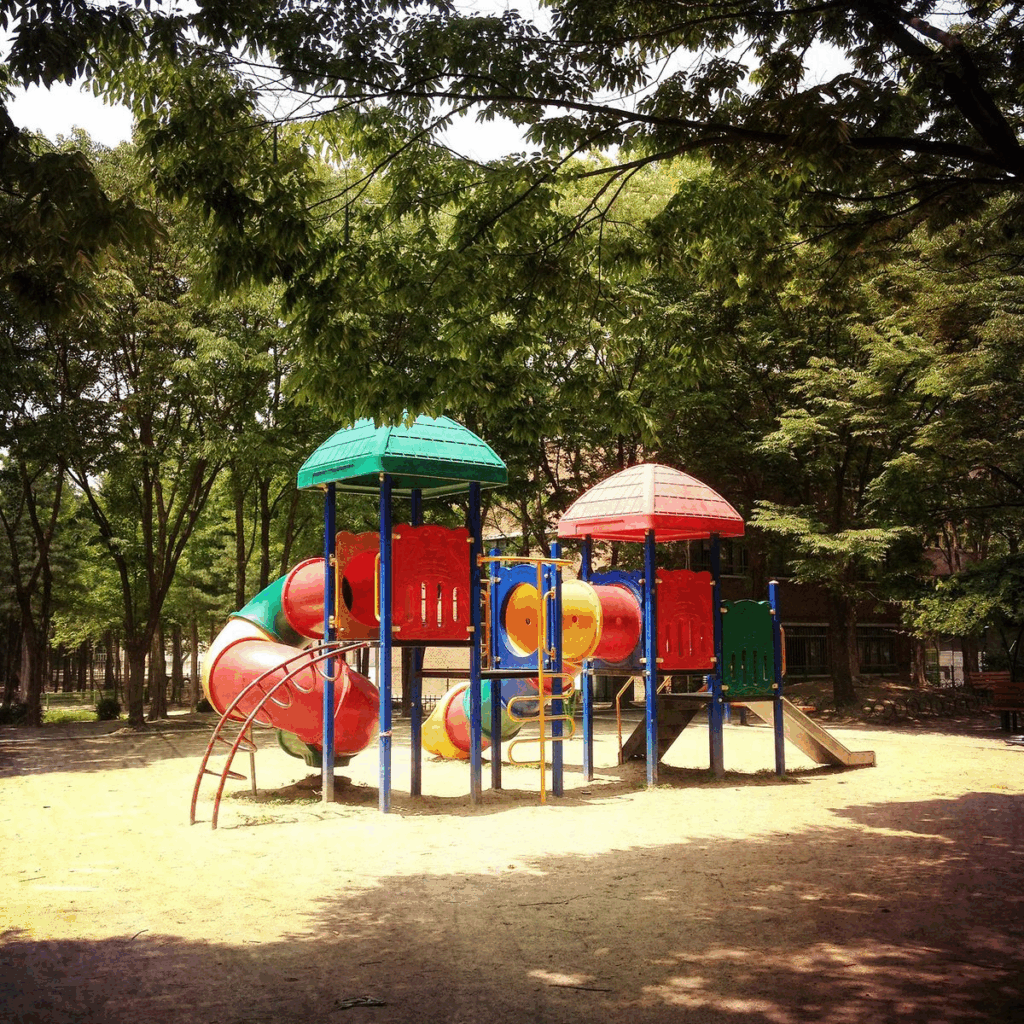
Figure 1 (traditional playgroun)
2. Adventure Playgrounds
Adventure playgrounds represent a contrasting philosophy. Originating in Europe and still widely implemented—approximately 1,000 adventure playgrounds exist today, with over 400 in Germany, and many in England, Holland, France, and Denmark—they emphasize flexibility, creativity, risk-taking, and child autonomy (Solomon, 2005; IPA, 2007).
These playgrounds typically include loose parts, such as wood, ropes, tires, and moveable objects that children can manipulate, combine, or repurpose. This dynamic environment “multiplies the opportunities” for exploration and problem-solving. Research strongly supports their value: Hayward, Rothenberg & Beasley (1974) found that children spend more time in adventure playgrounds and display higher levels of cognitive play compared to traditional and contemporary playgrounds. Similarly, Strickland (1979, cited in Hugh, 1995) emphasized that adventure playgrounds facilitate greater cognitive and social development.
Loose parts, in particular, appear central. Both Hayward et al. (1974) and Brower & Williamson (1974) (cited in Maxwell et al., 2008) demonstrated that mobile, manipulable materials are preferred by children and encourage more complex play behaviors than fixed equipment.

Figure 2 (adventure playground)
3. Contemporary Playgrounds
Contemporary playgrounds blend elements of traditional structures with more innovative, multi-functional designs. Barbour (1999) describes these playgrounds as including linked, multi-purpose structures that allow varied points of entry and exit. They often incorporate features that stimulate dramatic play, such as platforms, tunnels, themed structures, or interconnected climbing systems.
Coffin & Williams (1989) observed that multifunctional play structures encourage richer social, verbal, and psychomotor behaviors compared to single-use equipment. These findings indicate that contemporary designs—by expanding children’s choices and encouraging imaginative engagement—occupy a middle ground between the fixed nature of traditional parks and the flexibility of adventure playgrounds.
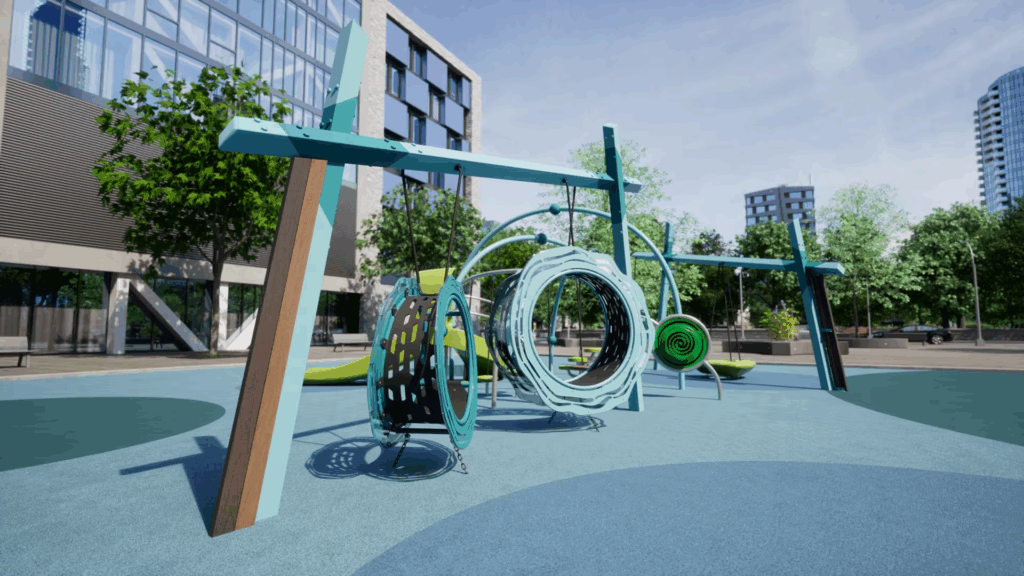
Figure 3 (contemporary playground)
Across studies, several consistent themes emerge:
- Flexibility and manipulability support cognitive and social development.
- Complex, multi-functional equipment fosters richer interaction and longer play duration.
- Traditional playgrounds, while valuable for basic motor skills, offer limited opportunities for creativity and problem-solving.
References
Barbour, A. C. (1999). The impact of playground design on the play behaviors of children with differing levels of physical competence. Early Childhood Research Quarterly, 14(1), 75–98.
Brower, D., & Williamson, D. (1974). Loose parts and creative play. In Maxwell et al. (2008)
Campbell, S., & Frost, J. L. (1985). The effects of playground type on children’s play behaviors. In J. L. Frost & S. Sunderlin (Eds.), When children play.
Coffin, G., & Williams, G. (1989). The influence of playground equipment on children’s play. Journal of Environmental Psychology, 9(1), 15–20.
Hayward, D. G., Rothenberg, M., & Beasley, R. (1974). Children’s play and urban playground environments: A comparison of traditional, contemporary, and adventure playgrounds. Environment and Behavior, 6(2), 131–168.
Hugh, S. (1995). Play environments and cognitive development.
IPA (International Play Association). (2007). Playground statistics and global overview. IPA Publications.
Maxwell, L. E., Mitchell, M. R., & Evans, G. W. (2008). Effects of play equipment and loose parts on preschool children’s outdoor play. In Children, Youth and Environments,
Solomon, S. (2005). The science of play: How to build playgrounds that enhance children’s development. University Press.
Strickland, E. (1979). Cognitive play in adventure playgrounds. I
