Author: dila.bayraktar
From Individual Activities to a Co-Design Toolkit (D&R2)(5/6)
During the development of my prototypes, I realized that presenting separate activities was not enough. Each activity explored a different aspect of children’s experiences, but they did not naturally connect with one another.
Instead of treating them as individual prototypes, I started combining them into one participatory toolkit. The goal changed from asking isolated questions to guiding children through a simple design journey.
The toolkit now follows three connected steps;
First, children choose a material or playground element that they would like to include. They then select a feeling that best represents how this element should make them feel. Finally, they choose a type of play they associate with it. Rather than giving fixed answers, the activity encourages children to create their own combinations and explain their choices.
After completing these steps, children receive a blank sheet where they can use the selected cards as inspiration to draw or design their own playground.
Although the prototype is still low-fidelity, I think structuring the activities into one continuous process makes participation much more natural and easier for children.
Learning from Co-Design: When Children Become Playground Designers (D&R2)(4/6)
One of the most inspiring parts of my research has been discovering how many projects already involve children as active contributors to playground design
The article “Children as Co-Designers” from Playground Research presents several examples where children are invited into the design process long before construction begins. Instead of asking children whether they like a finished playground, designers involve them in workshops, drawing sessions, storytelling activities, model making, and discussions about how they imagine play. These activities allow children to express ideas that adults might never consider.
One thing that stood out to me is that children rarely describe playgrounds in terms of equipment. Adults often ask questions such as “Do you want a bigger slide?” or “Should we add another swing?” Children, however, often talk about experiences. They imagine places for adventure, hiding, climbing, discovering, building, making friends, or inventing stories. This difference shows why simply asking children what equipment they want may not be enough.
Another interesting idea comes from the Design Council’s systemic design approach. The report argues that design problems should not be viewed as isolated objects but as systems involving many stakeholders, relationships, and long-term effects. Playground design is a perfect example of this. Children, parents, municipalities, schools, designers, safety regulations, and local communities all influence the final outcome. If one stakeholder is missing—especially children—the system becomes incomplete.
Rather than interviewing children in a formal way, designers create playful activities that feel like games instead of research. This inspired many of the low-fidelity prototypes I have been developing, where children use cards, stickers, drawings, and playful prompts instead of long verbal explanations.
One important lesson I learned is that participation is not simply asking children for opinions. It is about designing methods that allow them to communicate in ways that feel natural, enjoyable, and appropriate for their age. Good co-design is less about collecting answers and more about creating opportunities for children to share their imagination.
References
Design Council. (2021). Beyond Net Zero: A Systemic Design Approach. https://www.designcouncil.org.uk/fileadmin/uploads/dc/Documents/Beyond%2520Net%2520Zero%2520-%2520A%2520Systemic%2520Design%2520Approach.pdf
Playground Research. (n.d.). Children as Co-Designers. https://playgroundresearch.org/children-as-co-designers/
Playground Research. (n.d.). Playground Research. https://playgroundresearch.org/
IDEO U. (2020). What is Co-Design? https://www.youtube.com/watch?v=-2_6ozX4G_M&t=40s
Participatory Design Foundation. (Video). Participatory Design Process. https://www.youtube.com/watch?v=9PDWzPtpCZ8
Designing a Language Children Already Speak (D&R2)(3/6)
As I continued developing the card prototype, I asked myself a simple question:
How do children naturally talk about playgrounds?
The answer is—they often don’t.
Children usually describe experiences rather than designs. They might say “I like climbing trees,” “I want somewhere to hide,” or “Water is fun.” They think through feelings, materials, and play, not through architectural plans.
This observation became the basis of my next prototype.
Instead of asking children to design a playground directly, I created three categories:
- Materials & Elements
- Feelings
- Play
Children can connect these categories in different ways. For example, they might associate water with freedom, or wood with climbing. There are no correct combinations.
This approach is inspired by participatory design, where the role of the designer is not to collect fixed answers but to create tools that support expression.
I also intentionally left empty cards in every category. Children should not be limited by my assumptions. If they think of something I did not include, they can simply create a new card.
In this sense, the cards become less like a survey and more like a shared design language between children and designers.
From Three Ideas to One Direction (D&R2)(2/6)
After creating my three first low-fidelity prototypes, I started comparing them instead of thinking about them as separate ideas. Each prototype focused on a different aspect of participation: materials, emotions, or spatial experiences. However, while reflecting on them, I realized that they all had something in common—they encouraged children to communicate visually instead of relying only on words.
The more I thought about my research question, the more I realized that my goal is not to design a better playground, but to design a better way for children to participate in the design process.
Looking at examples from Playground Research, I noticed that successful co-design projects rarely begin with asking children direct questions like “What playground do you want?” Instead, they provide children with playful tools that help ideas emerge naturally through making, arranging, discussing, and imagining.
This made me reconsider my own prototypes. The first prototype; the card system felt the most flexible. It could easily be expanded, adapted, or combined with other activities. Unlike a questionnaire, it allows children to explore different possibilities without feeling like there is a right or wrong answer.
Rather than designing one perfect activity, I decided to continue developing the card-based approach. It has the potential to become a playful design tool that encourages conversation, creativity, and collaboration.
Instead of collecting answers, I want to create opportunities for children to express ideas that adults might never think of.
References
- Playground Research. (2024). Children as Co-Designers. https://playgroundresearch.org/children-as-co-designers/
- Sanders, E. B.-N., & Stappers, P. J. (2008). Co-creation and the new landscapes of design. CoDesign, 4(1), 5–18.
Elevator Pitch; Playgrounds
Here is my pitch for design and research class;
Have you ever imagined of a playground where children can explore imagine and learn through play ? Traditional playgrounds are often designed by adults and not by children. I am interested in play based interaction- driven methods that allows children to participate as co-designers.
Play is essential for children’s development like social skills, cognitive abilities and physical health. Interaction design can help include children in the design process of playgrounds. I believe children should have more saying in a place where it is only for them and not for adults.
2 Customer Profiles & Value Proposition Map
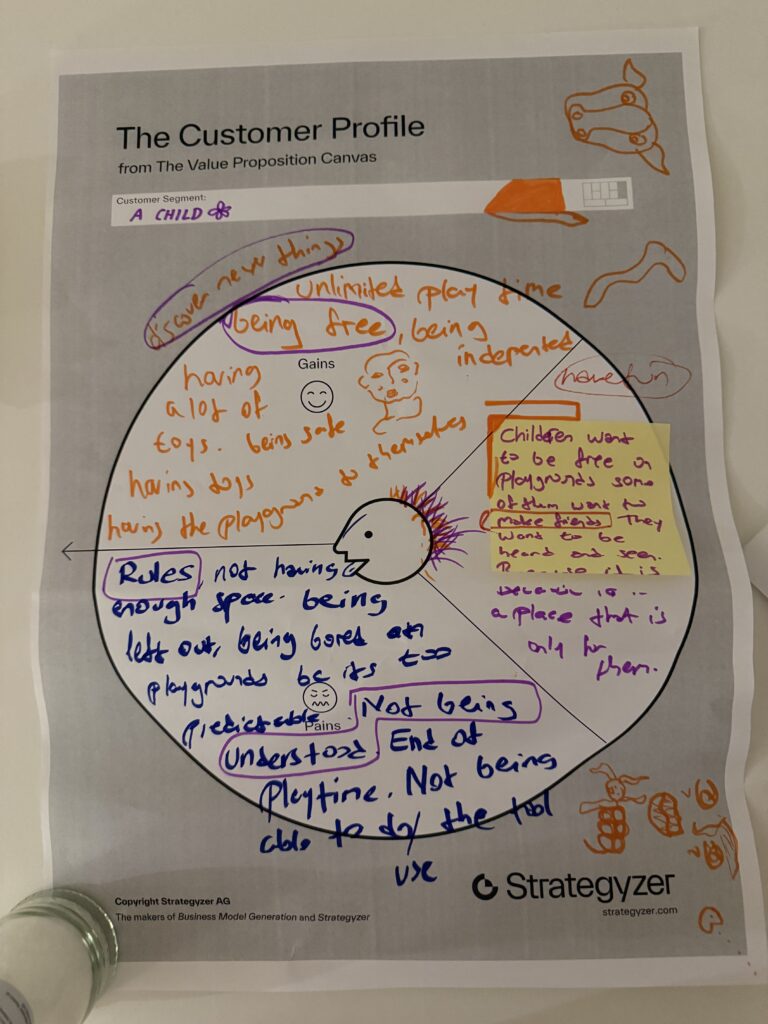
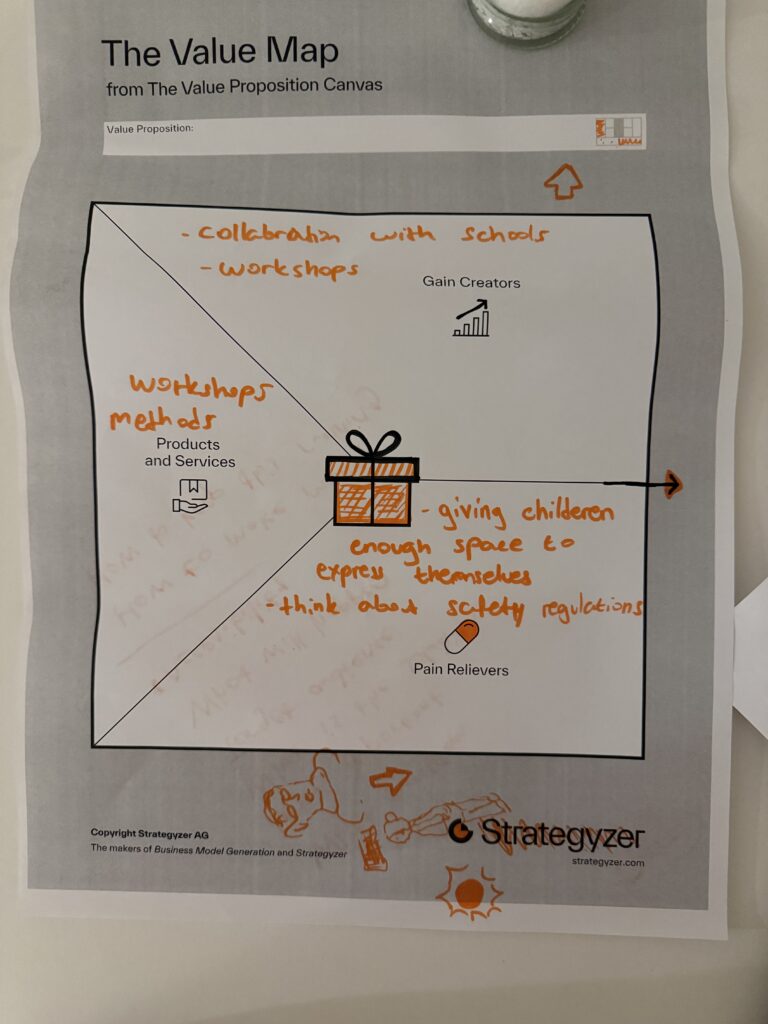
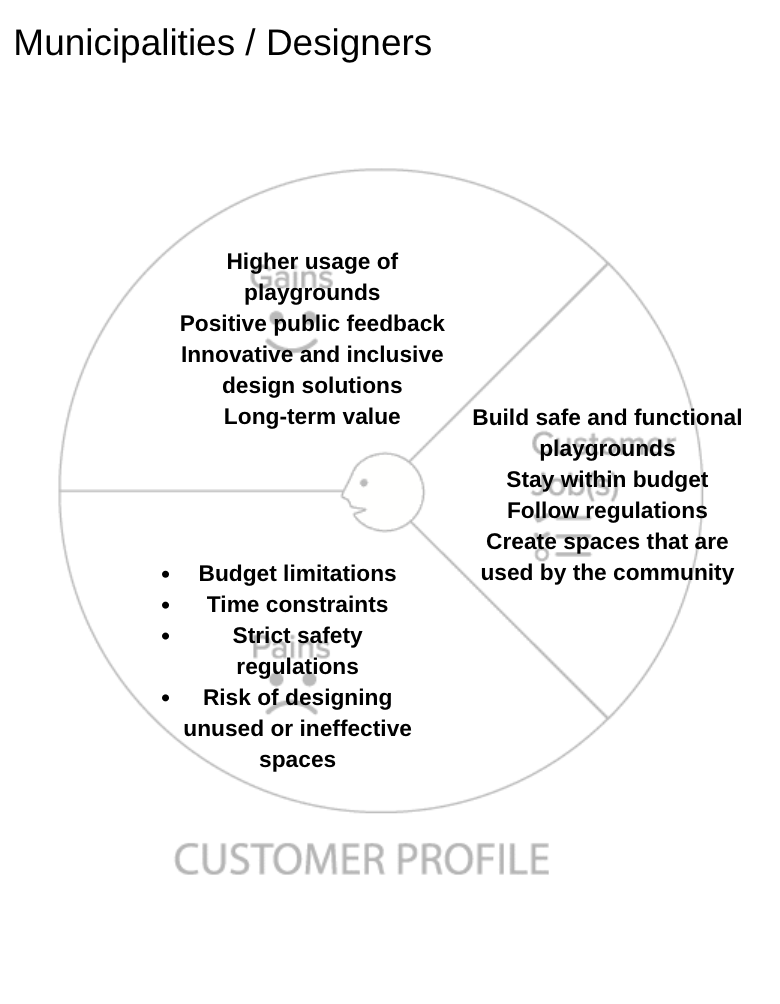
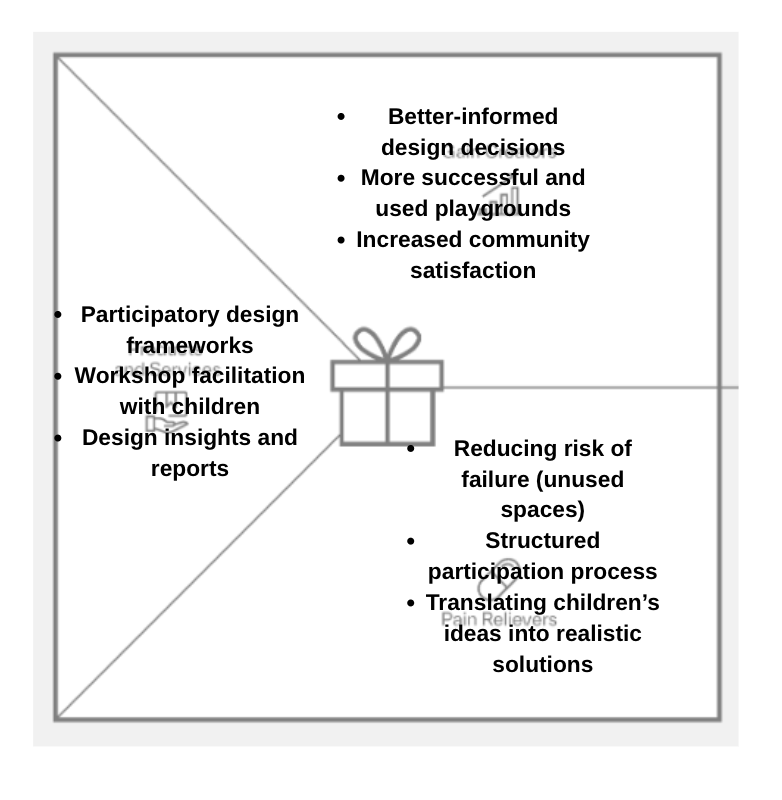
Business Idea Playground
What problem am I solving?
Most playgrounds are designed by adults, based on safety standards, budgets, and assumptions about children. As a result, they often become predictable, restrictive, and sometimes even boring.
From a child’s perspective, the challenges are different:
- Not enough freedom or space
- Too many rules
- Feeling excluded or not heard
- Limited opportunities to explore or discover
Playgrounds are supposed to be spaces of joy, but they often fail to reflect what children actually want: freedom, creativity, and a sense of ownership.
Why should we care?
This matters because playgrounds are not just physical spaces—they are environments where children develop socially, emotionally, and creatively.
When children are not included:
- They spend less time in these spaces
- They feel less connected to them
- Their needs and ideas are overlooked
But when they are included, something shifts. Playgrounds become more engaging, more meaningful, and more used. They stop being just “installed structures” and start becoming lived experiences.
What is the solution and how does it work?
My approach is to introduce participatory design methods, especially through workshops with children.
Instead of asking children to adapt to a finished design, the process invites them to:
- Express ideas through drawing, storytelling, and play
- Share feelings about existing playgrounds
- Imagine new possibilities
These workshops act as tools that translate children’s thoughts into design input. At the same time, the process still considers real-world constraints like safety regulations and feasibility.
So the solution is not a single playground design—but rather a design process:
→ one that creates space for children to be heard
→ one that balances creativity with structure
Who is the target audience?
The primary “users” are children, but the system involves multiple stakeholders:
- Designers and urban planners
- Schools (as collaborators)
- Parents and caregivers
- Municipalities
In this sense, children are both participants and beneficiaries, while institutions act as enablers of the process.
What is going to happen? (Change & Impact)
If children are included in the design process:
Before:
- Playgrounds are standardized and repetitive
- Children feel disconnected
- Design decisions are top-down
After:
- Playgrounds become more diverse and engaging
- Children feel ownership and belonging
- Spaces are used more actively
Bonus: How could this create value?
This approach could evolve into a service or framework:
- Workshops organized with schools and municipalities
- Participatory design toolkits for designers
- Consulting for inclusive playground design
NIME Article Review; PlaySoundGround, An Interactive Musical Playground
While reading about PlaySoundGround, I was struck by how a seemingly simple idea—combining sound and play—can completely transform the playground experience. The project turns familiar playground equipment into interactive musical instruments, where physical movement directly produces sound .
At first glance, this idea feels almost obvious. It made me question why more playgrounds are not designed in this way. If play is already based on movement, rhythm, and interaction, connecting it to sound seems like a natural extension. Yet, in most traditional playgrounds, this potential remains unexplored.
What I found particularly interesting is how the project reveals the relationship between playing and play. As the authors describe, both involve creative interaction within physical and social constraints . By making this connection explicit, the playground becomes more than just a physical space—it becomes an interactive, expressive environment.
Another aspect that stood out to me was that the playground was scaled for adults. This shift challenges the common assumption that playgrounds are only for children. Extending such experiences to adults opens up new possibilities for interaction, creativity, and social engagement. It suggests that play is not limited by age, but rather by how spaces are designed.
Overall, this project made me reflect on how small design interventions can unlock entirely new experiences. Even a simple addition like sound can make playgrounds more engaging, interactive, and meaningful. It also reinforces my interest in designing participatory and playful systems that invite users to actively shape their own experiences.
D&R- Accessibility and Barriers (3/3)
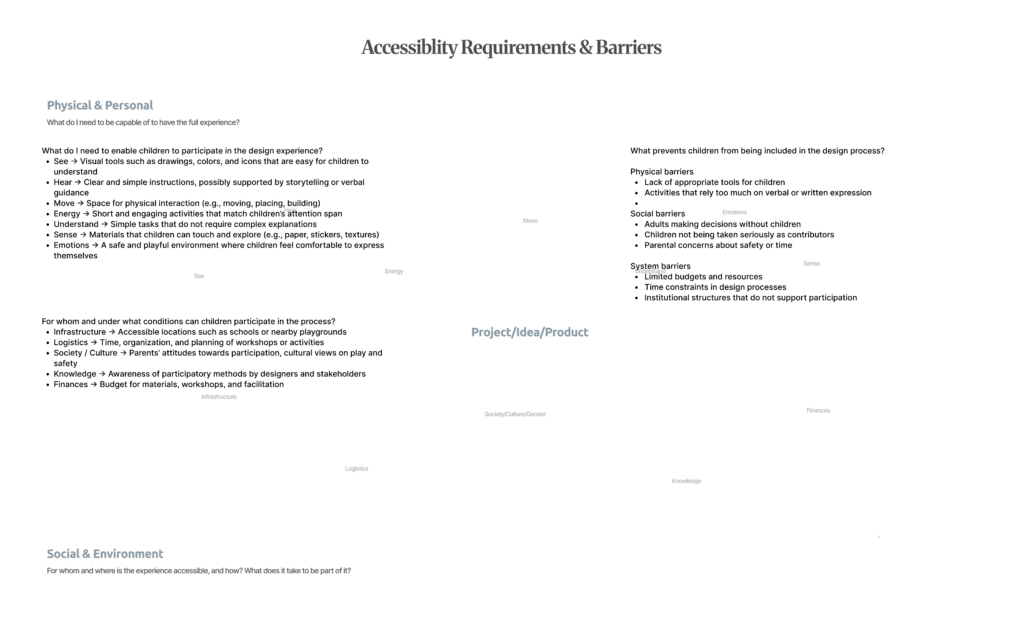
On a physical and personal level, participation requires tools and environments that match children’s abilities and ways of expression. Visual materials, simple instructions, and tactile elements such as stickers or drawing tools help make ideas more understandable and engaging. Equally important is creating a safe and playful atmosphere where children feel comfortable expressing themselves. Participation is not only about capability, but also about emotion and confidence.
At the same time, participation is shaped by broader social and systemic factors. Access to appropriate spaces, time for workshops, and available resources all influence whether children can be included. Cultural attitudes towards play and children’s roles in decision-making also play a significant part. In many cases, adults still dominate design processes, limiting children’s involvement.
Identifying barriers made this even more evident. These barriers are not only physical, such as the lack of suitable tools, but also social and institutional. Time constraints, limited budgets, and established decision-making structures often prevent participatory approaches from being implemented. Additionally, children are frequently not taken seriously as contributors, which further reduces their involvement.