Warning: There will be some spoilers for the animated Spider-Man movies, don’t read if you haven’t watched it
In a previous blog post the aspects of contrast were discussed. One of these aspects talked about the change of art styles. An art style change may occur to separate present and past of a character. A different subject to art style changes happens in combination with space. Specifically, if the narrative depicts different dimensions.
Spider-Man – across dimensions
The most popular and well known example of different art styles for other dimensions are the Sony Spiderman movies. In the first movie Spider-People from other dimensions end up in Miles Morales’ world. Each one of them with their own art and animation style. A few characters such as Peter Parker and Gwen share a similar style. One plausible reason for this is that their worlds are similar, thus they themselves are. Another reason could be to surprise the viewer. Gwen is established as a character at the beginning of the movie before the plotline of different dimensions. Therefore, a too unique style would have either spoiled or confused the viewer. Later in the movie, when the other Spider-People are introduced, the viewer has had time to familiarize themselves with the concept of multiverses and other dimensions. Seeing a 2D animated character in a 3D movie is at this point less surprising and offers a visual contrast to the world around strengthening the concept of multiverses.
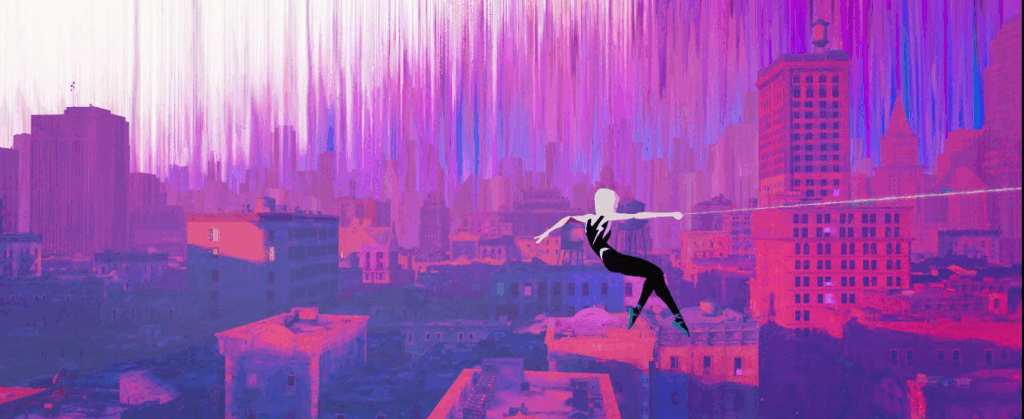
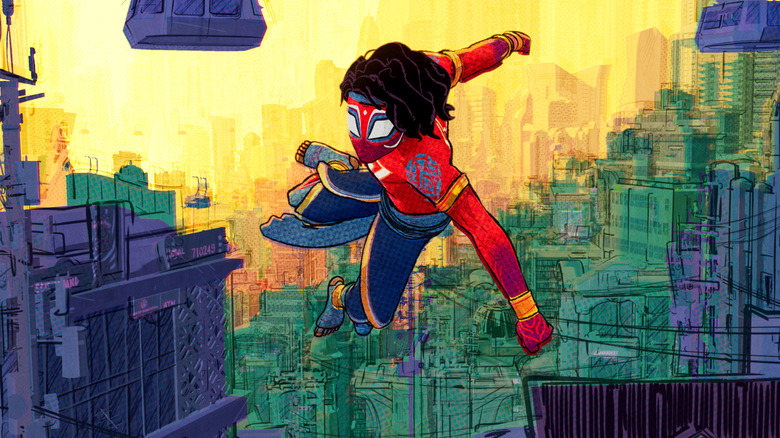
The first movie took place, for the most part, in Miles Morales’ dimension. Therefore, the art style changes were only present in the characters themselves. In the second movie, however, the narrative lead outside of the established dimension and dove into the multiverse. As a style concept the producers wanted the movies to look like a comic book, honouring the source material in the process. Now with new dimensions in mind, they decided to look at new art styles as well. The first dimension the viewer dives into is Gwen’s universe. The creators decided on a look like watercolour paintings. Gwen’s universe was not the only visited dimension. For the most part they all had their unique style. With this the viewers were provided with an aid to know where the movie was currently taking place. Now that the viewers have this confidence in their surroundings, the creators can use this as a story device. When the viewers see a dimension, which looks and feels like Miles’ world, they assume it is his. Therefore, at the end not being in Miles’ universe ends up being a surprising plot twist.
Other dimensions and their depictions
The theme of other dimensions or multiverses is not a new one. For example, in the movie “Pleasantville” from 1998 the main characters travel into their favourite TV-series. However, the contrast is limited to a switch from coloured to black and white. In “Tron” from 1982 the main characters land in a Computerworld. Fitting to that the scenes in the computer the creators are using a lot of CG, creating a contrast. In Marvel as well as DC Comics traveling through the multiverse is a common occurrence. In “Doctor Strange: Multiverse of Madness” shows traveling through many unique dimensions in a quick sequence, which span from close to ours to colour splashes or comic book styled worlds, just to name a few. The switches happen fast and are used to create disorientation because of the little time spent in each world. The viewers don’t have enough time to adjust. Another example of a rapid style changes, though not directly with dimensions is a scene from “Gravity Falls” were Dipper and Wendy travel through the bubbles of madness, which leads to various style changes. Similar to the Doctor Strange scene the goal is to confuse and overwhelm the viewers.
Conclusion
Changing styles can help viewers to orient themselves in movies with different dimensions or realities. It creates a clear cut between the familiar world and the new unknown. If the dimensions are very similar to the established one some confusion might occur, which can be used as a plot device like in “Spider-Man – Across the Spiderverse”. A very quick change of dimensions and art styles can have a disorientating result.
