About the Book
The book was written by the zoologist Dr. Arik Kershenbaum, who’s also a member of the international board of advisors for METI.org, a think tank on the topic of Messaging Extra Terrestrial Intelligence. The book is an exploration of what aliens could be like based around what we know about our current eco-system.
Aliens, Animals and Alien Animals
After giving a brief insight into the topic – what the current position of science is, what we can infer about aliens with our knowledge of zoology on earth, the book goes into the discussion of what is common in life on earth.
Kershenbaum declares that “If the nature of the universe is the same everywhere, then life conforms to the same rules everywhere.” Meaning there should be biological, universal laws, that form the absolute basics of what constrains life, and dictates its nature. If we find these, we can make general assumptions about life on other planets.
Form vs Function
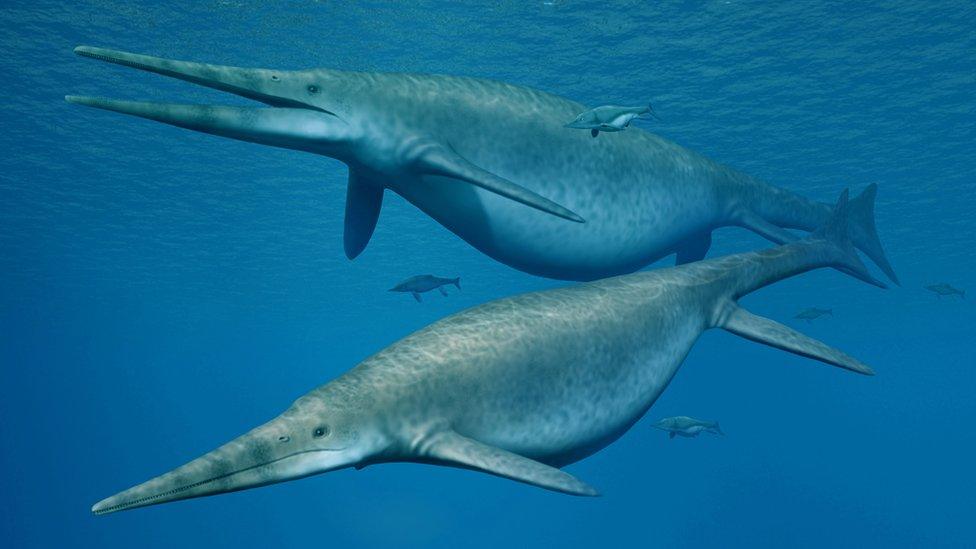
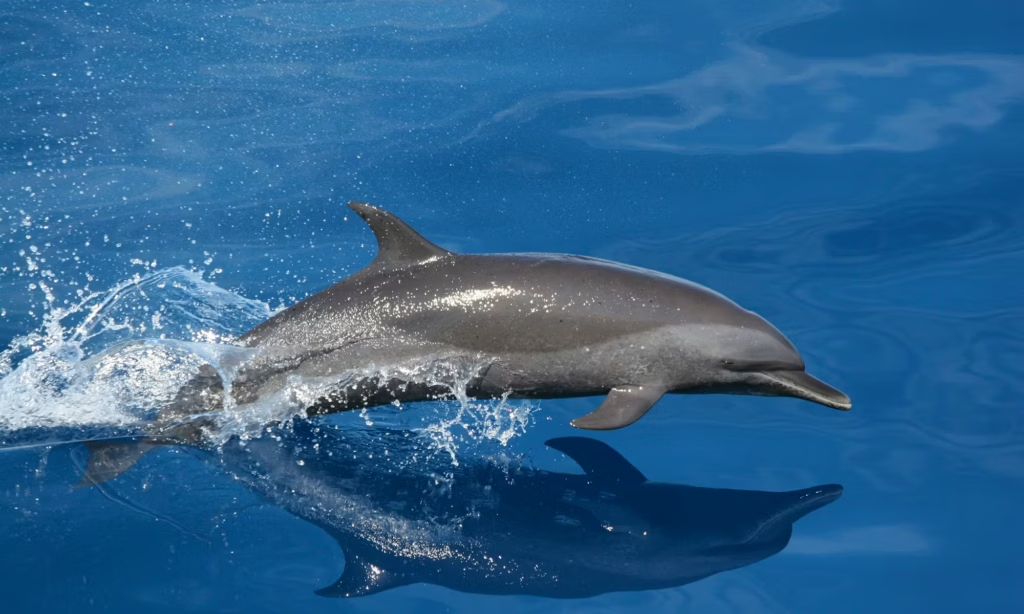
Convergent Evolution – Sometimes different animal species evolve into similar shapes because evolution tends to work similarly in similar environments (ichthyosaur and dolphin pictured here)
First, it’s important to separate form and function. Why are certain characteristics and behaviours prevalent? What purpose do they serve? What evolutionary role? Almost all the forms we see in animals have some function that improves the animal’s ability to live, thrive and survive.Sure, sometimes evolutionary “accidents” do occur, where a form has no proper function. But maybe it used to serve a purpose that’s not needed anymore.

Whales still have hip bones even though they don’t need them anymore because they used to be land mammals.
It’s also important to define what exactly an animal is. What separates us from other lifeforms like fungi for example? And in turn what would we perceive as an alien lifeform?
Movement
Animals need to move to survive, it’s an evolutionary pressure. Hunting, escaping predators, travelling from point A to point B (to find more food) – we need to move to achieve any of these things.
Communication
The senses – sight, hearing, smell, touch and taste – aren’t just for taking in our surroundings. Some of these signs and signals are directed at similar or other animals to communicate. The world is full of signals being transmitted through different physical means, though sight and sound are the most obvious to us. Even if alien life might communicate in completely different ways and wavelengths, they would still need to communicate somehow.
Intelligence
Humans and animal don’t outwardly share the same level of intelligence, but does that mean there is a qualitative difference between our cognitive abilities? And what if anything is fundamental to intelligence? What particular behaviours or abilities do we view as a sign of intelligence? Or should we focus on the brain itself? Its shape, size, the way it’s programmed? It’s not easy to measure intelligence, especially when we do it in a way that doesn’t just apply to humans. And if we can’t do it in a way that applies to life on earth, how could we possibly hope to measure the intelligence of alien life?
Instead, we should find a common basis. Fundamentally, intelligence is about solving problems. Energy, space, time are limited. So what’s the best way to make use these limited resources and gain an advantage over others? That’s what intelligence is.
Sociality
Humanity would not have come as far as it did if we hadn’t been social creatures. Building communities, advancing technology, none of it would have happened if we weren’t social animals. When applying the question of sociality to alien life there’s three things important to consider: Firstly, why do animals live in groups and what makes them actively participate? Secondly, which conditions will lead to cooperative societies and which might prevent them? And thirdly, what are the expected outcomes and consequences of this?
Information
We have talked about communication itself, but it’s also important to consider what kind of information lifeforms share and how much of it. Life or death can turn on the right or wrong piece of information for an animal; it’s a key factor in natural selection. Acquiring and transferring information, be it reliably or deceptively can be key to survival.
Language
Language is what separates us humans from animals. Every other feature like tools, culture, emotions, planning, even humour we share, but language is sole to us. Language allows us to glimpse into the minds of other people in a way we will never achieve with animals. It also shapes the way we think and makes us who we are. It drives and enables our ability to cooperate.
Language can’t be clearly defined, however. It has no clear-cut characteristics. We don’t even know whether language is an ability that a particular species either has or doesn’t have, or if some have more than others. We don’t know if language is a single thing or a structure shared by every civilization. Or maybe just an ability, a functionality, which could be implemented in any kind of way.
To understand what alien language could be like, first we must ask ourselves what language is on Earth. And whether this is how language must be everywhere else in the universe. Or if an alien language would be totally incomprehensible to us.
Biological Laws – What rules does all life abide by?
- Complex life evolves by natural selection.
- Adaptions happen for a reason and serve a specific purpose. Usually these purposes are finding food, avoiding becoming food, and reproducing.
- Organisms need to move to find food and avoid becoming someone else’s food.
- Senses are necessary to take in the world but also to communicate with other members of the species.
- The ability to solve problems is fundamental to life.
- Life thrives in social communities.
- Information is key, in every ecosystem, on every planet.
- Language allows for complex communication and is a sign of civilisation.
Sources
- Kershenbaum, Arik: The Zoologist’s Guide to the Galaxy. What Animals on Earth Reveal About Aliens – and Ourselves. UK u.a.: Penguin Books 2020 [E-Book]
