Okay, I’m wondering where I want to go with my research. Do I want to do something for neurodivergent people, or do I want to raise awareness among neurotypical people about what it’s like to be neurodivergent?
I have ideas and approaches for both directions, which I would like to discuss here one by one in the hope of being able to make a decision afterwards.
Direction 1: Tools for people with ADHD
The aim here is to make everyday life easier. As I mentioned in my last blog post, executive dysfunction is a big issue. Tasks can feel very daunting for people with ADHD, so it can help to break large tasks down into smaller subtasks.
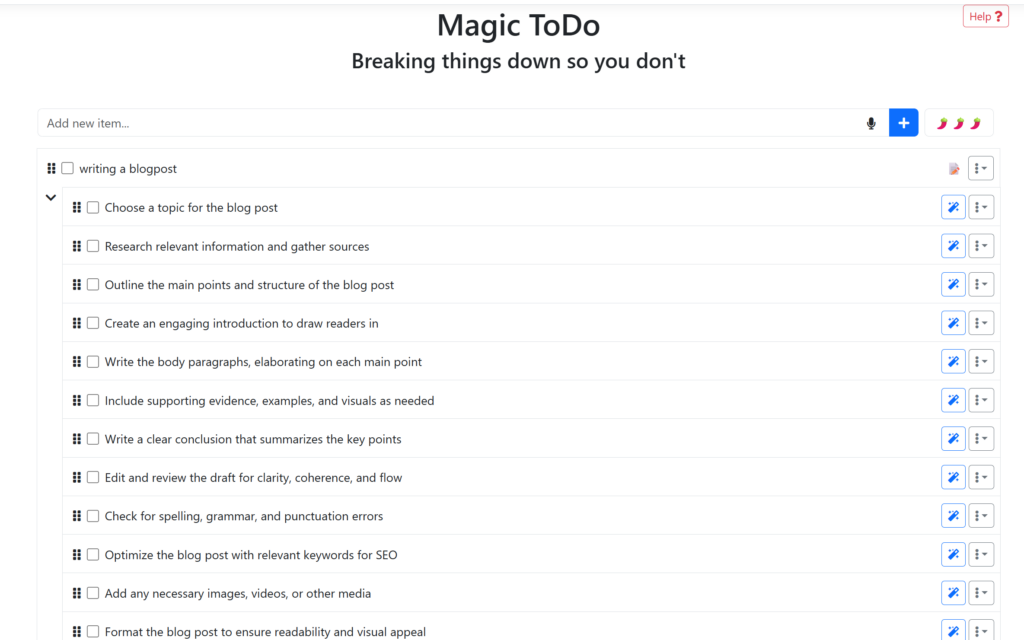
There is already a tool called gooblin.tools that breaks a large to-do list down into many small subtasks.
But here’s where it gets tricky: if I break a task down into twenty small steps, I suddenly have twenty tasks instead of one. For an ADHD brain, this can be just as paralyzing. You get lost in the details, the list seems endless, and your focus wanes. Real interaction design for neurodiversity must therefore go beyond simply “breaking things down.”
Where my research comes in: Three ways beyond the list
I ask myself: How can interfaces help us without overwhelming us with new information? In the specialist literature, there are strategies that I want to examine as design principles:
1. Adaptive scaffolding Instead of immediately showing the user all 20 subtasks, a system should only highlight the zone of next development. This means that I only ever see the next step. The interface keeps the rest of the list “invisible” in the background so as not to overload the working memory. Only when step A has been completed does step B appear.
2. Externalization & visual anchors Executive dysfunction often means that you cannot keep track of the time and sequence of tasks in your head. Design can act as an “external cognitive support” here.
• Instead of text: visual roadmaps or timers that show where I am in the process.
• Instead of lists: interactive boards that make priorities tangible through color or size.
3. Digital body doubling: An exciting approach from practice is “body doubling”. The mere presence of another person helps you stay in the flow. How can interaction design simulate this feeling?
• Through focus spaces where you can see that others are also working.
• Through interfaces that create a kind of “gentle presence” or social commitment without building up pressure.
It requires a balance that still allows for autonomy and does not come across as patronizing. A tool like this would have to function as a “breathing scaffold”: providing structure when task paralysis kicks in, but discreetly retreating as soon as you are hyperfocused,
It’s not about taking the user by the hand like a child, but rather making the interface flexible enough to adapt to the current cognitive load.
References & Further Reading
- Vygotsky, L. S. (1978): Mind in Society. The foundational work on the “Zone of Proximal Development” (ZPD). It explains why effective support (Scaffolding) must be placed just beyond a person’s current independent ability to help them reach the next level of action.
- Schmidt-Pott, H. (2024): Executive Dysfunction & The Action-Gap. A deep dive into why neurodivergent individuals often struggle to translate complex internal plans into physical steps. It highlights the specific need for tools that bridge this “initiation gap.” (Link)
- Bien-être Autiste (2023): Understanding Task Paralysis. This research discusses how “Choice Overload” and unorganized information lead to mental freezing. It advocates for reducing visible options to prevent the brain from becoming overwhelmed by its own to-do lists. (Link)
- Maier, G. (2024): Externalization and Body Doubling Strategies. An exploration of how external cues (visual timers, roadmaps) and the presence of others (Body Doubling) can bypass executive blocks and create a sustainable flow state. (Link)
Note: This text was developed with the assistance of artificial intelligence for research purposes and to refine the linguistic clarity and flow of the final draft.
