As a continuation of the last blog post, I would like to explain my findings about what works for advanced students, regarding the central research question of: How can we use interaction design to assist in the training of aerial silks, especially in enhancing people’s proprioception?
Besides what was already explained as best practices for beginners (which can also help some advanced students), the other strategies that I’ve found to be beneficial are as follows.
- 3D model miniature
Some teachers utilize novel methods such as 3D miniatures to explain figures and sequences, eliminating the need to go up in the silk, which when done repeatedly, takes a lot of physical energy from the teacher.
- Real-time communicator (through video or speech)
When up in the air, advanced aerialists find it helpful to have a second person (or even a video projection) to keep track of what the next move is, and either be able to communicate it through shared language (if there’s a second person), or through observational learning (if it’s a video).
- Reference to base knots and common language
Since advanced aerialist now have learned the names of the base knots and basic figures (footlock, kneelock, hip key, catcher’s pose, porter, star drop, etc.), when building new knowledge it’s more beneficial to fall back on this past knowledge, instead of relying on the beginner’s explanation methods.
- Analogies to other figures
In a similar manner to the past point, when learning a new skill in aerial silks, advanced students find themselves unconsciously relating them to past knowledge. For the figure shown in the picture, the unmethodological approach would be to explain it as “go upside down, hug one silk with one leg, keep grabbing it, and now use the hand that’s not on the wrapped silk to grab it from below and put it over your other leg, so that the silk is hanging in between your legs and toward the back.” Obviously, this unmethodological approach to explaining the knot is not sustainable, so advanced aerialist would translate it as follows:
- Go upside down = invert
- Hug one silk with one leg = make a half angel
- Everything else = make a catcher’s pose / as if you were doing a star drop
Or, even simpler, a more advanced aerialist would just explain it as “make a catcher’s wrap on one silk” (since it’s assumed that to do a catcher’s wrap you must either invert and make a half angel, or invert and hook).
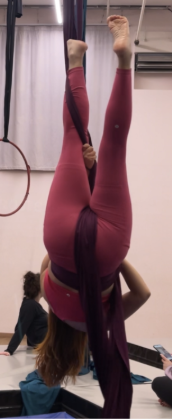
Own image.
–
Sources:
Own research.
