In order to better understand the interactions that take place in the game and in class, I examined interaction on a theoretical level and initially focused my research primarily on social interaction. Apart from the findings summarized below, I also looked at the principle of re-enactment or scenic understanding by Alfred Lorenzer and the associated transference and countertransference. However, due to its lack of relevance to the topic of physical education, I will refrain from elaborating on my findings in this blog article.
Forms of interaction
“Interaction (from Latin inter ‘between’ and actio ‘activity’, ‘action’) refers to the mutual influence of actors or systemsSocial interaction.” (Wikipedia: Interaktion. URL: https://de.wikipedia.org/wiki/Interaktion, last opened 07.02.2026)
Social Interaction
“Social interaction refers to processes of mutual influence, e.g., through communication and social reciprocal exchange relationships between individuals and social groups (social influence), as well as the resulting change in, for example, behaviors and attitudes (attitude change).” (Wikipedia: Interaktion. URL: https://de.wikipedia.org/wiki/Soziale_Interaktion, last opened 07.02.2026)
The term communication is sometimes used as a synonym for social interaction, but communication can also be one-sided, i.e., only from the sender to the receiver, whereas interaction always involves both parties. It therefore involves a response from the receiver to the content sent or parts thereof. Interaction can therefore be described as a symmetrical process and communication as either a symmetrical or asymmetrical process. [1]
Theme-centered interaction according to Ruth Cohn
Thematic-centered interaction (TCI) is a model for working in groups that was developed in the mid-1950s by American psychoanalyst and psychologist Ruth Cohn and therapists Norman Liberman, Yitzchak Zieman, and other representatives of humanistic psychology. Its goal is to promote social learning, personal development, and progress in the subject area [2]. It is used in the fields of education, leadership, social work, counseling, and social engagement. [3]
“TCI was developed against the theoretical backdrop of psychoanalysis, group therapy, and humanistic psychology, and takes into account experiences from Gestalt therapy and group dynamics.” (Wikipedia: Themenzentrierte Interaktion. URL: https://de.wikipedia.org/wiki/Themenzentrierte_Interaktion, last opened 08.02.2026)
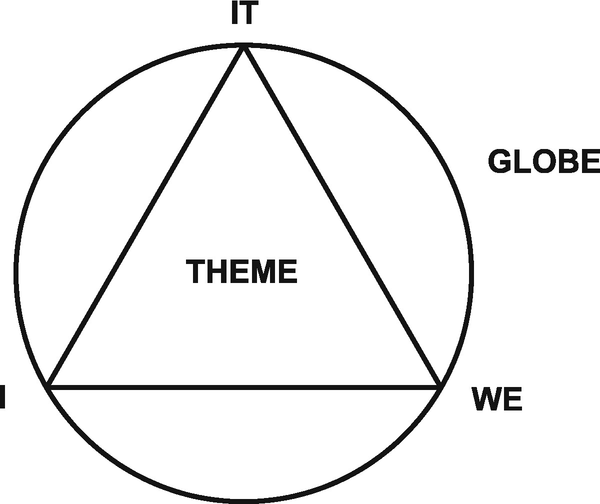
According to theme-centered interaction, there are four factors that influence interaction: the individuals (I), their relationships (we), the shared task (it), and the environment (globe). For successful interaction, it is essential that these factors are in balance. [3]

TCI is also based on a humanistic worldview that can be formulated in three axioms:
“1. Human beings are psycho-biological entities. They are also part of the universe. They are therefore both autonomous and interdependent. The more aware individuals are of their interdependence with everyone and everything, the greater their autonomy.
2. Respect is due to all living things and their becoming (and passing away). Respect for growth requires evaluative decisions. The humane is valuable, the inhuman threatens value.
3. Free decision-making takes place within conditioning internal and external boundaries; expansion of these boundaries is possible.”
(Ruth Cohn Institut: Themenzentrierte Interaktion. Werte und Menschenbild. URL: https://ruth-cohn-institute.org/themenzentrierte-interaktion-tzi/, last opened 08.02.2026)
Another key aspect of theme-centered interaction is that there is a theme that sets the goal for the group and is formulated in such a way that all group members can identify with it. The group leader has a moderating role, but is also a participant, so that cooperation on an equal footing can develop. [3]
The two postulates of TCI:
“1. The chairperson postulate: Lead yourself—become aware of your inner and outer reality, use your senses, make decisions, and take responsibility.
2. The disturbance postulate: Disturbances take precedence – obstacles, concerns, and conflicts require attention and should be taken seriously and dealt with so that the group remains capable of working and learning.”
(Ruth Cohn Institut: Themenzentrierte Interaktion. Postulate. URL: https://ruth-cohn-institute.org/themenzentrierte-interaktion-tzi/, last opened 08.02.2026)
Furthermore, the following rules are formulated in TCI:
1. Represent yourself in your statements; speak using “I” rather than ‘we’ or “one.”
2. When you ask a question, explain why you are asking and what your question means to you. Express yourself and avoid interviewing.
3. Be authentic and selective in your communications!
4. Refrain from interpreting others. Instead, express your personal reactions.
5. Be cautious with generalizations.
6. When you say something about another person, also say what it means to you.
7. Side conversations take precedence. They are disruptive and usually important.
8. Only one person at a time, please!
(Ruth Cohn Institut: Themenzentrierte Interaktion. Hilfsregeln. URL: https://ruth-cohn-institute.org/themenzentrierte-interaktion-tzi/, last opened 08.02.2026)
Interaction and pedagogy
Interaction serves to socialize individuals and plays a major role in psychosocial development. In social situations, skills such as role distance, empathy, tolerance of ambiguity, and identity representation can be acquired. In an educational context, a distinction is made between actions among peers and interaction between children and adults. Adults should create opportunities for children to interact. [1]
Sources
[1] Wikipedia: Interaktion. URL: https://de.wikipedia.org/wiki/Soziale_Interaktion, last opened 07.02.2026
[2] Wikipedia: Themenzentrierte Interaktion. URL: https://de.wikipedia.org/wiki/Themenzentrierte_Interaktion, last opened 08.02.2026
[3] Ruth Cohn Institut: Themenzentrierte Interaktion. URL: https://ruth-cohn-institute.org/themenzentrierte-interaktion-tzi/, last opened 08.02.2026