After creating the first prototype, I added more pages:
pages for song recommendations, including the title, artist, who recommended it, and why I love this song so much
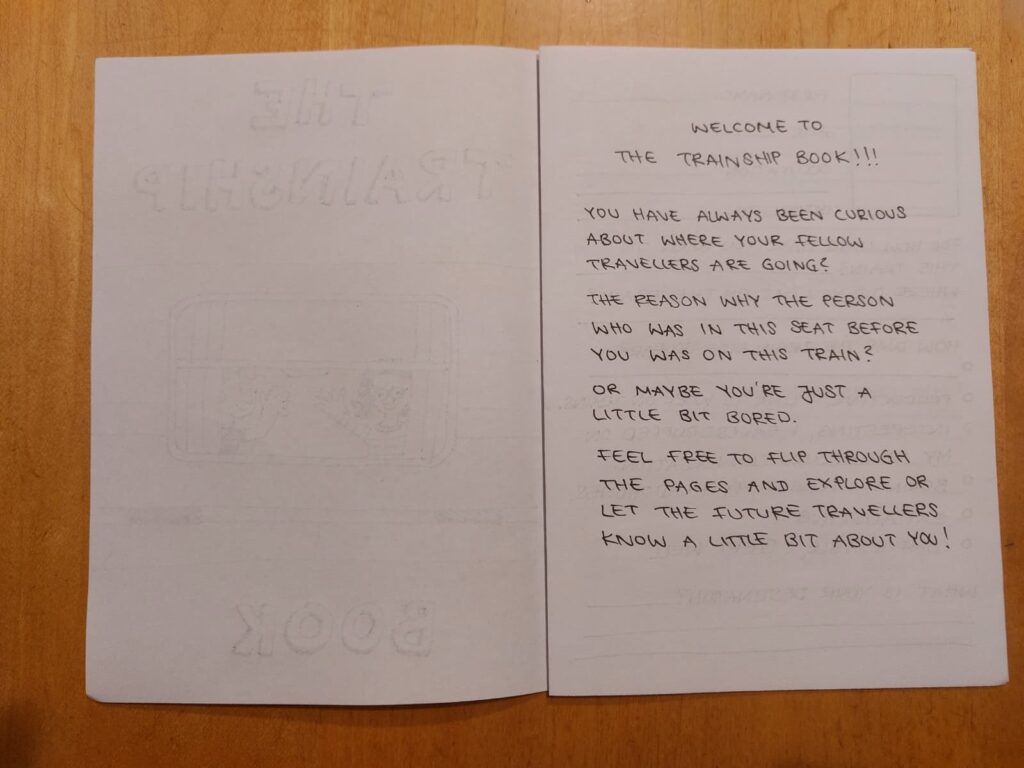
a cover
interactive pages to fill out together
The interactive pages are meant for people to fill out togehter. They are placed in a horizontal layout so both persons can write at the same time. Person A fills out the spread about person B based on assumptions and person B does the same thing for person A. After that they can compare if what they thought was true. This allows them to get to know each other on a fun and playful base and start a follow up conversation about it if they want to engage with each other even more. This interface facilitates the interaction on several levels: Not only is the barrier to approaching a stranger very low, but the interaction also has a clear beginning and end, which makes it more manageable and predictable. In addition, in my experience, people are generally curious to know what others think of them, and they enjoy observing others and coming up with stories and assumptions about them. What could potentially have a negative impact on the experience are negative stereotypes and prejudices, which might be hurtful to some people. I believe it’s essential to emphasize respectful behavior in the instructions for the interactive pages.
I decided to expand the first prototype rather than redesign it completely because the core concept had already proven to be working. The initial prototype adressed one of the main challenges I had identified: lowering the barrier to approaching strangers on long-distance train journeys. Instead of starting from scratch, I wanted to build on this and explore how the experience could become more engaging.
In my previous blog posts, I’ve tried to explore the topic as broadly as possible and cover everything that came to mind regarding observation. Because the scope of the topic has become so broad, there are still a few open questions that I’d like to address over the summer. Here is a list of the questions and sub-topics that came up during my research but that I haven’t been able to answer yet, so I don’t lose them:
the psychological effects of constant observation
the concept of social presence
feeling observed vs. feeling seen
voyeurism and stalking
observation amongst women
the male gaze
the objectification of women and it’s consequnces in relation to being observed
digital observation and data collection
Big Brother (?), not sure yet
observation in regimes (e.g. DDR)
observation in modern literature (George Orwell: 1984, Dave Eggers: The Circle)
smart glasses and how they impact the feeling of being observed
regarding hidden cameras in public restrooms:
Who is responsible?
How can the installation of hidden cameras be prevented?
What role can design play?
Analyzing interactions on public toilets -> How can they be improved so women feel saver?
Can public spaces ever feel truly private?
Do hidden cameras create distrust for public spaces?
What does it mean if people cannot return the gaze of their observer?
Planning future research
My main goal is to do more research on the topics listed above to find out what aspect of observation interests me most. I think that, by focusing on observation as a form of passive interaction and on hidden cameras, I’ve already identified two key areas that interest me a lot and that I’d like to explore further. Still, it would certainly be helpful to gain a general overview of the entire subject area.
In october / november I want to narrow the topic down to a specific research question that I can then focus on.
Literature collection
To get a head start on my research for the summer, I’ve already begun collecting relevant literature. I used ChatGPT to generate a list of keywords, which I then used to search the OPAC of the Augsburg University Library. I’ll also need to order some of the books through the Bavaria-wide interlibrary loan service. Since I’ll be spending most of the summer break at my parents’ house, this was the most logical choice for me, as it’s only 40 km from there to Augsburg, giving me easier access to the literature on site. Nevertheless, I also found a few books at the library in Graz that I’m sure I’ll be able to get my hands on as well. Here is a list of the works I was able to find during my initial search:
Spiekermann, Sarah (2016). Ethical IT innovation: a value-based system design approach. CRC Press, Taylor & Francis Group.
Klar, Manuel (2012). Datenschutzrecht und die Visualisierung des öffentlichen Raums. LIT.
Öztürk, Fatih (2022). Self and subjectivity in the twentieth century dystopian fiction. Cambridge Scholars Publishing.
Hijmans, Hielke (2016). The European Union as guardian of internet privacy. Springer
Kumpf, Benjamin (2017). Smart Cars – eine datenschutzrechtliche Analyse. Verlag Dr. Kovač
Richter, Volker (2009). Beobachtet und bewertet werden. LIT
Carah, Nicholas (2021). Media & society: power, platforms, & participation. SAGE
Klamt, Martin (2007). Verortete Normen: öffentliche Räume, Normen, Kontrolle und Verhalten. VS Verl. Für Sozialwiss.
Lefkeli, Deniz (2026). The Corporate Gaze: The Impact of Data Collection on Consumer Behaviour. Palgrave Macmillan
Schmitt, Martin (2026). Internet im Kalten Krieg: Eine Vorgeschichte des globalen Kommunikationsnetzes. transcript
Goffman, Erving (2009). Interaktion im öffentlichen Raum. Campus Verlag
Goffman, Erving (2014). Verhalten in sozialen Situationen: Strukturen und Regeln der Interaktion im öffentlichen Raum. Birkhäuser
Hahl, Olaf (1986). Alltagskommunikation im öffentlichen Raum: verbale Begegnungen zwischen Fremden. [Dissertation, Freie Universität Berlin West]
I’ve highlighted the most important sources in bold; the others may only be relevant in a marginal way.
I went to the library of the University Ulm yesterday to get my hands on the book “Überwachen und Strafen” by Michel Foucault, but I wasn’t able to find it, When asking for it at the front desk I was told that I have to order it first, because it’s not accessible in the public shelves there. Luckily, my sister studies at the university of Ulm, so she will order it for me and also borrow it so I can read it at home. But it will take a while until I get it, so I won’t be able to read it before the deadline for these blogposts. I will have enough time to read through it though during the summer break.
The Trainship Book
Unfortunately, I was sick during both “Bring Your Prototype” sessions this semester, and in the days leading up to them as well, so I didn’t sit down to develop my first 30-minute prototype until Friday. For this, I went back to the long-distance train ride setting, since I’d already had an idea for it some time ago.
The idea is to create a kind of “friendship book” that passengers can fill out during the train ride. It features questions that everyone might secretly ask themselves while observing their fellow passengers on the trip. Train passengers constantly construct stories about the people around them. They infer destinations, relationships or emotions based on clothing, luggage or behaviour. The friendship book shifts this process from imagination to voluntary self-disclosure. Instead of guessing, travellers can decide which parts of their story they want to reveal. It serves several purposes at once: On the one hand, the book is an interesting way to pass the time on long trips; on the other hand, it satisfies people’s natural curiosity without requiring direct interaction. The book can still serve as a conversation starter without forcing social interaction.
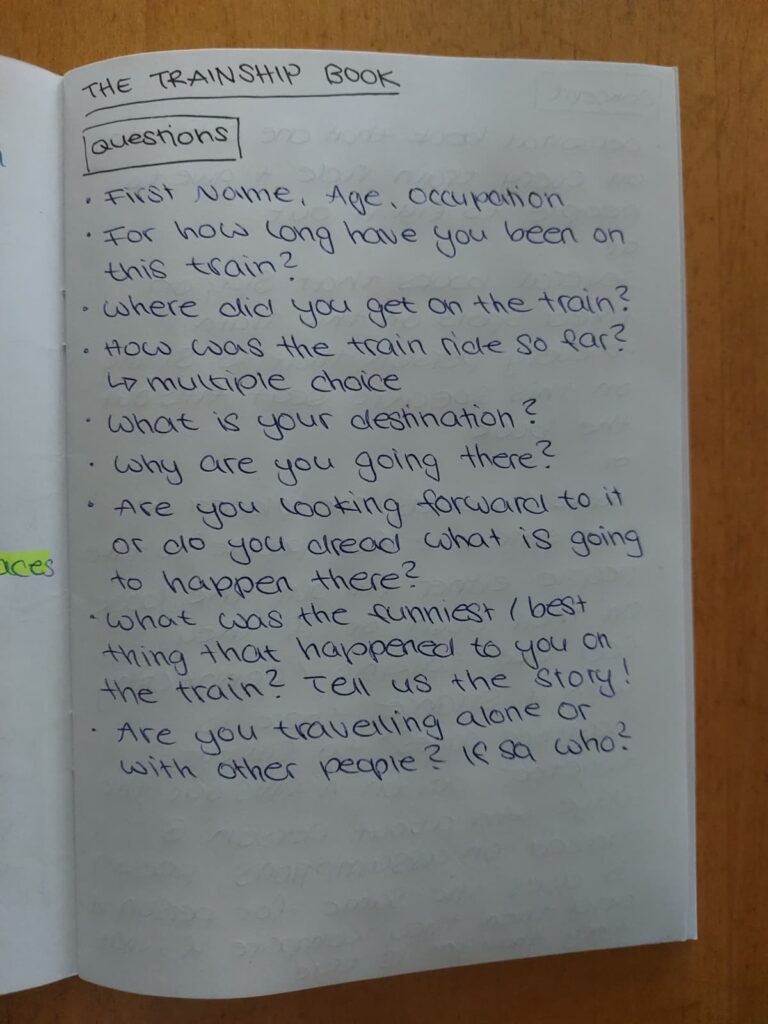
I’ve come up with the following questions for the book:
The Layout
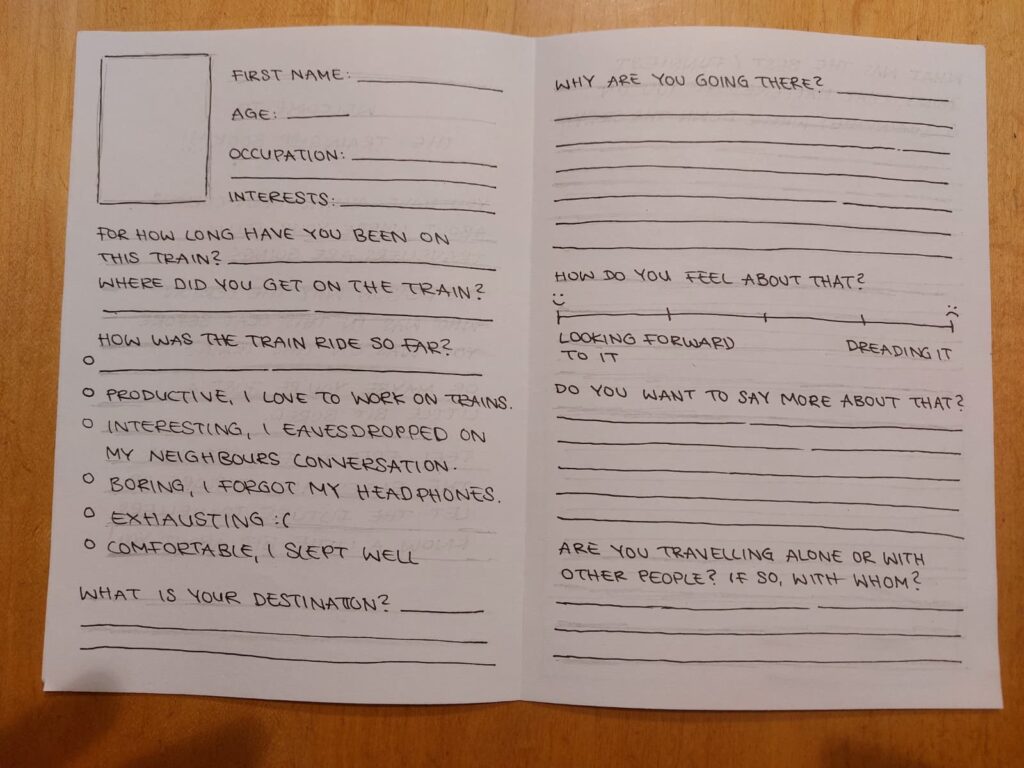
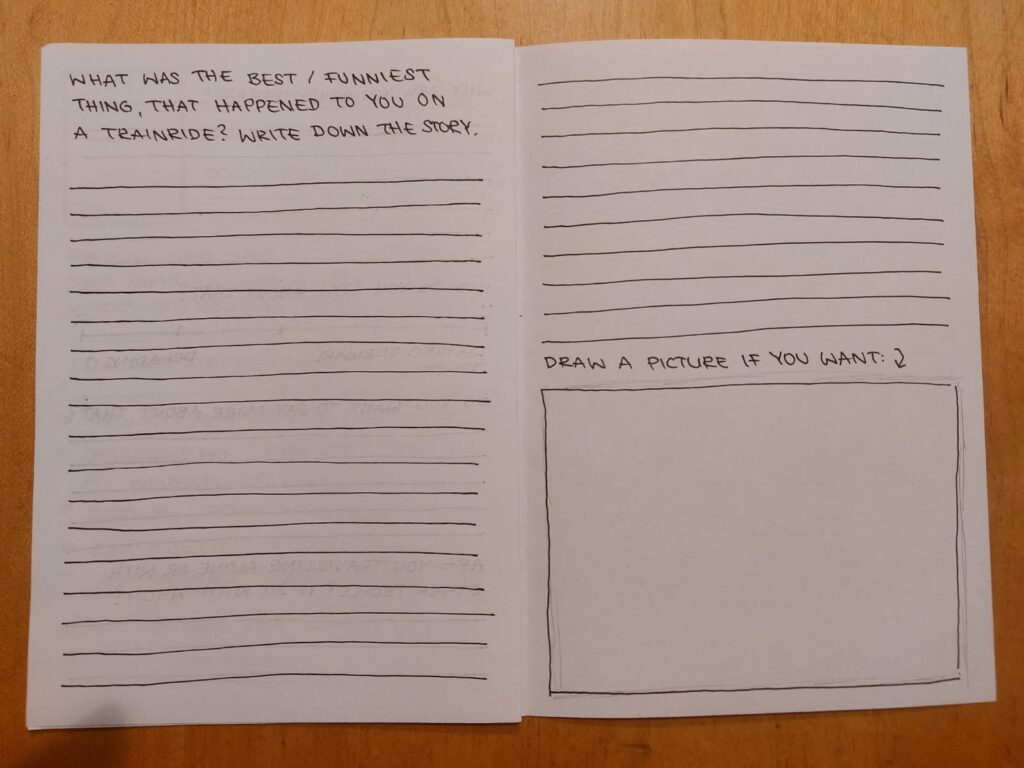
There will be a short introduction text on the first page, explaining the concept of the book and how it’s meant to be used. Then there will be double pages for the persons to fill out with questions related to their trip. The personal section on top will be very short, but I still decided to include it, so the readers would get a rough image about who that person is. After that it starts with some basic questions and goes more into detail when it comes to the reason why the person is travelling to this destination and how what is going to await them makes them feel. I think if the travellers feel comfortable to be honest here, it could create a sense of authenticity and connection, if other people find themselves in similar situations or struggeling with the same anxious thoughts, for example. Then there will also be some pages where people can tell stories about the best or funniest thing that happened to them on the train. This could as well be very entertaining to read. I also thought about including a spread where people can recommend songs to each other which they then can listen to while on the train. It might also be nice to sort the songs into different categories depending on the current mood, e.g. “Listen to this song when you are sad.” or “Listen to this song when it’s raining outside”.
The Prototype
I did a quick 30-minute prototype of the three spreads I described earlier. I tested it on the way back from Ulm, but I forgot the filled out version at my sister’s place, so I will have to ask her to send me a picture of it.
The Concept
There is different options when it comes to where the book is going to be placed / who owns it.
OPTION 1: The book belongs to an individual person and they can bring it on train rides whenever they feel like it and then just ask people to write in it. That way they “collect” friends on their journays over time. This might be a good option for more extrovert and outgoing people, but also for people who wish to engage more in conversations with strangers, as it causes active social interaction. This is also the option that I tested on my way to Ulm on the weekend.
OPTION 2: There is several books on the train that stay on fixed spots, so each person sitting in that specific seat would fill out the book. That way people would find out things about the people that were in the exact same place in the past, which could be also very interesting, since it causes asynchronous interaction.
OPTION 3: the books would be placed at the entrances for people to take and give to other people. These books would be more like booklets, only for this one trainride to keep as a memory afterwards. What is interesting about this option is that it connects more than two people on the same train ride.
My favourite would be option 2, since it’s the most appealing to me personally. I would enjoy to read about the people who were there before me. Apart from that I think one of the advantages is that after a while there is many filled out pages to read through, so it might be more interesting. Additionally, it serves as a temporary pastime for many people and is therefore more sustainable than individual books, which may eventually be forgotten or end up in the trash because they’re too much of a burden to carry while traveling.
The Testing
I found it easier to talk to someone on the train this time, because I had a “valid” reason for it. I realised that the prototype did not only test the book itself, but also gave me permission to approach a stranger as a way of “social excuse”, lowering the barrier that usually prevents conversations between passengers.
The journey from Augsburg to Ulm only takes around 45 minutes, which made the situation feel less intimidating, as I knew I would be leaving the train soon anyway if the interactionbecame awkward.
There was a girl around my age sitting next to me, so after briefly explaining my project, I asked if she would be willing to fill out the prototype pages I had prepared the evening before. Although I was a little nervous at first, but I soon realized that we were getting along quite well. While she was filling out the pages, we started talking about our experiences of travelling by train and realised that neither of us would usually start a conversation with a stranger unless we were approached first.
She told me that she found the questions interesting and enjoyed answering them. Nevertheless, I plan to conduct a small survey to evaluate which questions people find most interesting and whether some should be revised or replaced.
Overall, the prototype confirmed that the friendship book can work as an effective conversation starter. It provides a clear reason to approach someone while still making it easy for the other person to decline without feeling uncomfortable.
I wondered whether the book functions more as a social mediator than as the actual activity itself. In this particular situation, I think the physical object was probably more important than the questions it contained. Having a tangible artefact provided a natural reason to approach someone and made starting a conversation feel much less awkward. The questions mainly served as a gateway to further discussion about train journeys and interactions with strangers. However, I believe this would change if the books became a permanent feature on trains, as proposed in option two. In that case, the content of the questions would likely become much more important, since passengers would spend more time reading previous entries and contributing their own thoughts.
Would the same conversation have happened without the physical book? Probably not, or at least it would have been much more difficult to reach that point. Without the book, I would most likely have had to start with conventional small talk before changing the topic to how someone feels about talking to strangers.
Limitations
Of course, this was only a very small test, so I cannot draw any general conclusions from it yet. I only asked one person to participate, who also happened to be around my age. She was open to talking to me, so the situation was probably easier than it could have been with someone else. I also tested the prototype during the day on a relatively short train ride. I think the results could be different on a longer journey, in a crowded train, or with people who are in a hurry or simply do not want to interact. If I want to stick with the idea of the trainship book I will definitely have to test the concept with more people before I can properly evaluate it.
Since my last blog post, I’ve been thinking about the issue of women and observation. What sparked this was an Instagram post I saw a few days ago that made me very angry. It was about a hidden camera found in the women’s restroom at a climbing park that had been used to film the private parts of women and girls. Some of the affected women banded together and turned the camera over to the police. An investigation against persons unknown is currently underway. Unfortunately, I couldn’t find the post later on, and there’s not much information about it online either. I found a similar case on the website of the Saxon Mountaineering Association [1], but I’m not sure if it’s the same one. I did some research on the legal situation for hidden cameras on toilets, because I remember that the post said something about the legal situation not being very clear, and found that in Germany § 201a StGB and § 184 k StGB apply for such cases [2].
§ 201a StGB constitutes a violation of one’s most private sphere and of personal rights through the taking of photographs [3]. The text in German reads as follows:
“ Mit Freiheitsstrafe bis zu zwei Jahren oder mit Geldstrafe wird bestraft, wer (1.) von einer anderen Person, die sich in einer Wohnung oder einem gegen Einblick besonders geschützten Raum befindet, unbefugt eine Bildaufnahme herstellt oder überträgt und dadurch den höchstpersönlichen Lebensbereich der abgebildeten Person verletzt (…)“ § 201a Absatz 1 StGB [3]
Which translates to: Any person who (1) without authorization takes or transmits an image of another person who is in a dwelling or a space specially protected from view, thereby infringing upon the highly personal sphere of the person depicted, shall be punished by imprisonment for up to two years or a fine.
§ 184k StGB refers to the violation of a person’s private parts through photography [4]. This is the original text from StGB:
“Mit Freiheitsstrafe bis zu zwei Jahren oder mit Geldstrafe wird bestraft, wer
1. absichtlich oder wissentlich von den Genitalien, dem Gesäß, der weiblichen Brust oder der diese Körperteile bedeckenden Unterwäsche einer anderen Person unbefugt eine Bildaufnahme herstellt oder überträgt, soweit diese Bereiche gegen Anblick geschützt sind,
2. eine durch eine Tat nach Nummer 1 hergestellte Bildaufnahme gebraucht oder einer dritten Person zugänglich macht oder
3. eine befugt hergestellte Bildaufnahme der in der Nummer 1 bezeichneten Art wissentlich unbefugt einer dritten Person zugänglich macht.
(2) Die Tat wird nur auf Antrag verfolgt, es sei denn, dass die Strafverfolgungsbehörde wegen des besonderen öffentlichen Interesses an der Strafverfolgung ein Einschreiten von Amts wegen für geboten hält.
(3) Absatz 1 gilt nicht für Handlungen, die in Wahrnehmung überwiegender berechtigter Interessen erfolgen, namentlich der Kunst oder der Wissenschaft, der Forschung oder der Lehre, der Berichterstattung über Vorgänge des Zeitgeschehens oder der Geschichte oder ähnlichen Zwecken dienen.
(4) Die Bildträger sowie Bildaufnahmegeräte oder andere technische Mittel, die der Täter oder Teilnehmer verwendet hat, können eingezogen werden. § 74a ist anzuwenden.“ § 184k StGB [4]
The first part is the one most relevant and translates to: Any person who commits any of the following acts shall be punished by imprisonment for up to two years or a fine: 1. intentionally or knowingly taking or transmitting, without authorization, an image of another person’s genitals, buttocks, female breasts, or the underwear covering these body parts, provided that these areas are shielded from view
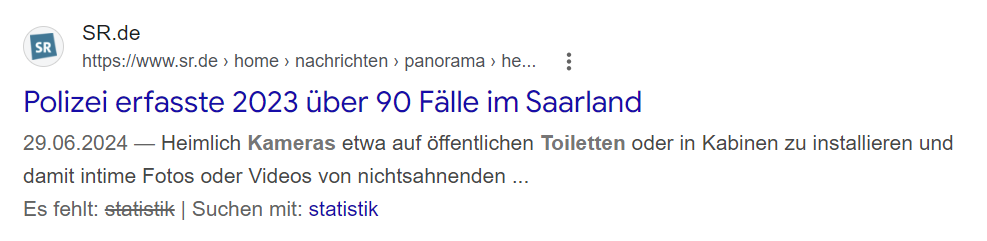
Unfortunately, incidents like this are not isolated cases. I couldn’t find any meaningful statistics on this, but the number of unreported cases is likely very high. During my Google search, I came across a headline stating that, according to the police, there were 90 cases in Saarland in 2023. Unfortunately, the page no longer loads, so I couldn’t read any more details about it. If you search for “camera found in restroom,” numerous articles about incidents in a wide variety of cities and facilities pop up.
1) Screenshot of Google search result
There are several websites online with tips on how to find hidden cameras. There are also some apps that can detect cameras via Wi-Fi or radio signals. In my opinion, however, it’s not fair to shift the responsibility onto the victims. The question is rather how the installation of hidden cameras could be prevented, what role design could play in this, and how restrooms could be designed overall to make women feel safer there. It might be helpful to identify and analyse interactions in a public restroom to identify pain points and determine how these interactions could be improved. Can public spaces ever feel truly private? In addition, it makes sense to examine the architecture of restrooms and identify which architectural elements facilitate the installation of cameras, so that measures can be determined to prevent this from happening. This also sheds new light on the question of responsibility. In the end, is it the architects of restroom facilities who are responsible for making it difficult to install cameras? Or does the responsibility lie with the operators? With lawmakers? Or with the manufacturers of miniature cameras?
Potential observation and the feeling of being safe
Observing people while they use the restroom reveals interesting parallels to the concept of the panopticon explained earlier. The most obvious aspect is the feeling of being constantly watched, which, on the one hand, constitutes a massive invasion of privacy (as was also the case with the original Panopticon, where inmates had no way to withdraw from observation). At the same time, however, this leads to a loss of the feeling of security. This, combined with the constant possibility of being watched, has a major impact on the behaviour of those being observed. The constant uncertainty can foster a deep mistrust of public places. Moreover, precisely because of this uncertainty, invisible observation often feels more threatening than overt observation. This raises the question of what role the fact that there is no way to return the observer’s gaze plays. In my opinion, control and the loss of control play a major role here. In the Panopticon as well, the observer in the tower cannot be seen from the cells, which means that power clearly lies with the observer, and the inmates lose all control over the situation and are at the mercy of the observer. I would like to research in greater detail the effects this constant tension has on the psyche. I have already identified Michel Foucault’s “Überwachen und Strafen” (English: Discipline and Punish) as a source for this, which I will be able to access tomorrow at the university library in Ulm. In his work, Michel Foucault examined penal systems and power relations in 18th-century Europe [5] and, among other things, discusses the concept of the Panopticon and its implications. There is also a chapter in which he develops the concept of panoptism, which I’m already very curious about [6].
Hidden observation from an interaction point of view
The question that rises in the context of observation as a form of interaction is, whether or not it is still an interaction if only one side of the interaction knows of it’s existence. I found this definition of interaction in the Cambridge Dictionary:
“An occasion when two or more people or things communicate with or react to each other” [7]
This definition leaves some room for interpretation: if taken very literally, the criteria for an interaction would no longer be met, since the parties involved would have to react to one another. However, the person being observed does not actively react to the camera or the person who installed it, since they are unaware of its existence. On the other hand, in my view, the person is nonetheless unknowingly involved in an interactional relationship with the camera or the observer, even though they never consented to this. So the question cannot be answered unequivocally.
Follow Up Post
Other topics I’d like to explore in relation to women and observation include the objectification of women, the male gaze, voyeurism, and stalking, as well as why women observe and judge one another.
With regard to observation in general, I’d also like to examine digital observation and data collection, as well as live-streaming culture and the television show *Big Brother* as a pop-cultural digression.
[3] Bundesministerium der Justiz. (n.d.). German Criminal Code (Strafgesetzbuch, StGB), Section 201a: Violation of the highly personal sphere of life and personal rights through image recordings. Retrieved July 3, 2026, from https://www.gesetze-im-internet.de/stgb/__201a.html
[4] Bundesministerium der Justiz. (n.d.). German Criminal Code (Strafgesetzbuch, StGB), Section 184k: Violation of the intimate sphere through image recordings. Retrieved July 3, 2026, from https://www.gesetze-im-internet.de/stgb/__184k.html
My last blogpost was quite a while ago, after the one-on-one session. For the last few weeks, I have been postponing my user research task. It turns out that I’m more introvert than I thought I would be. My initial goal was to speak to people on the public transport and ask them if they would like to play a game with me. I already knew that I am normally not that comfortable talking to strangers, especially when I must make the first move, but it turns out that it’s very hard to convince myself to walk up to someone. Especially when I have no specific reason for it other than playing a game on a 10-minute tram ride (or even shorter, depending on when the person would have to get off). I started questioning why that was the case, because I think if I really wanted to, I could easily get myself to talk to people. I think what actually makes me curious is people and their stories, not playing games with them, even though I realize that this might be a good conversation starter.
I love sitting in public spaces like cafés or squares, or on the public transport and just observing people. It’s interesting to me how they walk, how they behave, how they dress and talk to other people, the conversations they have, the emotions on their faces and their thoughts. I love making up my own story about them in my head. This led me to start exploring the act of observation more deeply. What makes observation so fascinating? How does it affect you when you’re being observed? Is observation always purely neutral? Can observation be a form of interaction?
Observing as passive social interaction
Social interaction not always consists of only conversations. A big part of it is also what is not being said, the looks, body language, the vibes someone gives off. Sometimes nothing is being said at all, but you can still feel the atmosphere in a room. Observing also plays a role in this: feeling observed can change the vibe of a situation a lot. As soon as the person being observed realizes they are being watched, one of the following passive interactions takes place: either the person feels a sense of sympathy for their observer, makes brief eye contact and smiles, and after repeated eye contact, a conversation may even ensue, or the person feels uncomfortable being watched, which becomes apparent through their gaze or by looking away. Often, the person’s body language also changes, signalling a clear sense of discomfort. Ideally, this indirect communication leads to the observation being discontinued. If the signals are not correctly recognized or are ignored by the other person, the last resort is often to leave the situation. I occasionally observe such interactions and have noticed that they usually occur without any verbal exchange. Sometimes it feels okay to be observed, sometimes it can even feel good, but it can also make you feel uncomfortable.
The dynamic between the observer and the observed can create a power imbalance, since the observed person is initially at the mercy of the observer if they have no way to shield themselves from being watched. Women, in particular, can find themselves in dangerous or extremely uncomfortable situations as a result, some of which are not easy to escape. I’d like to write more about this dynamic in one of my upcoming blog posts.
Being observed vs. being unobserved
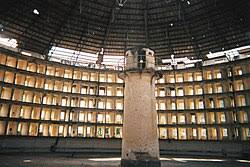
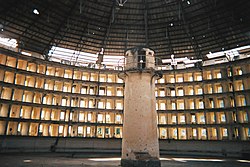
Another interesting aspect is how people behave when they feel like they are not being observed. They might feel more at peace with themselves because they don’t need to perform for anyone. They might even do something that goes against certain social conventions. On the other side of that is what happens when someone is constantly observed. It can put a lot of pressure on somebody. A very drastic example that comes to my mind is the Panopticon, an architectural concept for prisons or factories that are built in a way that all the inmates / workers can be observed at any time. The building is circular and has a tower in the centre, from where all the prison cells could be watched. The backlighting makes it easy for the observer to see all the inmates while the observer stays hidden in the dark tower, so the inmates never know if they are currently being watched or not. Jeremy Bentham, a philosopher and founder of Utilitarianism, who invented the concept, assumed that this would make the inmates behave in a more disciplined way, as if they were constantly being watched. Several prisons were built based on this model, including some in Germany and the Presidio Modelo on Isla de la Juventud in Cuba.
1) Panopticon observation tower, Presidio Modelo, Kuba2) Presidio Modelo, Isla de la Juventud, Kuba
I found further information on Wikipedia on how the Panopticon concept was reflected on by other philosophers. The philosopher Foucault described the Panopticon as a central concept of the Western liberal world and its surveillance society. Building on this, Zygmunt Bauman presents the Panopticon as a symbol of territorial power and transposes it into the postmodern era, in which power is slowly being redistributed and shifting into the digital world, namely the Internet and smartphones, and refers to this phenomenon as “post-panoptic.” In the 2000s, information theorist Branden Hookway further developed the concept of the Panopticon into that of the Panspectron, in which there is no longer a predefined object to be monitored, but rather everything and everyone is monitored. Only in hindsight is the object defined by a specific question. [1] I think this is a very fitting description of the internet, where everyone is constantly being watched.
As I was reflecting on the act of observation, this very phenomenon of constant surveillance in our digital age also came to mind. I remember an exhibition during International Design Week at FH Joanneum where visitors could submit screenshots of the apps installed on their smartphones, and an AI then compiled personal data about them based on the installed apps. It was fascinating how much the AI could deduce based on the combination of apps – even though it had no access to the data within the apps themselves, only to which apps were on the phone. It was able to draw conclusions about a person’s age, place of residence, living circumstances, and interests. When you consider the data that is collected and processed on social media, for example, it’s hard to even imagine how accurate a picture of a person could be painted based on that data and what consequences this knowledge could have. This could become very dangerous for certain groups of people if the political situation were to change drastically. Even right now it is interesting to see how different people perceive the collection of their data, ranging from indifference to concern.
On top of that, it’s not only more or less abstract data about people that’s being collected. The rapid development of smart glasses means that, in the future, you can never be sure whether you’re being watched (= recorded) or not. These glasses are already barely distinguishable from conventional glasses. Once they become more widespread, this could lead to a Panopticon-like state of constant potential observation. This raises the question of how this will affect our society in the long term and whether there will be ways to protect ourselves against it. I think the feeling of being constantly monitored could cause a great deal of stress and anxiety.
An interesting question might be how people could be made more aware of this issue and what role design could play in this process.
Conclusion
I found it very interesting to shift the focus from active social interaction to passive social interaction, since this form of interaction is often overlooked. I’d like to learn more about social presence, since I only touched on this aspect briefly during the research for this blog post and don’t yet have a deeper understanding of it. I also found the digression on the feeling of being watched and the feeling of constant surveillance, as an extreme, to be very promising. I might do more research on how the inmates of the prison in Cuba, which was built on the model of the Panopticon, were impacted by the architecture. Maybe this provides some insights on the impact of digital observation.
When I looked up the term “unbeobachtet” to check whether I had translated it correctly, I came across the translation ‘unnoticed’ in addition to “unobserved.” This led me to wonder how observation relates to being seen or noticed.
Note
Parts of this text were translated from German to English by Deepl.com.
Activities must accommodate different physical abilities and fitness levels.
Multiple participation roles should exist beyond throwing, catching, or running.
Exercises should allow adjustable intensity and difficulty.
Social Accessibility
The game should minimize situations where students feel exposed or judged.
Collaborative mechanics should ensure every student can contribute meaningfully.
Group structures should avoid exclusion and fixed hierarchies.
Cognitive Accessibility
Rules and objectives should be easy to understand.
Instructions should be visual, verbal, and simple.
Activities should allow flexibility for different learning speeds.
Emotional Accessibility
The environment should reduce performance pressure and fear of failure.
Positive reinforcement and shared success should be emphasized.
Students should feel psychologically safe participating.
Teacher Accessibility
The system should be adaptable to different school contexts and resources. Preparation time should remain low. Materials should be intuitive and easy to implement in large groups.
Potential Barriers
Student-Related Barriers
Fear of embarrassment or failure
Existing negative experiences with sports
Social anxiety or low self-confidence
Physical disabilities or varying motor skill levels
Teacher-Related Barriers
Limited preparation time
Large class sizes
Lack of training in inclusive PE methods
Resistance to changing traditional PE structures
School-Related Barriers
Limited budget for materials or training
Fixed curricula and time constraints
Limited gym space or equipment availability
Social & Cultural Barriers
Strong focus on competition in sports culture
Stereotypes about athletic ability
Peer pressure and social comparison among students
Technical / Product Barriers
Overly complicated game rules
Lack of adaptability for different age groups
Insufficient guidance or onboarding for teachers
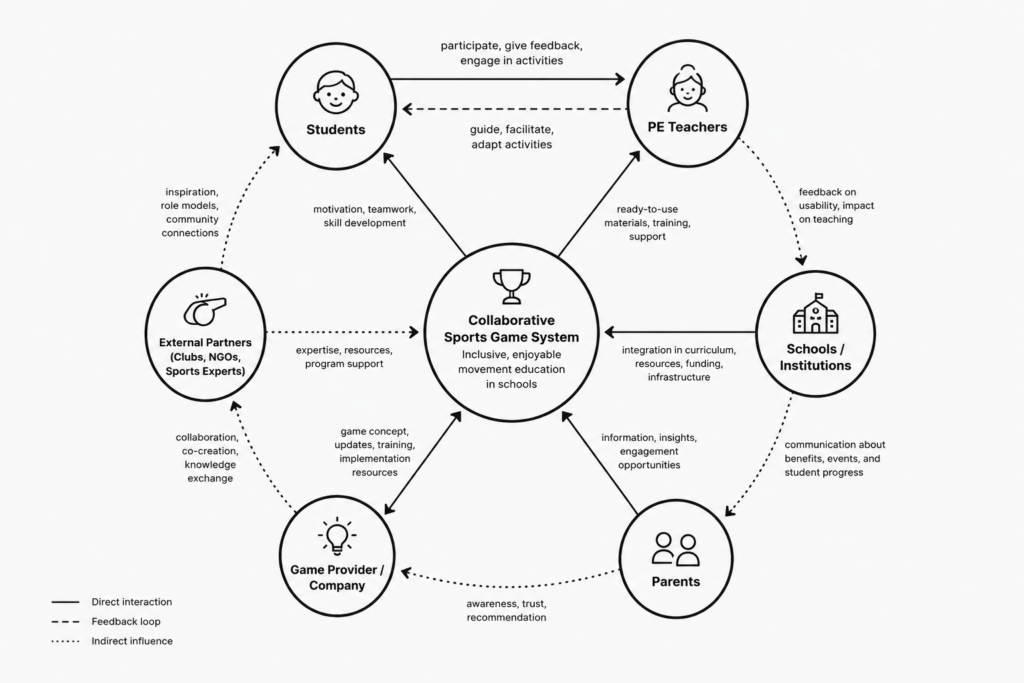
System Map
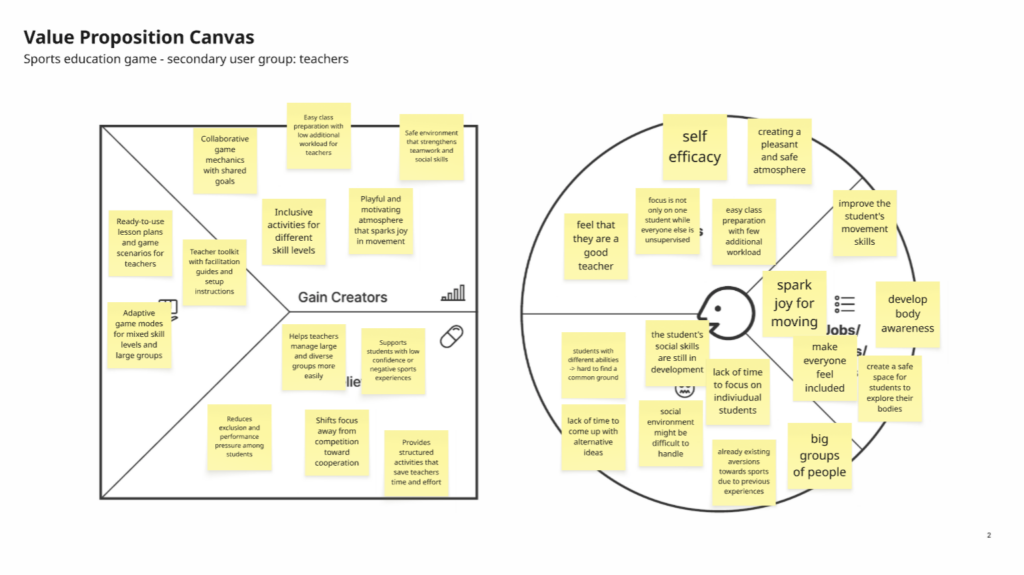
For the system map I identified the main stakeholders and their relationships. I then put my notes and findings into ChatGPT to create an image that shows how they are related in a graphic way.
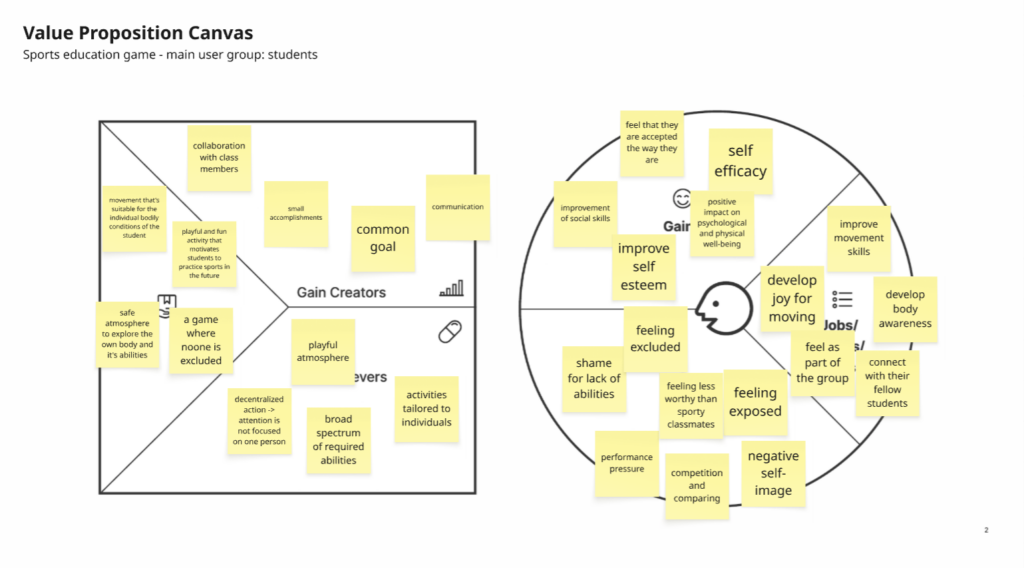
I started with the value proposition canvas for the main user group (the students). Most of it was easy to fill out because I had already done research on it previously. I identified teachers a secondary user group. While filling it out, I noticed that some of the aspects, especially the jobs to be done, were very closely related.
Based on those canvases I formulated the following business idea:
Physical education classes are meant to encourage movement, teamwork, and confidence, yet for many students they are associated with pressure, exclusion, and comparison. A German study from 2022 found that 39% of students do not enjoy PE classes, which can contribute to a long-term aversion toward sports and physical activity. This is especially concerning because sports and movement are closely linked to psychological well-being, self-esteem, and social development.
The idea behind this project is to rethink how movement is experienced in schools by creating a collaborative game concept specifically designed for PE classes. Instead of focusing on competition and individual athletic performance, the game encourages students to work together toward a shared goal. The activities rely on decentralized action and a broad range of abilities, meaning that participation does not depend only on traditional sports skills such as throwing, catching, or speed.
The concept is designed for school environments with diverse groups of students and aims to create situations in which everyone can contribute in different ways. By shifting the focus from performance to collaboration, the game can help reduce feelings of exclusion while making movement more enjoyable and accessible. Teachers also benefit from a structure that is easy to prepare, adaptable to large groups, and flexible enough for different ages and ability levels.
The long-term goal is to create more positive experiences with movement during school years and help students build confidence, social skills, and a healthier relationship with sports. Beyond the classroom, the project could contribute to a more inclusive understanding of physical education where participation and teamwork become more important than competition alone.
As a product, the concept could be offered to schools and educational institutions through physical or digital game kits, ready-to-use lesson plans, and a platform with adaptable activities for PE teachers. Additional revenue streams could include teacher workshops, subscriptions for new game content, or partnerships with schools and educational organizations.
„Your Master Thesis should be the most ambitious thing you ever did.” This sentence, written on a presentation slide of our Design and Research course with Birgit made me think. It made so much sense to me, but at the same time it shifted my view on the Masters thesis. It’s not only something that I have to do, but also something that should feel in a way meaningful to me. It also made me rethink the topic I chose for last semester. I think the sentence wouldn’t apply to that – it doesn’t feel big enough. It would not be the most ambitious and meaningful thing I ever did. It doesn’t seem important enough to me.
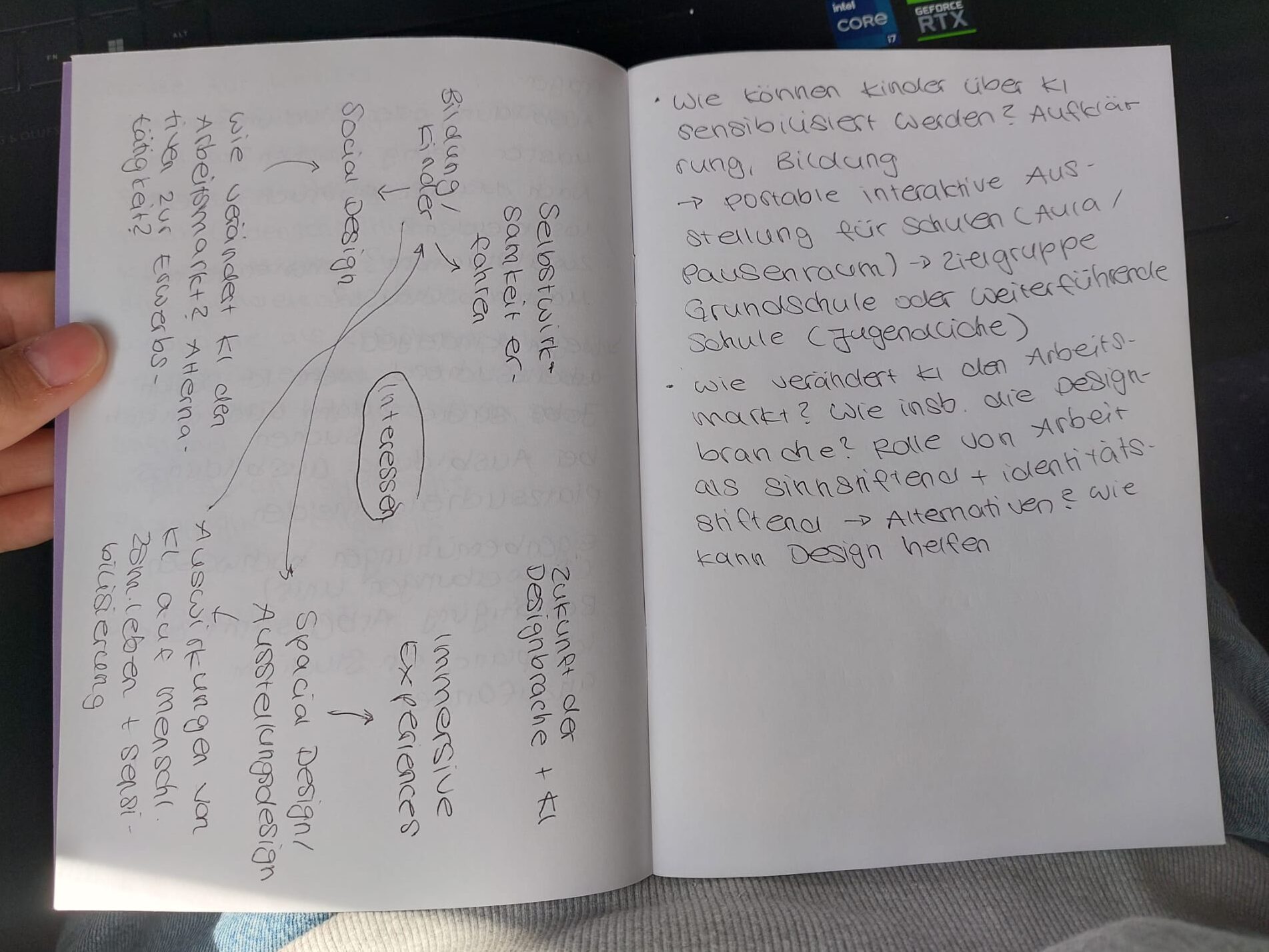
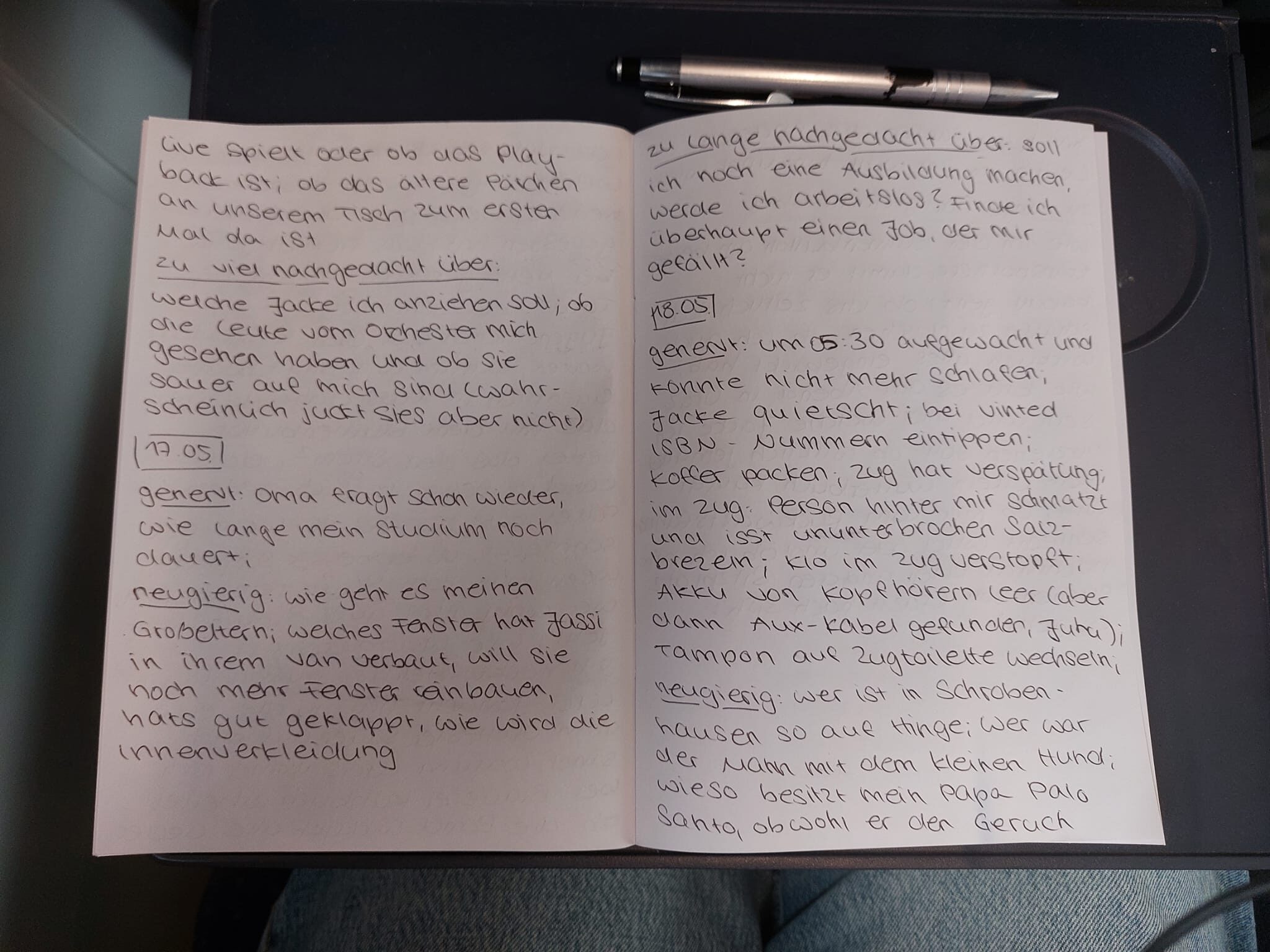
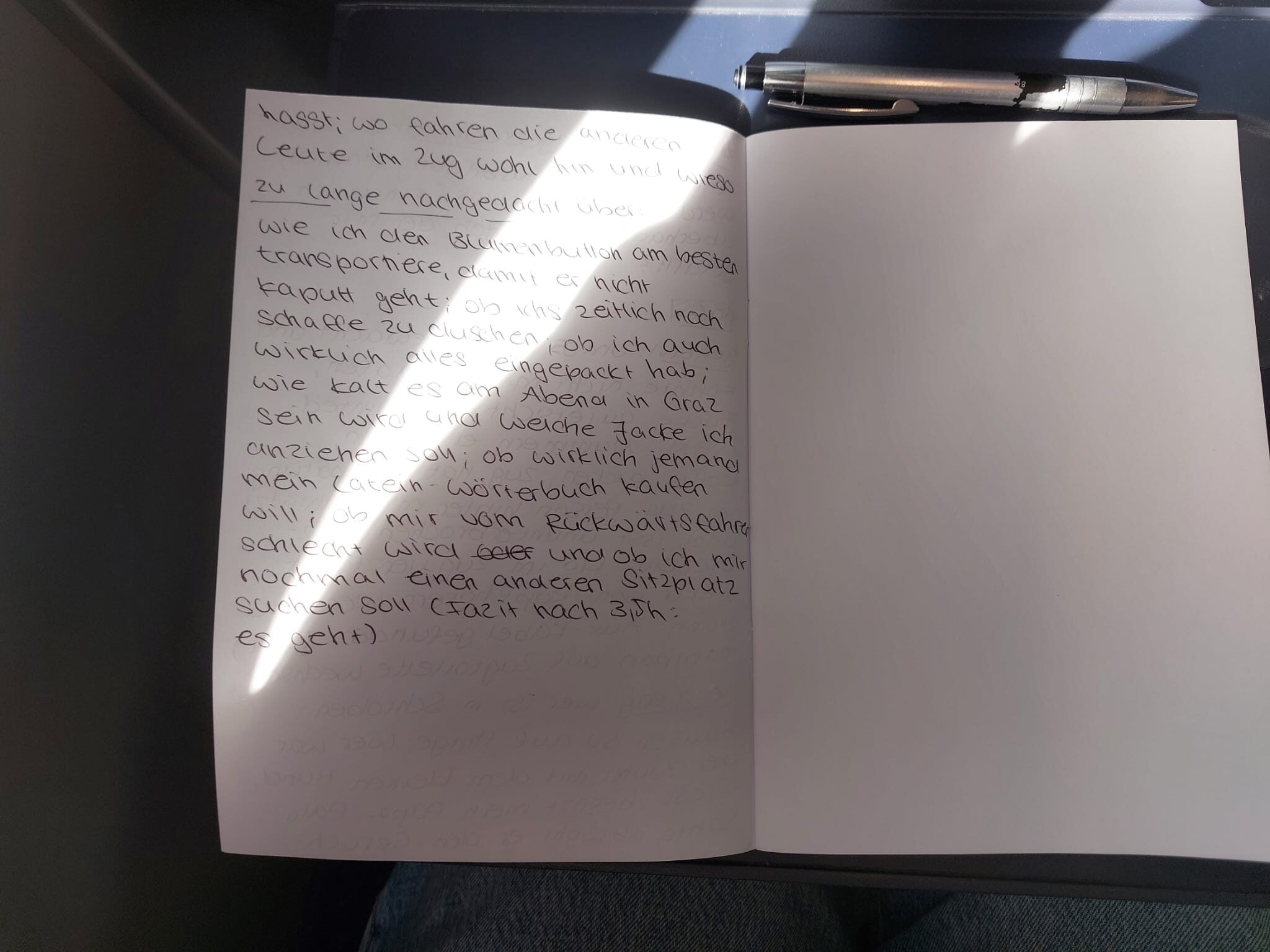
So what now? What would feel important enough? As always when I need to sort my thoughts, I pulled out a notebook (I upgraded from random sheets of paper to something more durable) and started writing everything that would interest me as a topic on a mindmap and connected aspects that I thought would match. I wrote topics as well as things that make me worried, but also possible media I would specifically like to design as an outcome of the process. I will later take a picture of the notebook pages and upload them to this post.
The outcome of my brainstorming session was the following:
Idea 1: Investigate how the use of AI will affect human coexistence. Then think about how the situation could be improved by design. Then think about how to raise awareness about the effects of AI and what people could do to avoid possible negative consequences. How could this be conveyed? Possible outcome: interactive installation / exhibition either for adults or children / youths, that travels from school to school
Idea 2: How will AI affect the job market? Will paid work play a lesser role or even disappear entirely? How will the design sector in particular be affected? Research on the role of employment in building identity and creating meaningfulness. How could alternatives that fulfil the same purpose look like? What role can design play here?
I took notes in german since it’s easier that way for me.
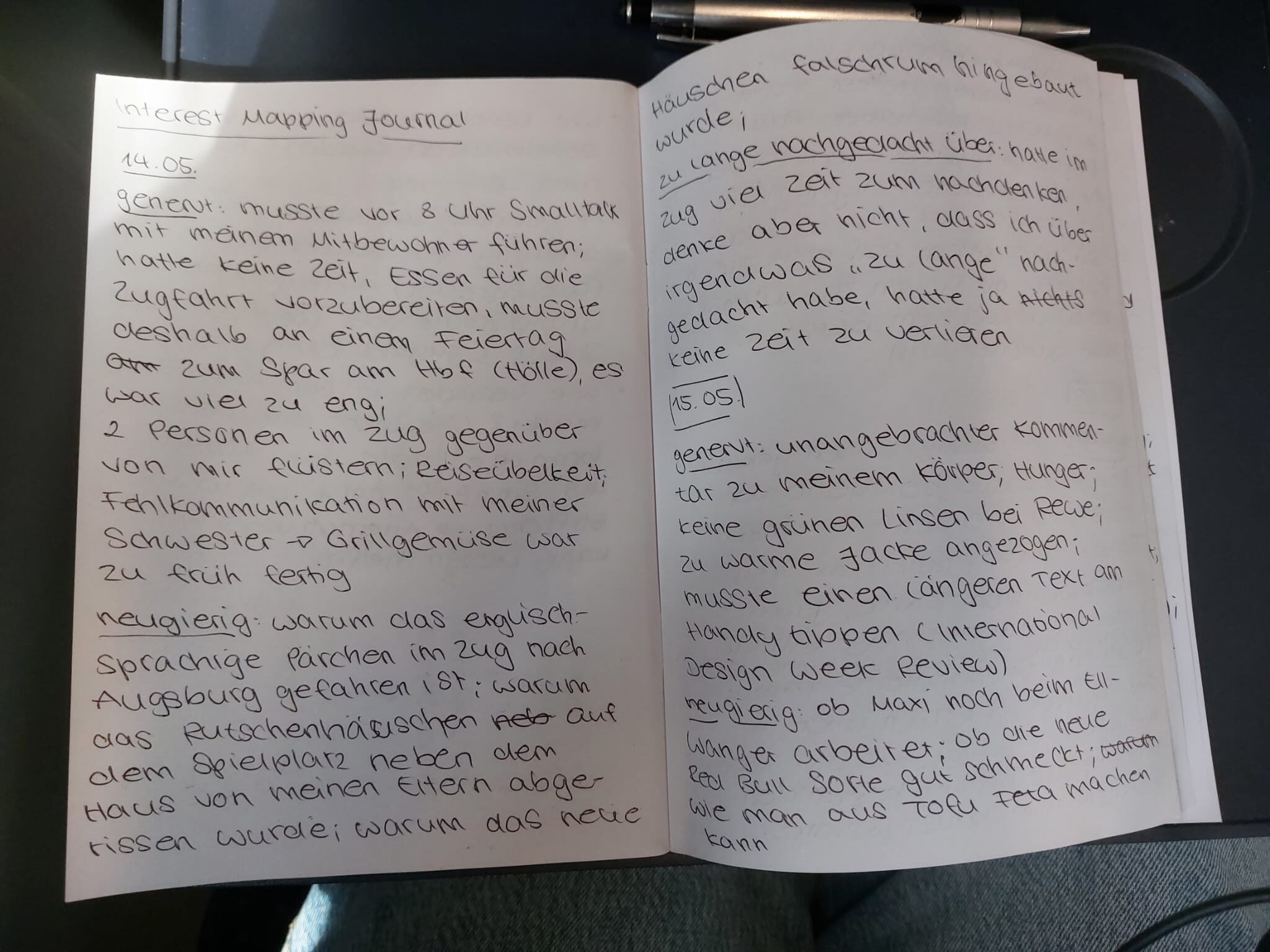
After this first round of brainstorming I read some online articles on how to find a topic for a master thesis. Then I asked ChatGPT to give me 3 journal prompts to find a suitable topic. This is what it gave me as a first task:
1. Interest Mapping Journal (What really draws you in?)
Here’s how it works: For 1–2 weeks, keep a daily journal with three brief categories:
What sparked my curiosity today?
What irritated or annoyed me?
What did I think about longer than necessary?
Important: Don’t filter. Everything counts:
Interfaces
social situations
technologies
habits
physicality
work
learning
AI
public spaces
games
digital fatigue, etc.
Why this helps
Master’s thesis topics often don’t arise from “cool ideas,” but from:
recurring attention
unresolved tensions
personal obsessions
After a few days, you’ll start to see patterns:
recurring terms
specific contexts
the same emotions
similar problems
These often lead to promising research directions.
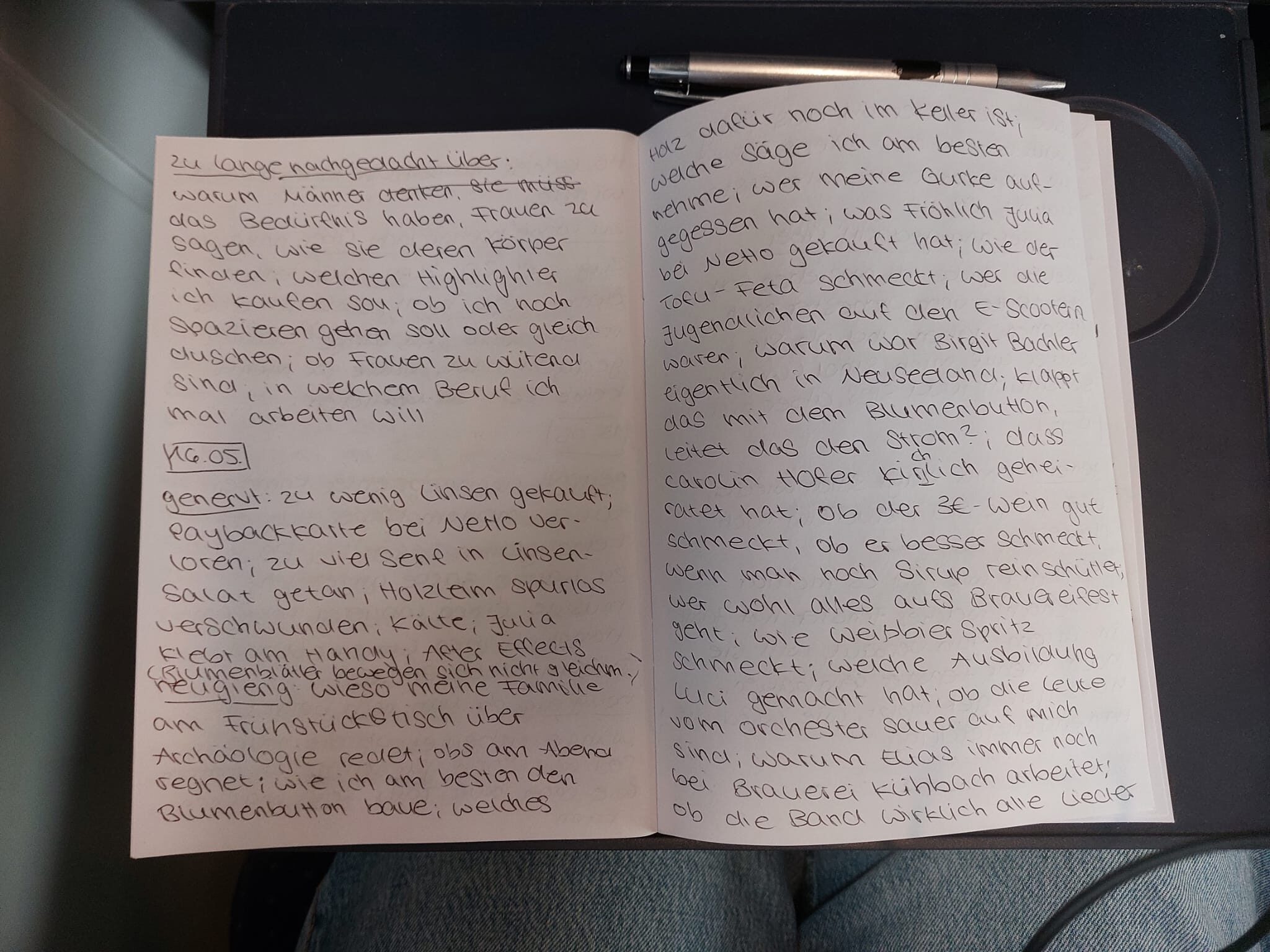
I documented the questions for five days in my notebook. I found that I’m annoyed either by people or the sounds they make, by the weather or trains, I’m apparently quite curious about gossip and people on the train and think a lot about what jacket to wear, my future and daily errands. While analysing this, I kind of got stuck on my curiosity for other people and their travel destinations. I sometimes wonder if I should just ask the people opposite of me in the 4-person seat where they are going and why, but I’m usually too shy or I fear I might annoy them. I once had a very nice conversation with a woman from Graz who lives close to Mannheim now. We even ended up exchanging numbers because she was looking for a new renter for her apartment in Graz.
I take the train home to Germany every few months and I’m usually quite bored during the 6h journey. I think it would be cool to ask the people next to me if they would be interested in a round of card games, but first, I never have any games with me and second of all they usually seem very busy on their laptops or wear headphones. Maybe it would be interesting to investigate if people are generally open to connecting with others on long train rides, e.g. while playing games, or if they prefer to just be by themselves. I also wonder how people could naturally be motivated to interact with each other without making it feel forced.
Thoughts on the journalling method
I was a bit sceptical about this method in the beginning, especially because I went home to my parents place this weekend and didn’t expect anything extraordinary interesting to happen during those days – even while writing things down I thought there would be nothing relevant as a research topic. I’m surprised that it actually helped me a bit. I’m not sure if I will stick with the connecting-people-on-trains thing, but I definitely think it could be interesting. I will continue this method for the upcoming week since I think there might be different results when I may days are more structured and when I spend more time at FH. Also continuing especially the curiosity part during our trip to WebExpo in Prag could bring some interesting findings.
I think I will have to postpone the other 2 journalling methods to another day, but I’m already curious about what new ideas they might bring me. For a start I don’t feel as lost anymore as I did on thursday, when I started writing this post.
For the sake of completeness I will include pictures of my notes at the end of this post.
Next steps:
Try out the other methods, hopefully find another interesting topic idea and start prototyping for some interactive approaches to connect travellers.
The paper introduces the concept of ViVo, a tool for instrument learning, that combines the already well-researched but until now separately used methods of vocalization and visualization. It has two modes: One that visualizes the real-time vocalizations of the user, transforming it into illuminations of the corresponding piano keys and a mode where the user can practise with visualizations of pre-recorded vocalizations.
In the introduction the author gives information about the technique of vocalizing, which is an important tool to learn instruments and improve the general sense of music and improvisation and composition skills. Its effectiveness can be attributed to the fact that vocalized melodies can be memorized better than instrumental melodies. Despite this, vocalization is not used in instrument learning environments to its full potential. Visualization, on the other hand, is broadly used in music education, guiding the learners through real-time instructions and feedback. ViVo aims to combine both learning methods to create a more effective and intuitive tool.
The tool consists of a microphone that’s being used to record the vocalizations, a processor and an electronic piano with illuminable keys. In another section there is more specific information on the used hardware.
The goals of ViVo are described as follows: portability, low material costs, effective real-time operation, pitch accuracy, pitch range and note onset/offset fidelity.
The author then describes the algorithms, that were used for ViVo: firstly, two pitch detection methods (YIN algorithm and an FFT-based heuristic approach) to extract pitch from vocal input. While standard interpolation techniques (like parabolic fitting) are already known, ViVo adapts them specifically for singing. Its modified method focuses on a typical vocal pitch range (100–1000 Hz), calculates the average energy within that range, and then scans for the first three consecutive frequency bins exceeding this average. It applies a parabola fit to these bins to estimate the fundamental frequency (f₀), optionally smoothing the result with a filter. These adjustments improve robustness to noise and reduce common errors, such as detecting the wrong octave when harmonics are stronger than the fundamental frequency.
To test if ViVo fulfils the previously set goals, it was being tested by playing a voices library through a speaker placed 70cm from the microphone to simulate the expected use conditions.
In the following sections the methods of pitch detection, range and note onset/ offset are described in more detail. After this the author gives an outlook on future work. Planned features are for example the extension of the detection system to recognize polyphonic melodies which allows to use recorded music instead of only relying on unison vocals. The use case will be extended to larger music education contexts such as classrooms. There will also be studies on how the tool can help to learn jazz improvisation. Another mentioned step is to develop the ViVo tool for other instruments such as guitar. Then the author illustrates how the tool could be used in live performances.
In the last part of the paper there is a section on ethical standards. The author declares that she used low-cost materials and open-source software that was funded by herself. She also indicates that there were no conflicts of interest and that all participation in the project was voluntary. This part is followed by the references.
I found the approach of combining vocalization and visualization as learning methods very interesting. The prototype shown on a picture seems a bit raw and unfinished, but I think has potential to be further developed. I wonder if the idea of this tool can also be applied to other instruments that do not have a visible scale, such as trumpet, saxophone or French horn. In my own experience of learning the flute, trumpet, French horn and guitar I never worked with visualization, but sometimes used vocalization with my French horn teacher, which I think is helpful to establish a feeling for pitch and intervals and makes it easier to hit the right notes. This is especially crucial for brass instrument players, since those instruments usually only have 3-4 keys, so the same key combinations are being used for various notes that have to be controlled through air pressure.
The paper itself was well structured, although I would have put some of the sections in a different orde. In my opinion it would make more sense to put the goals of the tool right after the introduction that describes the concept of the tool. Other than that I think it was easy to understand the idea and how ViVo works.
At the beginning of my research, I listed a podcast episode from the “So bin ich eben!” podcast by renowned psychologist, psychotherapist, and bestselling author Stefanie Stahl and psychologist and podcaster Lukas Klaschinski as a possible source. Since Stefanie Stahl has focused primarily on working with the inner child and building self-esteem and healthy relationships, it seemed very appropriate to me to include what she has to say on the subject.
In this episode, Stefanie Stahl and Lukas Klaschinski give tips on how to promote children’s self-esteem: not only for parents, but also for everyone else who deals with children on a daily basis. Although the episode is mainly told from the parents’ perspective, I think that much of it can also be applied to how teachers interact with children. In addition, I would like to conclude by exploring the extent to which the aspects mentioned can be incorporated into the game.
At the beginning of the episode, Stefanie once again emphasizes the importance of self-esteem for later life, describing it as the epicenter. She says it is a gift for life that adults can give to children.
The topic of the episode was inspired by an email from a listener: a mother describes how her son no longer wants to go to soccer practice because he is not as good as the other children and feels ashamed of his abilities. The mother asks for tips on how to encourage him and boost his self-esteem. Since this example is closely related to the topic of physical education, I wanted to mention it in this article.
At the beginning, the two psychologists explain that it is important to sometimes stick with something for longer in order to realize that things can change for the better and that you can achieve things. However, you shouldn’t force anything, as the child may later develop an aversion to the activity.
A concrete solution for the example situation is therefore to talk openly with the child and explain what you are concerned about (learning opportunity, seeing things through), validate the child’s feelings, and accept the child’s decision if they do not change their mind.
The following general tips are explained:
– Important: Love and secure attachment, empathy, recognizing the child’s needs -> Parents must have good access to their own feelings
– Presence: Children should not be sent to daycare in their first year of life if possible. Parents must convey security, be reliable; a repeated pattern of dashed hopes is not good for building secure attachment behavior
– Encourage the child, do not link love to expectations or performance
– Read the child’s signals, recognize and respect physical boundaries, do not overwhelm them with closeness -> Children are not at the mercy of adults; children must learn that they have the right to communicate their boundaries; adults must ensure that other adults respect their children’s boundaries
– Autonomy: the child must have the opportunity to assert their opinion sometimes, otherwise they will become conflict-averse later on and feel that there is no point in expressing their own opinions/needs at all -> if agreements are negotiated with the child, they are more likely to stick to them
– Autonomy -> Children learn that relationships can be actively shaped and are not something that must be endured, but that it is still important to find balance and set boundaries.
– Self-efficacy: Children should take on age-appropriate responsibilities, do things for themselves, and take on tasks. You have to trust children, because self-confidence is learned through the trust of others.
– Mistakes are okay and opportunities to learn. This way, children are not ashamed and develop a better tolerance for frustration.
– Encourage strengths and talents, reinforce a positive self-image, do not praise too much or pointlessly (i.e., for trivial things), because then the child will not feel taken seriously and credibility will be lacking -> so praise and recognize real strengths, focus on the process rather than the result, e.g., recognize perseverance.
– If a child is “always exceptional” because they are praised for everything, they feel that they always have to be exceptional.
– Know your own background and be self-reflective: what did I want (when I was little), how did I grow up, how did my parents influence me, and what does my child actually want? Your own issues should not be transferred to your child.
– Children need to have friends and feel like they belong.
– Be a positive role model: How do I talk about myself as a parent, how good am I at dealing with conflict, do I come across as confident, do I set good boundaries for myself, and do I stand up for my needs?
– Establish rituals to promote a positive self-image.
How can these tips be applied to physical education?
One aspect that is very important to me is that the focus should not be on the end result, i.e., the specific performance, but on the process and learning success. This also goes hand in hand with meaningful praise, i.e., not only students who perform well should be praised, but all students should receive praise for things they have done well, such as high perseverance or a high willingness to learn, or even social skills such as helpfulness. I think it would be useful to address this specifically in the game instructions for teachers, even though this knowledge should already be available to them due to their educational background. In my opinion, teachers also have a responsibility to be vigilant and recognize when a child’s physical boundaries are not being respected, and to intervene in an emergency and point this out to the children.Here is an exercise that I know from my work with young people: The children stand in two rows facing each other, a few meters apart. Then one row moves toward the other, and the children who remain standing have the task of saying “stop” when the other person gets too close to them. The distance that results is different for each child, but it is important for the children to recognize that personal space is different for everyone and must be respected. It also gives the children the opportunity to learn about their own personal space and to set boundaries in a protected environment. Another task for the teacher is to recognize when a child feels excluded and to ensure that they feel part of the group. This task can also be achieved through the game by promoting teamwork and togetherness.
I have already discussed promoting the individual strengths of each student at length in previous posts, so I don’t want to go into this aspect in greater depth here.
Students should be given the opportunity to actively participate in the design and implementation of the game. This gives them the feeling that their opinion is important and their needs are being seen. It also teaches them to do things on their own and take responsibility, which gives them a sense of self-efficacy.
Another particularly important aspect of physical education is fostering a positive culture of error. Mistakes should be allowed and given to children as learning opportunities. If an exercise is not yet being performed correctly, children should not feel that they are not good enough, but should reflect on how they can use the mistake to identify ways to improve their technique.
Finally, it occurred to me to incorporate small rituals at the beginning or end of the lesson. Ideally, these would fit seamlessly into the game concept or storyline, so that the rituals seem more natural and less imposed from outside. For example, the students could sit in a circle or in small groups and reflect on what they are particularly looking forward to today, even if it’s just small things, or what they did well today and where they have improved. I also think it would be helpful if each child said something about their neighbor that they are good at or did well today. This gives the children external validation and confirms their positive self-image. It also trains the children to see and appreciate individual strengths in others and challenges them to engage with other children with whom they might not otherwise have much to do and to perceive them in their entirety.
Sources
Stahl, Stefanie, Klaschinski, Lukas: So bin ich eben! Stefanie Stahls Psychologie-Podcast für alle “Normalgestörten”. 5 psychologische Tipps, die das Selbstwertgefühl von Kindern fördern. URL: https://open.spotify.com/episode/4AHoVP7Uplw2AJ8EbH9JLq?si=55257233ed6a4d4a, published on may 13th 2025 on Spotify