My last blogpost was quite a while ago, after the one-on-one session. For the last few weeks, I have been postponing my user research task. It turns out that I’m more introvert than I thought I would be. My initial goal was to speak to people on the public transport and ask them if they would like to play a game with me. I already knew that I am normally not that comfortable talking to strangers, especially when I must make the first move, but it turns out that it’s very hard to convince myself to walk up to someone. Especially when I have no specific reason for it other than playing a game on a 10-minute tram ride (or even shorter, depending on when the person would have to get off). I started questioning why that was the case, because I think if I really wanted to, I could easily get myself to talk to people. I think what actually makes me curious is people and their stories, not playing games with them, even though I realize that this might be a good conversation starter.
I love sitting in public spaces like cafés or squares, or on the public transport and just observing people. It’s interesting to me how they walk, how they behave, how they dress and talk to other people, the conversations they have, the emotions on their faces and their thoughts. I love making up my own story about them in my head. This led me to start exploring the act of observation more deeply. What makes observation so fascinating? How does it affect you when you’re being observed? Is observation always purely neutral? Can observation be a form of interaction?
Observing as passive social interaction
Social interaction not always consists of only conversations. A big part of it is also what is not being said, the looks, body language, the vibes someone gives off. Sometimes nothing is being said at all, but you can still feel the atmosphere in a room. Observing also plays a role in this: feeling observed can change the vibe of a situation a lot. As soon as the person being observed realizes they are being watched, one of the following passive interactions takes place: either the person feels a sense of sympathy for their observer, makes brief eye contact and smiles, and after repeated eye contact, a conversation may even ensue, or the person feels uncomfortable being watched, which becomes apparent through their gaze or by looking away. Often, the person’s body language also changes, signalling a clear sense of discomfort. Ideally, this indirect communication leads to the observation being discontinued. If the signals are not correctly recognized or are ignored by the other person, the last resort is often to leave the situation. I occasionally observe such interactions and have noticed that they usually occur without any verbal exchange. Sometimes it feels okay to be observed, sometimes it can even feel good, but it can also make you feel uncomfortable.
The dynamic between the observer and the observed can create a power imbalance, since the observed person is initially at the mercy of the observer if they have no way to shield themselves from being watched. Women, in particular, can find themselves in dangerous or extremely uncomfortable situations as a result, some of which are not easy to escape. I’d like to write more about this dynamic in one of my upcoming blog posts.
Being observed vs. being unobserved
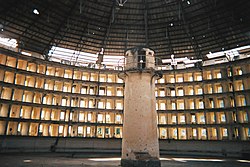
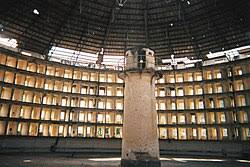
Another interesting aspect is how people behave when they feel like they are not being observed. They might feel more at peace with themselves because they don’t need to perform for anyone. They might even do something that goes against certain social conventions. On the other side of that is what happens when someone is constantly observed. It can put a lot of pressure on somebody. A very drastic example that comes to my mind is the Panopticon, an architectural concept for prisons or factories that are built in a way that all the inmates / workers can be observed at any time. The building is circular and has a tower in the centre, from where all the prison cells could be watched. The backlighting makes it easy for the observer to see all the inmates while the observer stays hidden in the dark tower, so the inmates never know if they are currently being watched or not. Jeremy Bentham, a philosopher and founder of Utilitarianism, who invented the concept, assumed that this would make the inmates behave in a more disciplined way, as if they were constantly being watched. Several prisons were built based on this model, including some in Germany and the Presidio Modelo on Isla de la Juventud in Cuba.

I found further information on Wikipedia on how the Panopticon concept was reflected on by other philosophers. The philosopher Foucault described the Panopticon as a central concept of the Western liberal world and its surveillance society. Building on this, Zygmunt Bauman presents the Panopticon as a symbol of territorial power and transposes it into the postmodern era, in which power is slowly being redistributed and shifting into the digital world, namely the Internet and smartphones, and refers to this phenomenon as “post-panoptic.” In the 2000s, information theorist Branden Hookway further developed the concept of the Panopticon into that of the Panspectron, in which there is no longer a predefined object to be monitored, but rather everything and everyone is monitored. Only in hindsight is the object defined by a specific question. [1] I think this is a very fitting description of the internet, where everyone is constantly being watched.
As I was reflecting on the act of observation, this very phenomenon of constant surveillance in our digital age also came to mind. I remember an exhibition during International Design Week at FH Joanneum where visitors could submit screenshots of the apps installed on their smartphones, and an AI then compiled personal data about them based on the installed apps. It was fascinating how much the AI could deduce based on the combination of apps – even though it had no access to the data within the apps themselves, only to which apps were on the phone. It was able to draw conclusions about a person’s age, place of residence, living circumstances, and interests. When you consider the data that is collected and processed on social media, for example, it’s hard to even imagine how accurate a picture of a person could be painted based on that data and what consequences this knowledge could have. This could become very dangerous for certain groups of people if the political situation were to change drastically. Even right now it is interesting to see how different people perceive the collection of their data, ranging from indifference to concern.
On top of that, it’s not only more or less abstract data about people that’s being collected. The rapid development of smart glasses means that, in the future, you can never be sure whether you’re being watched (= recorded) or not. These glasses are already barely distinguishable from conventional glasses. Once they become more widespread, this could lead to a Panopticon-like state of constant potential observation. This raises the question of how this will affect our society in the long term and whether there will be ways to protect ourselves against it. I think the feeling of being constantly monitored could cause a great deal of stress and anxiety.
An interesting question might be how people could be made more aware of this issue and what role design could play in this process.
Conclusion
I found it very interesting to shift the focus from active social interaction to passive social interaction, since this form of interaction is often overlooked. I’d like to learn more about social presence, since I only touched on this aspect briefly during the research for this blog post and don’t yet have a deeper understanding of it. I also found the digression on the feeling of being watched and the feeling of constant surveillance, as an extreme, to be very promising. I might do more research on how the inmates of the prison in Cuba, which was built on the model of the Panopticon, were impacted by the architecture. Maybe this provides some insights on the impact of digital observation.
When I looked up the term “unbeobachtet” to check whether I had translated it correctly, I came across the translation ‘unnoticed’ in addition to “unobserved.” This led me to wonder how observation relates to being seen or noticed.
Note
Parts of this text were translated from German to English by Deepl.com.
Sources:
[1] Panopticon. (n.d.). In Wikipedia. Retrieved June 30, 2026, from https://de.wikipedia.org/wiki/Panopticon