Since my last blog post, I’ve been thinking about the issue of women and observation. What sparked this was an Instagram post I saw a few days ago that made me very angry. It was about a hidden camera found in the women’s restroom at a climbing park that had been used to film the private parts of women and girls. Some of the affected women banded together and turned the camera over to the police. An investigation against persons unknown is currently underway. Unfortunately, I couldn’t find the post later on, and there’s not much information about it online either. I found a similar case on the website of the Saxon Mountaineering Association [1], but I’m not sure if it’s the same one. I did some research on the legal situation for hidden cameras on toilets, because I remember that the post said something about the legal situation not being very clear, and found that in Germany § 201a StGB and § 184 k StGB apply for such cases [2].
§ 201a StGB constitutes a violation of one’s most private sphere and of personal rights through the taking of photographs [3]. The text in German reads as follows:
“ Mit Freiheitsstrafe bis zu zwei Jahren oder mit Geldstrafe wird bestraft, wer (1.) von einer anderen Person, die sich in einer Wohnung oder einem gegen Einblick besonders geschützten Raum befindet, unbefugt eine Bildaufnahme herstellt oder überträgt und dadurch den höchstpersönlichen Lebensbereich der abgebildeten Person verletzt (…)“
§ 201a Absatz 1 StGB [3]
Which translates to: Any person who (1) without authorization takes or transmits an image of another person who is in a dwelling or a space specially protected from view, thereby infringing upon the highly personal sphere of the person depicted, shall be punished by imprisonment for up to two years or a fine.
§ 184k StGB refers to the violation of a person’s private parts through photography [4]. This is the original text from StGB:
“Mit Freiheitsstrafe bis zu zwei Jahren oder mit Geldstrafe wird bestraft, wer
1. absichtlich oder wissentlich von den Genitalien, dem Gesäß, der weiblichen Brust oder der diese Körperteile bedeckenden Unterwäsche einer anderen Person unbefugt eine Bildaufnahme herstellt oder überträgt, soweit diese Bereiche gegen Anblick geschützt sind,
2. eine durch eine Tat nach Nummer 1 hergestellte Bildaufnahme gebraucht oder einer dritten Person zugänglich macht oder
3. eine befugt hergestellte Bildaufnahme der in der Nummer 1 bezeichneten Art wissentlich unbefugt einer dritten Person zugänglich macht.
(2) Die Tat wird nur auf Antrag verfolgt, es sei denn, dass die Strafverfolgungsbehörde wegen des besonderen öffentlichen Interesses an der Strafverfolgung ein Einschreiten von Amts wegen für geboten hält.
(3) Absatz 1 gilt nicht für Handlungen, die in Wahrnehmung überwiegender berechtigter Interessen erfolgen, namentlich der Kunst oder der Wissenschaft, der Forschung oder der Lehre, der Berichterstattung über Vorgänge des Zeitgeschehens oder der Geschichte oder ähnlichen Zwecken dienen.
(4) Die Bildträger sowie Bildaufnahmegeräte oder andere technische Mittel, die der Täter oder Teilnehmer verwendet hat, können eingezogen werden. § 74a ist anzuwenden.“
§ 184k StGB [4]
The first part is the one most relevant and translates to: Any person who commits any of the following acts shall be punished by imprisonment for up to two years or a fine: 1. intentionally or knowingly taking or transmitting, without authorization, an image of another person’s genitals, buttocks, female breasts, or the underwear covering these body parts, provided that these areas are shielded from view
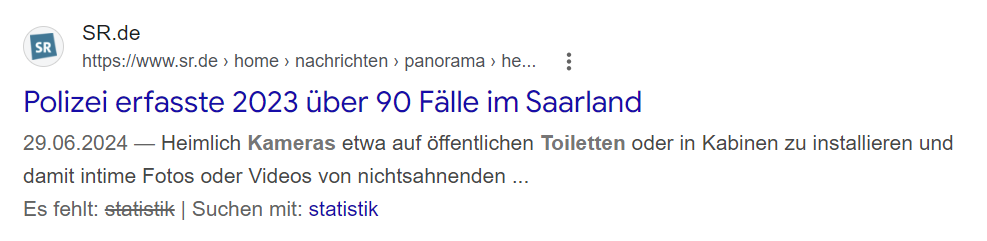
Unfortunately, incidents like this are not isolated cases. I couldn’t find any meaningful statistics on this, but the number of unreported cases is likely very high. During my Google search, I came across a headline stating that, according to the police, there were 90 cases in Saarland in 2023. Unfortunately, the page no longer loads, so I couldn’t read any more details about it. If you search for “camera found in restroom,” numerous articles about incidents in a wide variety of cities and facilities pop up.
There are several websites online with tips on how to find hidden cameras. There are also some apps that can detect cameras via Wi-Fi or radio signals. In my opinion, however, it’s not fair to shift the responsibility onto the victims. The question is rather how the installation of hidden cameras could be prevented, what role design could play in this, and how restrooms could be designed overall to make women feel safer there. It might be helpful to identify and analyse interactions in a public restroom to identify pain points and determine how these interactions could be improved. Can public spaces ever feel truly private? In addition, it makes sense to examine the architecture of restrooms and identify which architectural elements facilitate the installation of cameras, so that measures can be determined to prevent this from happening. This also sheds new light on the question of responsibility. In the end, is it the architects of restroom facilities who are responsible for making it difficult to install cameras? Or does the responsibility lie with the operators? With lawmakers? Or with the manufacturers of miniature cameras?
Potential observation and the feeling of being safe
Observing people while they use the restroom reveals interesting parallels to the concept of the panopticon explained earlier. The most obvious aspect is the feeling of being constantly watched, which, on the one hand, constitutes a massive invasion of privacy (as was also the case with the original Panopticon, where inmates had no way to withdraw from observation). At the same time, however, this leads to a loss of the feeling of security. This, combined with the constant possibility of being watched, has a major impact on the behaviour of those being observed. The constant uncertainty can foster a deep mistrust of public places. Moreover, precisely because of this uncertainty, invisible observation often feels more threatening than overt observation. This raises the question of what role the fact that there is no way to return the observer’s gaze plays. In my opinion, control and the loss of control play a major role here. In the Panopticon as well, the observer in the tower cannot be seen from the cells, which means that power clearly lies with the observer, and the inmates lose all control over the situation and are at the mercy of the observer. I would like to research in greater detail the effects this constant tension has on the psyche. I have already identified Michel Foucault’s “Überwachen und Strafen” (English: Discipline and Punish) as a source for this, which I will be able to access tomorrow at the university library in Ulm. In his work, Michel Foucault examined penal systems and power relations in 18th-century Europe [5] and, among other things, discusses the concept of the Panopticon and its implications. There is also a chapter in which he develops the concept of panoptism, which I’m already very curious about [6].
Hidden observation from an interaction point of view
The question that rises in the context of observation as a form of interaction is, whether or not it is still an interaction if only one side of the interaction knows of it’s existence. I found this definition of interaction in the Cambridge Dictionary:
“An occasion when two or more people or things communicate with or react to each other” [7]
This definition leaves some room for interpretation: if taken very literally, the criteria for an interaction would no longer be met, since the parties involved would have to react to one another. However, the person being observed does not actively react to the camera or the person who installed it, since they are unaware of its existence. On the other hand, in my view, the person is nonetheless unknowingly involved in an interactional relationship with the camera or the observer, even though they never consented to this. So the question cannot be answered unequivocally.
Follow Up Post
Other topics I’d like to explore in relation to women and observation include the objectification of women, the male gaze, voyeurism, and stalking, as well as why women observe and judge one another.
With regard to observation in general, I’d also like to examine digital observation and data collection, as well as live-streaming culture and the television show *Big Brother* as a pop-cultural digression.
Sources
[1] Bergsteigerbund. (n.d.). Fund einer Kamera in der Toilette im Klettergarten Rochlitz. Retrieved July 3, 2026, from https://bergsteigerbund.de/fund-einer-kamera-in-der-toilette-im-klettergarten-rochlitz/
[2] HT-Strafrecht. (n.d.). Heimliche Bildaufnahmen (§ 201a StGB). Retrieved July 3, 2026, from https://ht-strafrecht.de/sexualstrafrecht/sexualdelikte/heimliche-bildaufnahmen-201-a-stgb/
[3] Bundesministerium der Justiz. (n.d.). German Criminal Code (Strafgesetzbuch, StGB), Section 201a: Violation of the highly personal sphere of life and personal rights through image recordings. Retrieved July 3, 2026, from https://www.gesetze-im-internet.de/stgb/__201a.html
[4] Bundesministerium der Justiz. (n.d.). German Criminal Code (Strafgesetzbuch, StGB), Section 184k: Violation of the intimate sphere through image recordings. Retrieved July 3, 2026, from https://www.gesetze-im-internet.de/stgb/__184k.html
[5] Wikipedia contributors. (n.d.). Discipline and Punish. In German Wikipedia. Retrieved July 3, 2026, from https://de.wikipedia.org/wiki/%C3%9Cberwachen_und_Strafen
[6] Michel Foucault. (1977). Überwachen und Strafen: Die Geburt des Gefängnisses. Suhrkamp.
[7] Cambridge University Press. (n.d.). Interaction. In Cambridge Dictionary. Retrieved July 3, 2026, from https://dictionary.cambridge.org/de/worterbuch/englisch/interaction
Note
Parts of this text were translated from German to English by Deepl.com.
