„Your Master Thesis should be the most ambitious thing you ever did.” This sentence, written on a presentation slide of our Design and Research course with Birgit made me think. It made so much sense to me, but at the same time it shifted my view on the Masters thesis. It’s not only something that I have to do, but also something that should feel in a way meaningful to me. It also made me rethink the topic I chose for last semester. I think the sentence wouldn’t apply to that – it doesn’t feel big enough. It would not be the most ambitious and meaningful thing I ever did. It doesn’t seem important enough to me.
So what now? What would feel important enough? As always when I need to sort my thoughts, I pulled out a notebook (I upgraded from random sheets of paper to something more durable) and started writing everything that would interest me as a topic on a mindmap and connected aspects that I thought would match. I wrote topics as well as things that make me worried, but also possible media I would specifically like to design as an outcome of the process. I will later take a picture of the notebook pages and upload them to this post.
The outcome of my brainstorming session was the following:
- Idea 1: Investigate how the use of AI will affect human coexistence. Then think about how the situation could be improved by design. Then think about how to raise awareness about the effects of AI and what people could do to avoid possible negative consequences. How could this be conveyed? Possible outcome: interactive installation / exhibition either for adults or children / youths, that travels from school to school
- Idea 2: How will AI affect the job market? Will paid work play a lesser role or even disappear entirely? How will the design sector in particular be affected? Research on the role of employment in building identity and creating meaningfulness. How could alternatives that fulfil the same purpose look like? What role can design play here?
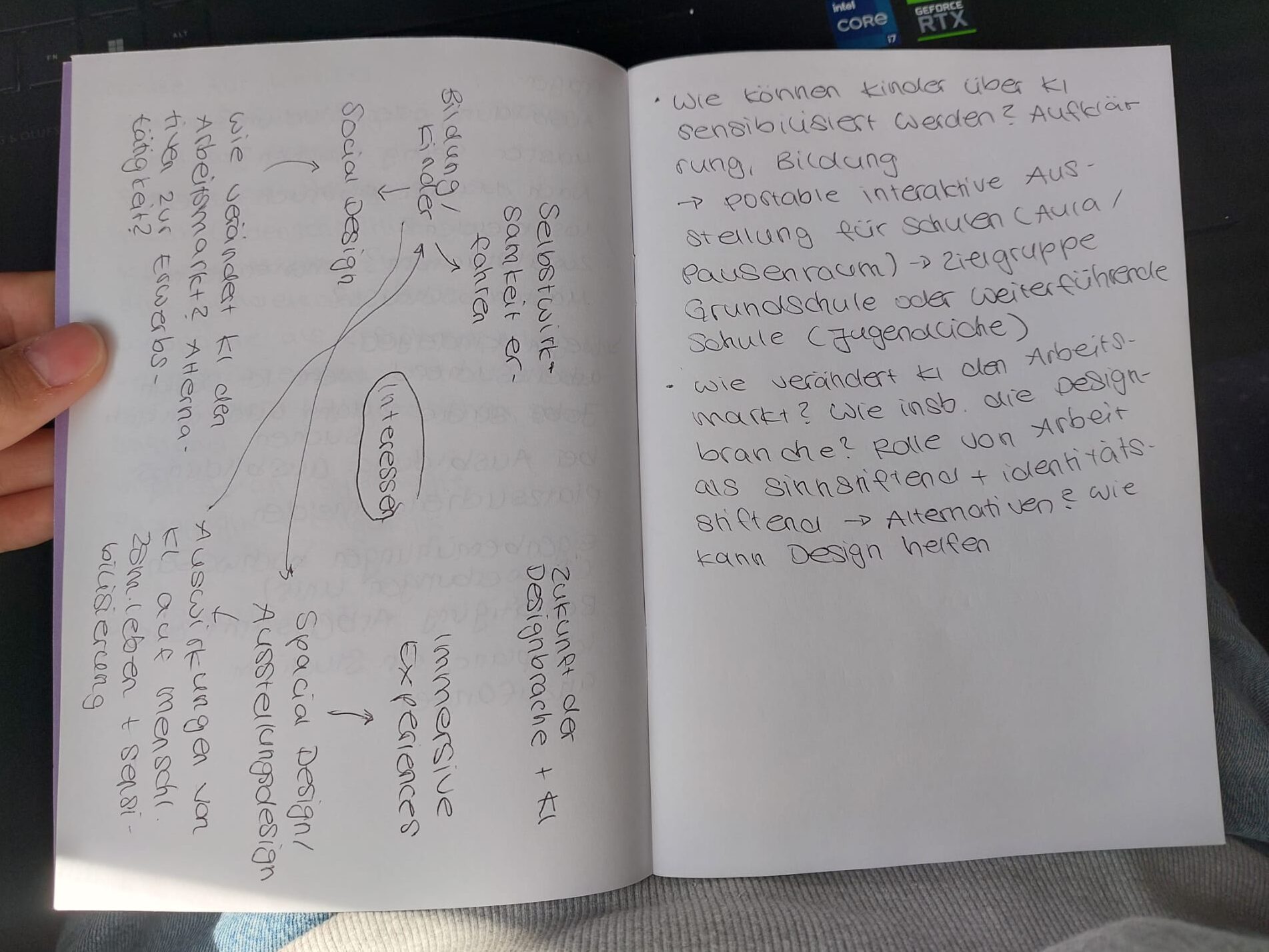
After this first round of brainstorming I read some online articles on how to find a topic for a master thesis. Then I asked ChatGPT to give me 3 journal prompts to find a suitable topic. This is what it gave me as a first task:
1. Interest Mapping Journal
(What really draws you in?)
Here’s how it works: For 1–2 weeks, keep a daily journal with three brief categories:
- What sparked my curiosity today?
- What irritated or annoyed me?
- What did I think about longer than necessary?
Important: Don’t filter. Everything counts:
- Interfaces
- social situations
- technologies
- habits
- physicality
- work
- learning
- AI
- public spaces
- games
- digital fatigue, etc.
- Why this helps
Master’s thesis topics often don’t arise from “cool ideas,” but from:
- recurring attention
- unresolved tensions
- personal obsessions
After a few days, you’ll start to see patterns:
- recurring terms
- specific contexts
- the same emotions
- similar problems
These often lead to promising research directions.
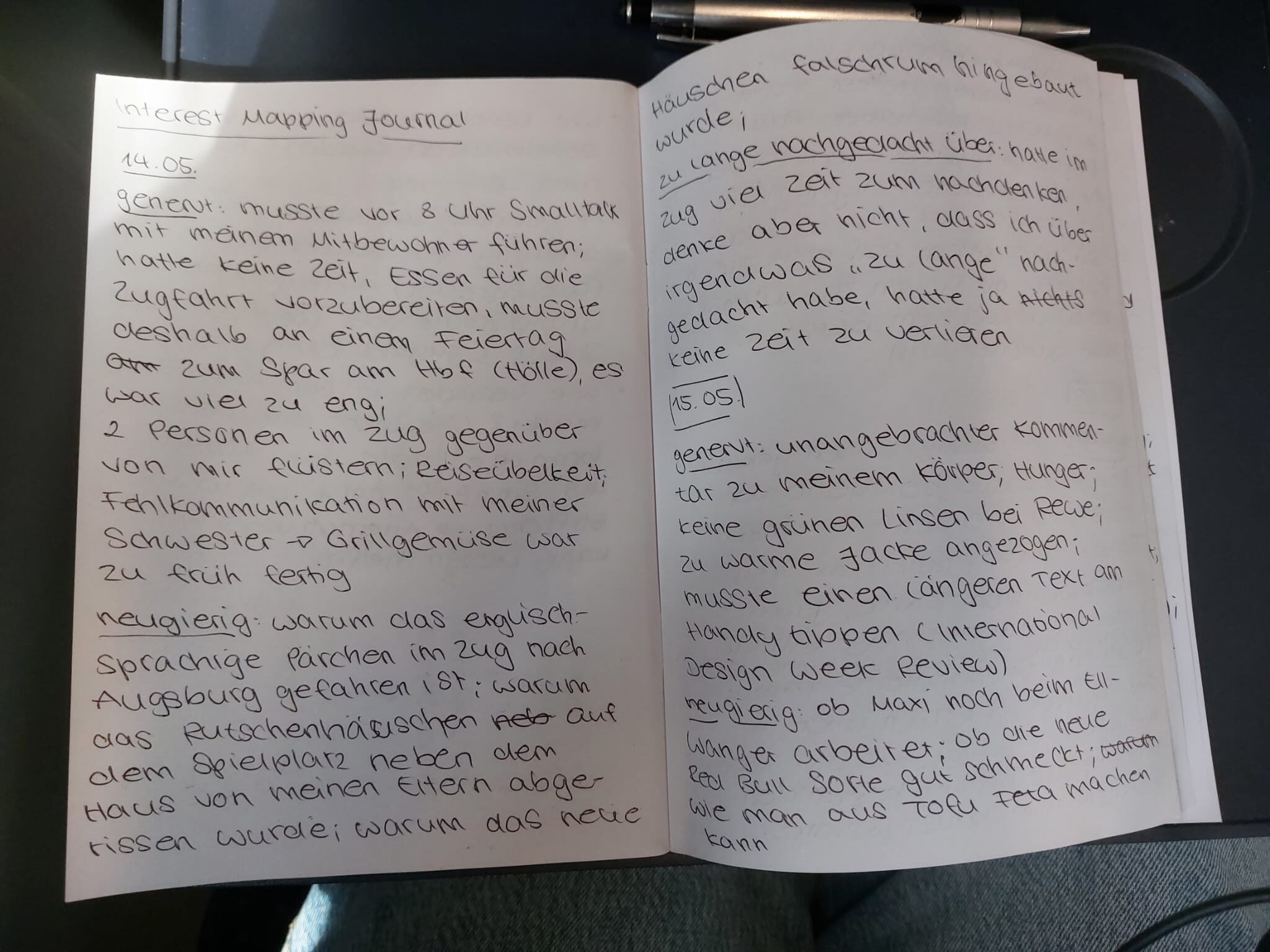
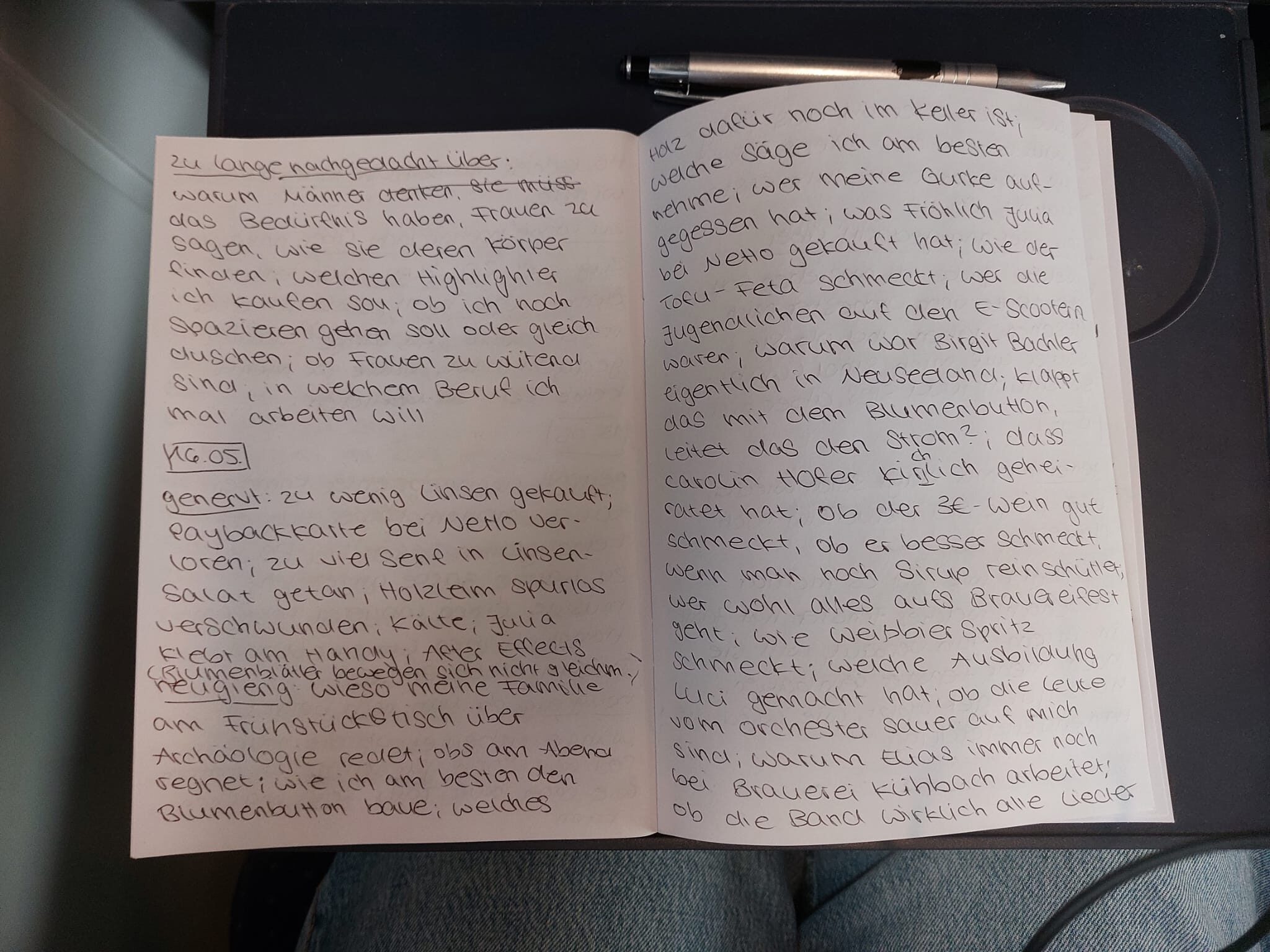
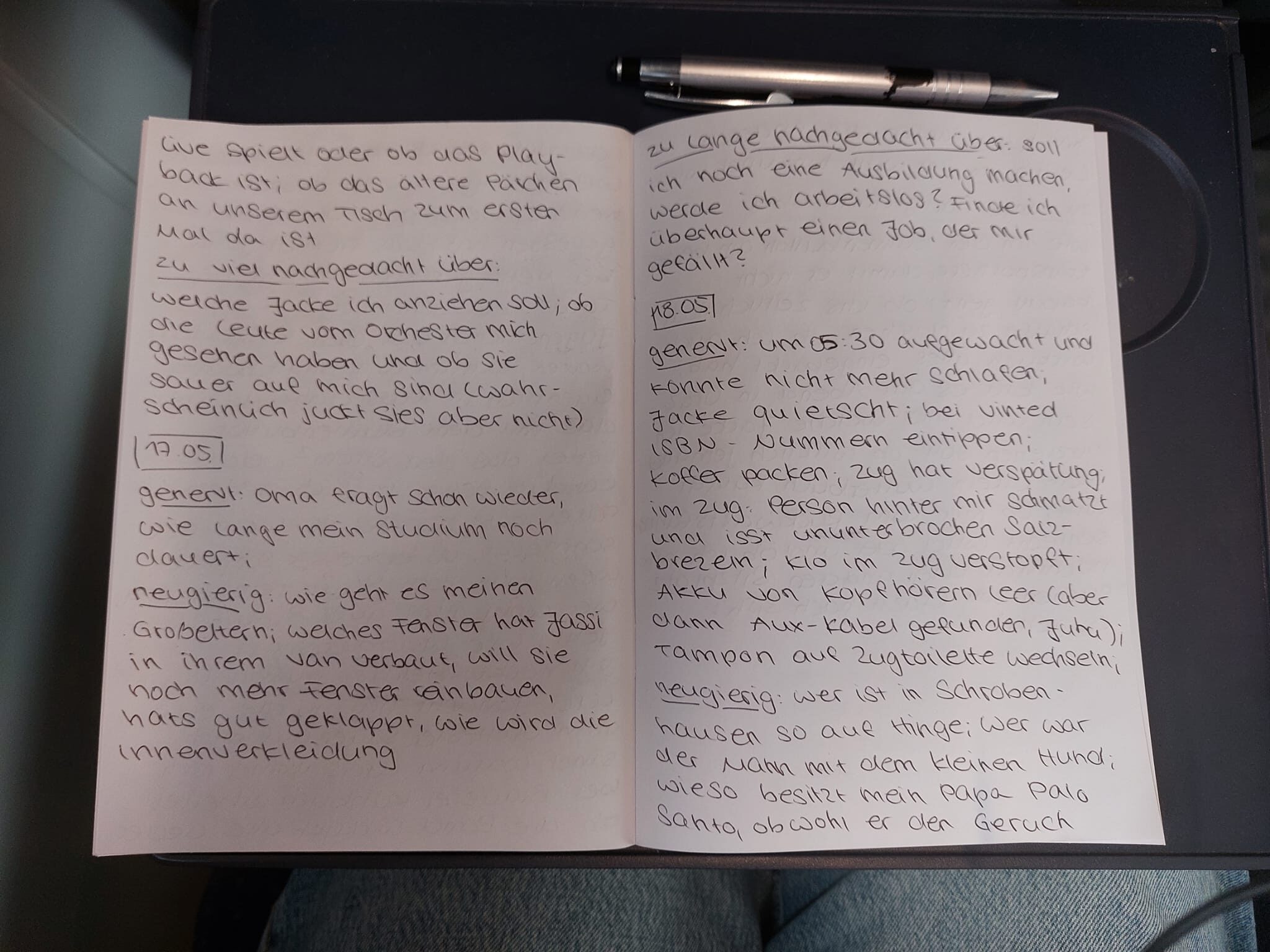
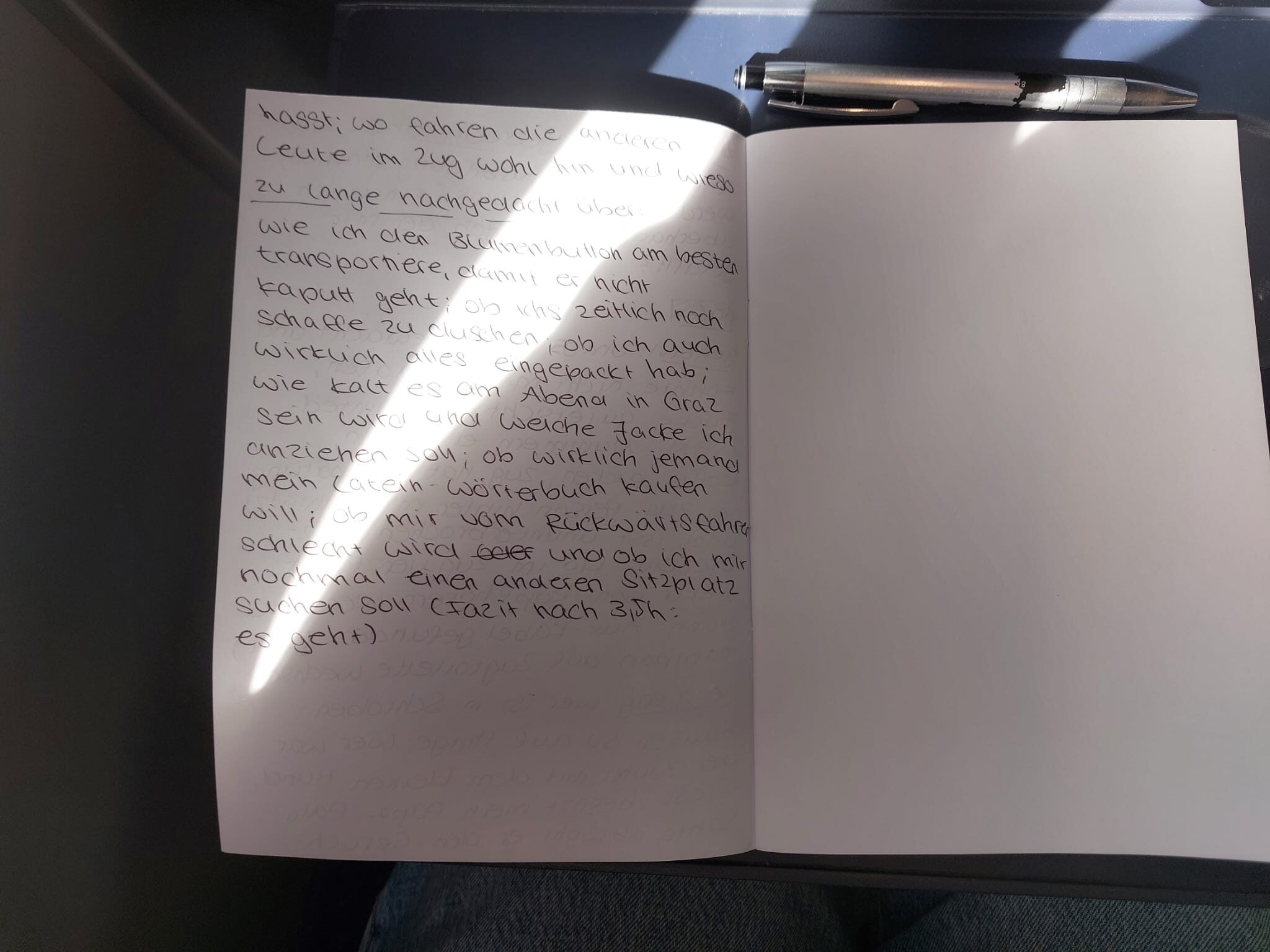
I documented the questions for five days in my notebook. I found that I’m annoyed either by people or the sounds they make, by the weather or trains, I’m apparently quite curious about gossip and people on the train and think a lot about what jacket to wear, my future and daily errands. While analysing this, I kind of got stuck on my curiosity for other people and their travel destinations. I sometimes wonder if I should just ask the people opposite of me in the 4-person seat where they are going and why, but I’m usually too shy or I fear I might annoy them. I once had a very nice conversation with a woman from Graz who lives close to Mannheim now. We even ended up exchanging numbers because she was looking for a new renter for her apartment in Graz.
I take the train home to Germany every few months and I’m usually quite bored during the 6h journey. I think it would be cool to ask the people next to me if they would be interested in a round of card games, but first, I never have any games with me and second of all they usually seem very busy on their laptops or wear headphones. Maybe it would be interesting to investigate if people are generally open to connecting with others on long train rides, e.g. while playing games, or if they prefer to just be by themselves. I also wonder how people could naturally be motivated to interact with each other without making it feel forced.
Thoughts on the journalling method
I was a bit sceptical about this method in the beginning, especially because I went home to my parents place this weekend and didn’t expect anything extraordinary interesting to happen during those days – even while writing things down I thought there would be nothing relevant as a research topic. I’m surprised that it actually helped me a bit. I’m not sure if I will stick with the connecting-people-on-trains thing, but I definitely think it could be interesting. I will continue this method for the upcoming week since I think there might be different results when I may days are more structured and when I spend more time at FH. Also continuing especially the curiosity part during our trip to WebExpo in Prag could bring some interesting findings.
I think I will have to postpone the other 2 journalling methods to another day, but I’m already curious about what new ideas they might bring me. For a start I don’t feel as lost anymore as I did on thursday, when I started writing this post.
For the sake of completeness I will include pictures of my notes at the end of this post.
Next steps:
Try out the other methods, hopefully find another interesting topic idea and start prototyping for some interactive approaches to connect travellers.
Journalling pages