Short Note on “Überwachen und Strafen”
I went to the library of the University Ulm yesterday to get my hands on the book “Überwachen und Strafen” by Michel Foucault, but I wasn’t able to find it, When asking for it at the front desk I was told that I have to order it first, because it’s not accessible in the public shelves there. Luckily, my sister studies at the university of Ulm, so she will order it for me and also borrow it so I can read it at home. But it will take a while until I get it, so I won’t be able to read it before the deadline for these blogposts. I will have enough time to read through it though during the summer break.
The Trainship Book
Unfortunately, I was sick during both “Bring Your Prototype” sessions this semester, and in the days leading up to them as well, so I didn’t sit down to develop my first 30-minute prototype until Friday. For this, I went back to the long-distance train ride setting, since I’d already had an idea for it some time ago.
The idea is to create a kind of “friendship book” that passengers can fill out during the train ride. It features questions that everyone might secretly ask themselves while observing their fellow passengers on the trip. Train passengers constantly construct stories about the people around them. They infer destinations, relationships or emotions based on clothing, luggage or behaviour. The friendship book shifts this process from imagination to voluntary self-disclosure. Instead of guessing, travellers can decide which parts of their story they want to reveal. It serves several purposes at once: On the one hand, the book is an interesting way to pass the time on long trips; on the other hand, it satisfies people’s natural curiosity without requiring direct interaction. The book can still serve as a conversation starter without forcing social interaction.
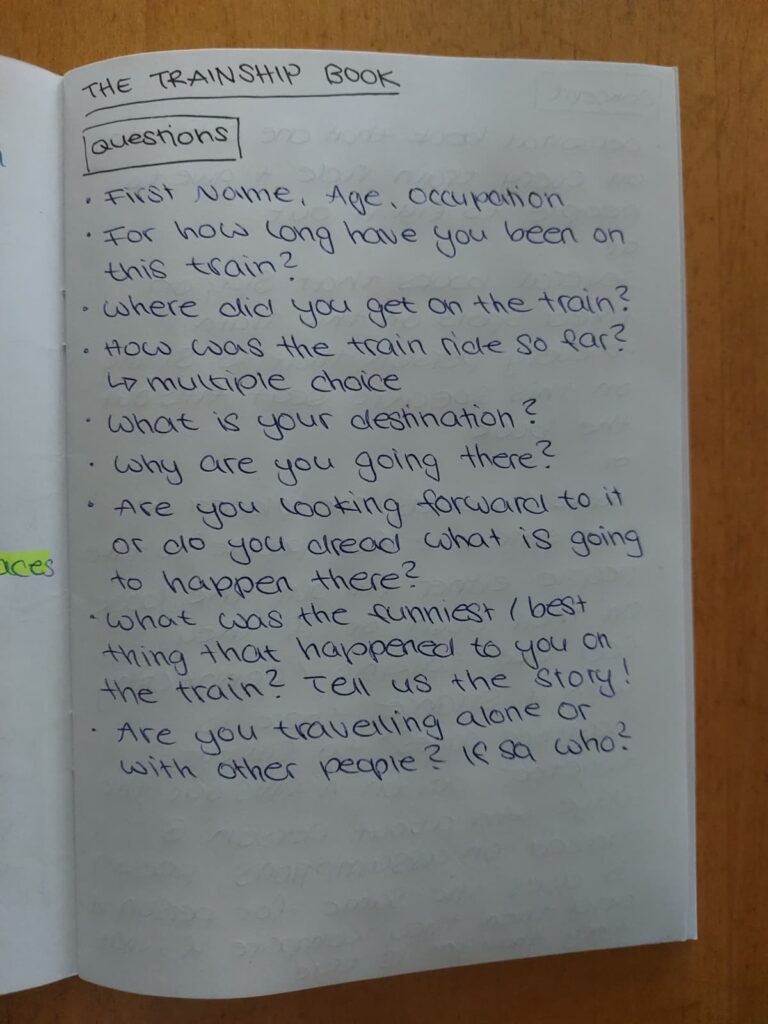
I’ve come up with the following questions for the book:
The Layout
There will be a short introduction text on the first page, explaining the concept of the book and how it’s meant to be used. Then there will be double pages for the persons to fill out with questions related to their trip. The personal section on top will be very short, but I still decided to include it, so the readers would get a rough image about who that person is. After that it starts with some basic questions and goes more into detail when it comes to the reason why the person is travelling to this destination and how what is going to await them makes them feel. I think if the travellers feel comfortable to be honest here, it could create a sense of authenticity and connection, if other people find themselves in similar situations or struggeling with the same anxious thoughts, for example. Then there will also be some pages where people can tell stories about the best or funniest thing that happened to them on the train. This could as well be very entertaining to read. I also thought about including a spread where people can recommend songs to each other which they then can listen to while on the train. It might also be nice to sort the songs into different categories depending on the current mood, e.g. “Listen to this song when you are sad.” or “Listen to this song when it’s raining outside”.
The Prototype
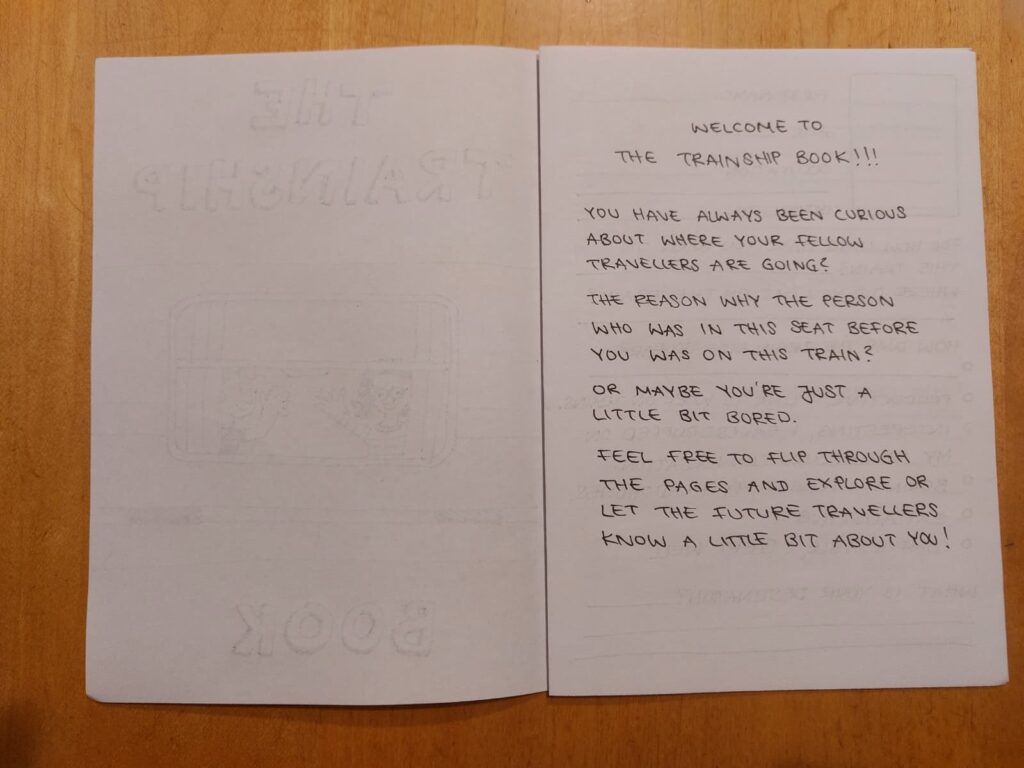
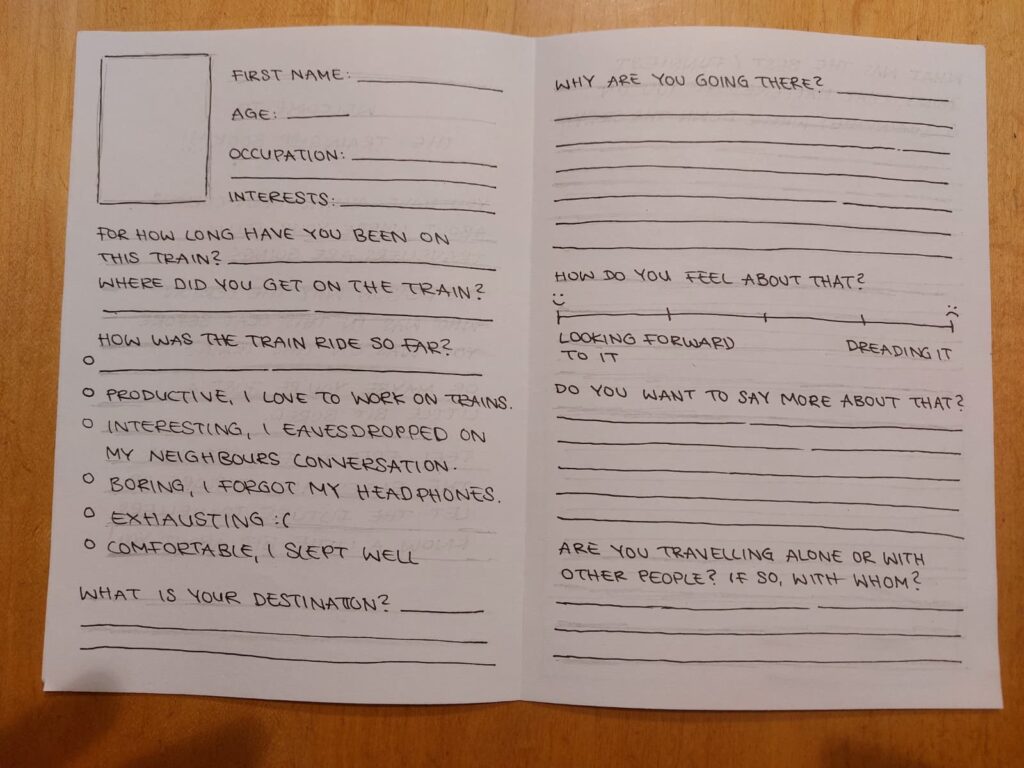
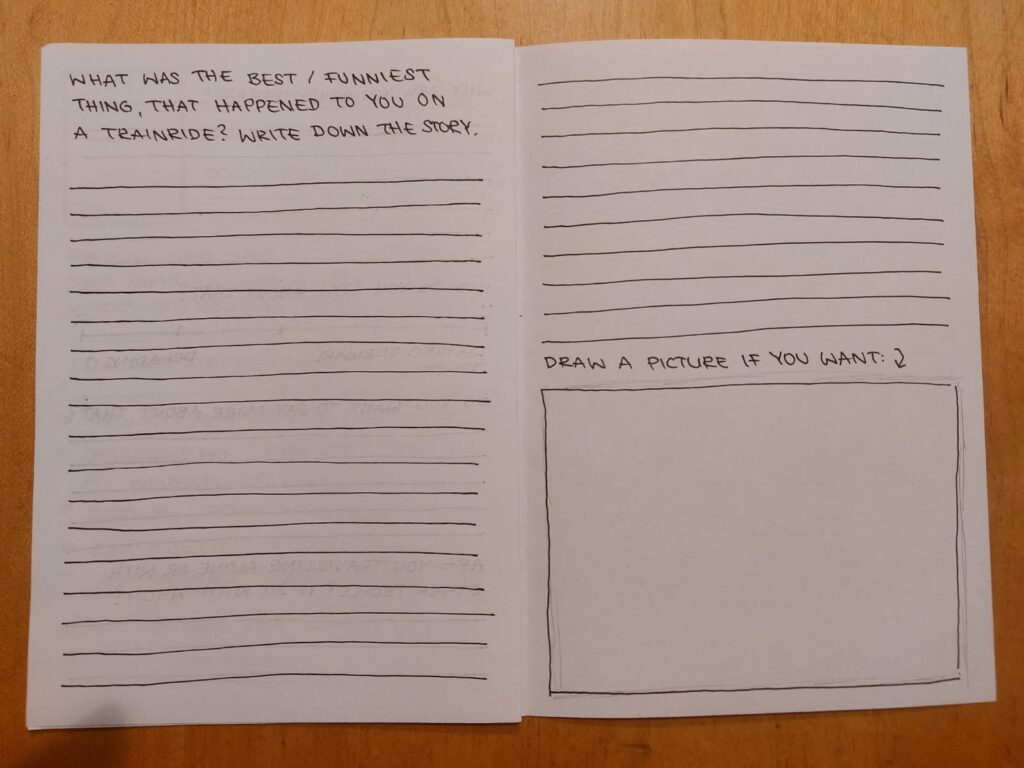
I did a quick 30-minute prototype of the three spreads I described earlier. I tested it on the way back from Ulm, but I forgot the filled out version at my sister’s place, so I will have to ask her to send me a picture of it.
The Concept
There is different options when it comes to where the book is going to be placed / who owns it.
OPTION 1: The book belongs to an individual person and they can bring it on train rides whenever they feel like it and then just ask people to write in it. That way they “collect” friends on their journays over time. This might be a good option for more extrovert and outgoing people, but also for people who wish to engage more in conversations with strangers, as it causes active social interaction. This is also the option that I tested on my way to Ulm on the weekend.
OPTION 2: There is several books on the train that stay on fixed spots, so each person sitting in that specific seat would fill out the book. That way people would find out things about the people that were in the exact same place in the past, which could be also very interesting, since it causes asynchronous interaction.
OPTION 3: the books would be placed at the entrances for people to take and give to other people. These books would be more like booklets, only for this one trainride to keep as a memory afterwards. What is interesting about this option is that it connects more than two people on the same train ride.
My favourite would be option 2, since it’s the most appealing to me personally. I would enjoy to read about the people who were there before me. Apart from that I think one of the advantages is that after a while there is many filled out pages to read through, so it might be more interesting. Additionally, it serves as a temporary pastime for many people and is therefore more sustainable than individual books, which may eventually be forgotten or end up in the trash because they’re too much of a burden to carry while traveling.
The Testing
I found it easier to talk to someone on the train this time, because I had a “valid” reason for it. I realised that the prototype did not only test the book itself, but also gave me permission to approach a stranger as a way of “social excuse”, lowering the barrier that usually prevents conversations between passengers.
The journey from Augsburg to Ulm only takes around 45 minutes, which made the situation feel less intimidating, as I knew I would be leaving the train soon anyway if the interactionbecame awkward.
There was a girl around my age sitting next to me, so after briefly explaining my project, I asked if she would be willing to fill out the prototype pages I had prepared the evening before. Although I was a little nervous at first, but I soon realized that we were getting along quite well. While she was filling out the pages, we started talking about our experiences of travelling by train and realised that neither of us would usually start a conversation with a stranger unless we were approached first.
She told me that she found the questions interesting and enjoyed answering them. Nevertheless, I plan to conduct a small survey to evaluate which questions people find most interesting and whether some should be revised or replaced.
Overall, the prototype confirmed that the friendship book can work as an effective conversation starter. It provides a clear reason to approach someone while still making it easy for the other person to decline without feeling uncomfortable.
I wondered whether the book functions more as a social mediator than as the actual activity itself. In this particular situation, I think the physical object was probably more important than the questions it contained. Having a tangible artefact provided a natural reason to approach someone and made starting a conversation feel much less awkward. The questions mainly served as a gateway to further discussion about train journeys and interactions with strangers. However, I believe this would change if the books became a permanent feature on trains, as proposed in option two. In that case, the content of the questions would likely become much more important, since passengers would spend more time reading previous entries and contributing their own thoughts.
Would the same conversation have happened without the physical book? Probably not, or at least it would have been much more difficult to reach that point. Without the book, I would most likely have had to start with conventional small talk before changing the topic to how someone feels about talking to strangers.
Limitations
Of course, this was only a very small test, so I cannot draw any general conclusions from it yet. I only asked one person to participate, who also happened to be around my age. She was open to talking to me, so the situation was probably easier than it could have been with someone else. I also tested the prototype during the day on a relatively short train ride. I think the results could be different on a longer journey, in a crowded train, or with people who are in a hurry or simply do not want to interact. If I want to stick with the idea of the trainship book I will definitely have to test the concept with more people before I can properly evaluate it.
