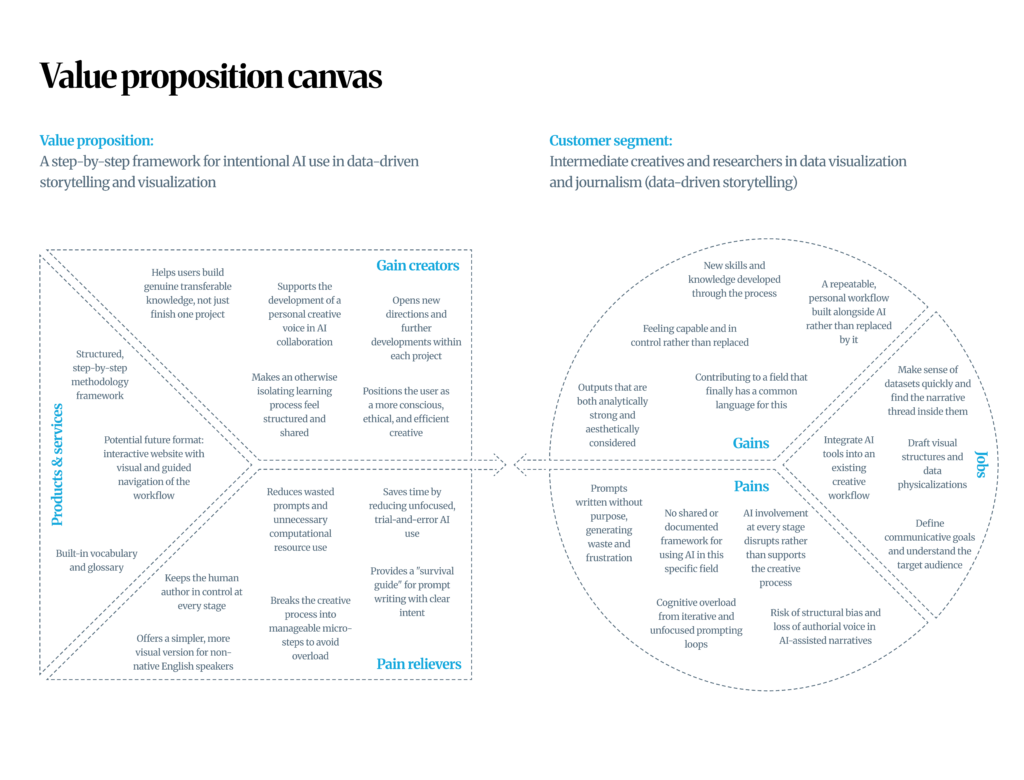
Every research project, at some point, has to find an answer to the following question: who actually needs this, and why would they reach for it? Mapping out the customer profiles and value proposition for this methodology felt like one of the more revealing steps of the process, mainly because it forced me to stop thinking like a researcher and start thinking like someone who has to explain why this matters to a stranger. Two potential users came to mind immediately, and they arrive at the same problem from different starting points.
Profile 1: the intermediate creative or researcher
This person already works in data visualization or data journalism. They know their tools, they have communicative goals, and they have probably already experimented with AI in some part of their process. The frustration is not unfamiliarity. It is the lack of structure. They write prompts without a clear framework, use AI across too many stages, and spend more time correcting output than creating. What they want is a workflow they can repeat, trust, and call their own. A process that saves resources, reduces noise, and keeps their authorial voice intact.
Profile 2: the student or freelancer new to data-driven storytelling
This person has just entered the field. They might be studying design, communication, or journalism, or picking up freelance work that is pushing them toward data narratives for the first time. AI feels both exciting and overwhelming. They do not yet have a reference point for what “good” looks like in this process, and the specialized terminology alone is enough to make them feel like they do not belong. What they need is not just a workflow but something that builds their confidence and knowledge at the same time as it guides their practice.
What this methodology could offer to both
For both profiles, the core offer is the same: a step-by-step framework that makes intentional AI use in data storytelling accessible, documented, and repeatable. For the intermediate user, it brings order to an already active practice. For the newcomer, it lowers the barrier to entry without oversimplifying the field.
The pain relievers are practical: fewer wasted prompts, a clear structure for each stage of the creative process, a built-in glossary so no one has to go looking for definitions elsewhere, and a simpler visual version for those who find dense theoretical language a barrier.
The gain creators go deeper. Both profiles walk away with more than a finished project. They build transferable skills, develop a personal voice in how they collaborate with AI, and become more conscious and ethical users of a tool that is not going away.