When I stood in front of the interactive screen at the Ars Electronica Center, there was one thing that sparked my interest immediately. The installation invites you to do something incredibly simple: pick up a digital pen, sketch a few lines, and watch a machine learning system immediately try to transform your doodles into a fully rendered, colorful cat. The piece plays on a popular piece of German internet slang for a cat, setting a lighthearted tone for what is actually an existential encounter with artificial intelligence. I drew a few shaky, anatomically questionable lines, and almost instantly, a furry, slightly cursed digital creature arose on the screen.
Beneath the humor of creating these accidental monsters lies a fascinating look into how modern generative AI interprets human input. The engine driving this transformation is an advanced neural network known as a Conditional Generative Adversarial Network. To understand how it brought my terrible drawings to life, I found it helpful to picture a high-stakes creative competition happening inside the computer. The system splits into two competing algorithms: a Generator and a Discriminator. The Generator acts like an art forger, starting with no knowledge of what a cat looks like and trying to create one from scratch. The Discriminator acts as a detective, comparing the forger’s creations against thousands of real cat photos it memorized during training. They push each other until the fake images become astonishingly detailed.
What makes this specific setup so fascinating to interact with is the conditional part of the tech, which is designed for image-to-image translation. In a standard setup, you press a button, and the AI spits out a random, perfect image. Here, the system is given a strict blueprint: a simple sketch. The Generator is forced to translate my exact lines, curves, and mistakes into the final image. It looks at the brushstrokes and figures out how to cram the textures of fur, whiskers, and shadows into the bizarre boundaries provided.
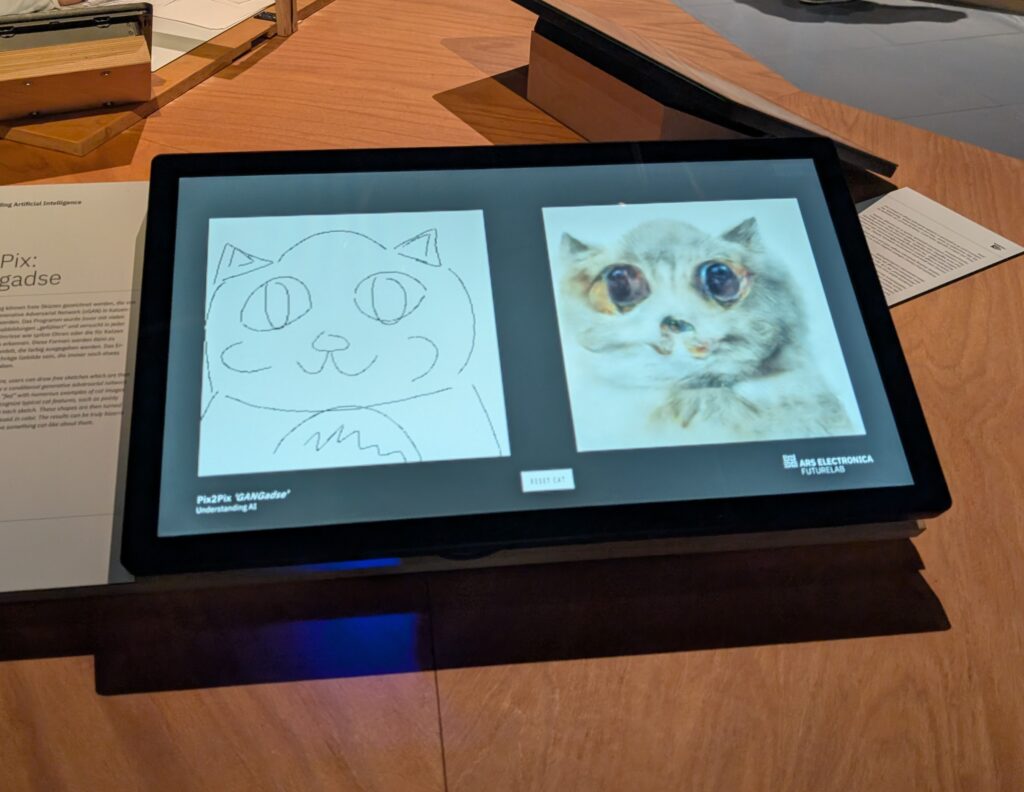
This translation process relies on the network’s ability to recognize spatial patterns. For my first attempt, captured in the image above, I tried to play along and drew a relatively standard, cartoonish cat face with big round eyes and pointed ears. Because the drawing roughly aligned with what the AI expected, it tried its best to map realistic textures over those specific regions. However, you can see how it over-interpreted the massive eyes I drew, filling them with an unsettlingly realistic, glossy depth that makes the final output look incredibly intense, yet undeniably feline.
Because this network was trained exclusively on felines, it possesses a hilarious, stubborn blindness. It is completely incapable of seeing anything else. If you try to draw a house, a car, or something else entirely, the system will still desperately search your lines for pointy ears or whiskers, forcing cat attributes onto absolutely everything. I decided to test the absolute limits of this bias with my next drawing, which you can see in the image below. Instead of a cat, I drew a stylized character wearing a backwards cap, sporting giant elephant-like ears, and a long trunk-like shape on its face. The AI was completely unfazed by my lack of cooperation. It looked at the round head and the brim of the hat and somehow translated those shapes into a furry, shadowy texture, attempting to force the contours of an animal coat onto human streetwear.
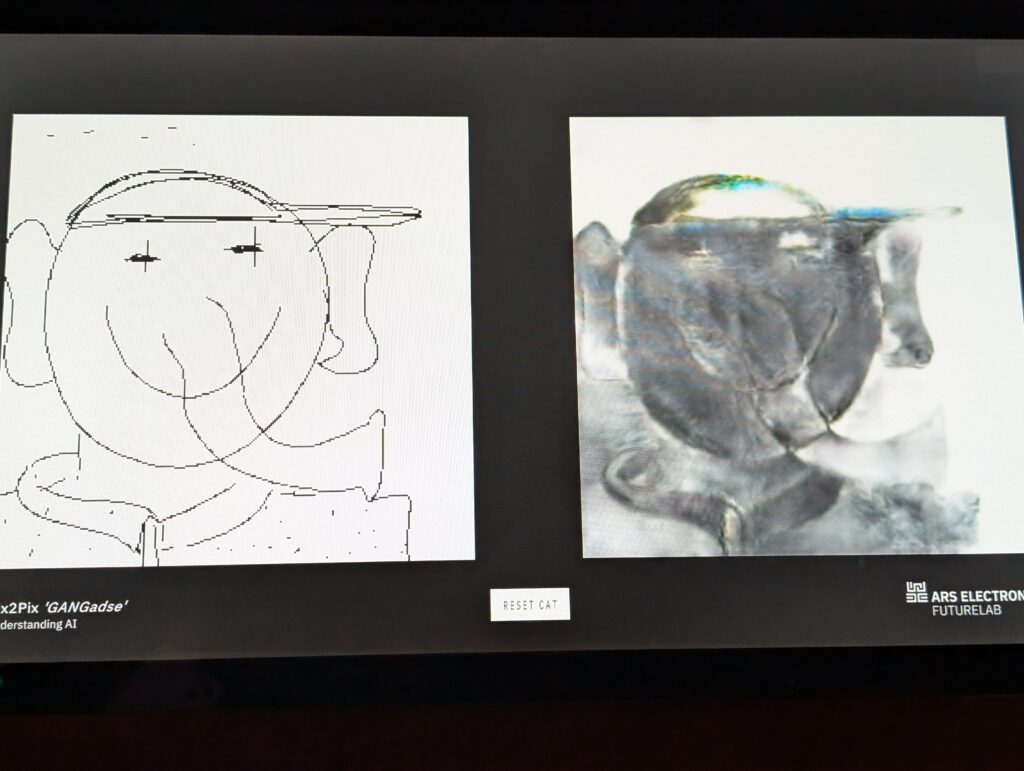
This rigid worldview is exactly why the final drawings turn out so beautifully bizarre. The machine has no conceptual understanding of biology, anatomy, clothing, or what a living creature actually is; it only understands pixel statistics. When I drew an impossible, abstract shape, the network faithfully attempted to render photorealistic fur, depth, and organic lighting over my nonsensical geometry. The result was a surreal hybrid—a digital creature that looked like a cubist painting brought to life with organic textures.
Walking away from the screen, I realized the installation is a brilliant educational tool wrapped in a playful artistic experience. It peels back the layers of the mysterious AI black box and lets you see firsthand how these algorithms interpret, distort, and reconstruct our world. It left me thinking about a future where human-machine collaboration looks exactly like this: we provide the messy, creative spark through a simple sketch, and the machine handles the complex, data-driven task of rendering it into reality.
