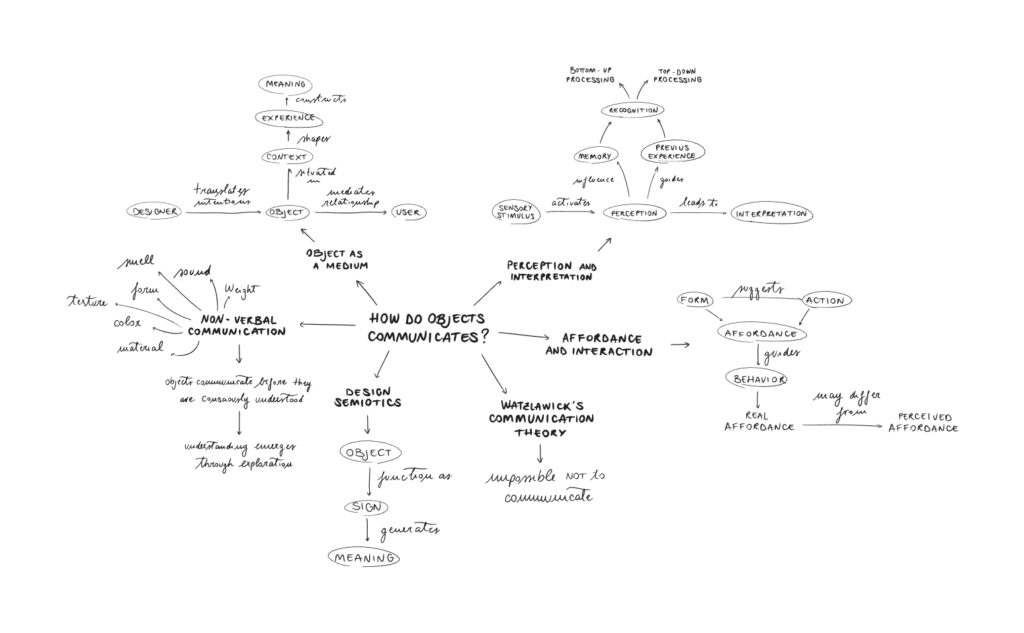
Creating this concept map helped me organize and connect the different topics I explored during my research. Since the map is a general overview of the subject, it allowed me to identify relationships between concepts that I had initially considered separately.
One of the main insights I gained is that communication is not a one-way process: objects do not communicate only through their function. The meaning of an object is created through the relationship between the object, the user and the context in which it exists. This made me realize that communication is not fixed, but changes according to perception, experience and interpretation.
I found the connection between perception and affordance particularly relevant because it shows how design can guide actions and behaviours.
Another interesting aspect was with Watzlawick’s communication theory, especially the idea that “it is impossible not to communicate”. This principle can also be applied to objects: every designed artifact communicates something through its form, materials and presence, even when this communication is not intentional.
Since this concept map is only an introduction to the topic, many aspects could be explored further.
In particular, I would like to explore how different people interpret the same object and how personal experiences influence meaning.
Overall, this exercise helped me develop my research question further. I am still interested in how objects communicate, but I now want to explore more specifically how design choices influence perception and how people create meaning through their interaction with objects.
This research helped me see everyday objects not only as functional products, but also as active elements of communication!
