Can design help prevent doomscrolling?
With social media platforms like Instagram and Tiktok it’s easy to get trapped in a cycle of never-ending scrolling. These platforms are designed to keep our attention for as long as possible, making it hard for the user to put the phone down and move on. They are tempting the user with a never ending supply chain of content with an algorithm perfectly fitted to the individual user. I myself, and many other people in my life have experienced this fist hand. You scroll on social media constantly having new content pop up and all of a sudden, an hour or two has passed by. It is called doom scrolling when this chain of content has a negative affect on the user, leaving them with feelings like sadness, anxiety or stress. This does not only affect people’s mental health but can also shape how people perceive the world and interact with technology. The algorithm is often so good that people still continue to scroll endlessly even though the content the consume is mainly negative, because it shows the type of content they find interesting, not recognising that overconsumption of these topics can be bad for their mental health.
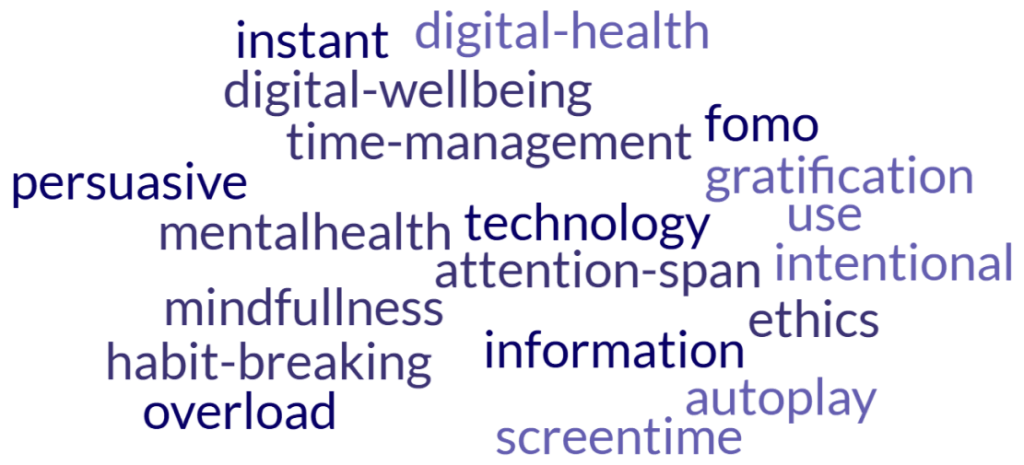
Research questions
- How can interaction design be used to reduce or prevent doomscrolling
- Can designers prevent the negative side affects of social media usage while still keeping the good parts?
- What role does interface design play in helping users manage their screentime?
Potential challenges
- Will external nudging be enough or is personal motivation needed
- Design is part of the problem and hopefully also the solution
- Getting designers to take ethical responsibility and puting it over their/ the companies buisnes goals.
Possible approaches
The project could explore different ways of limiting peoples screentime or the content they consume by for example nudging the user to take breaks or swich focus, or simplifying the design of this kind platform to strictly necessary features.
Personal motivation
This topic is very relevant for todays time, espessially with younger generations that are growing up with the access of smartphones and tablets, being so used to having access to constant entertainment. Personally, this topic also raises the question of ethical design. Is it ethical of an app designer to design a platform so well formed that the user get trapped? The designer is doing its job very well, and is probably getting paid what they deserve, but is it right when the use can lead to healt issues? One can argue that the platforms also inflict a lot of joy when used corectly. Is there a way to use design to keep the joy and decrease the negative side affects? I want to find out. As an interaction designer, I want to find out how we can design digital environments that promote healthy use of social platforms rather than feeding this addiction.
Relevance to design
The issue of doomscrolling is highly relevant to the design field, as designers shape the interfaces, flows, and feedback systems that can either encourage or help prevent compulsive use. Domscrolling highlights how design directly influence user behavior, attention, and wellbeing
For interaction designers, the topic questions current engagement-driven patterns such as infinite scrolls and autoplay, and prompting exploration of more mindful, reflective, and balanced alternatives. From a product and service design perspective, it highlights the need to prioritize digital wellbeing.
On an ethical level, designers should consider their responsibility within the users mental wellbeing, within both mental heath and peoples attention span and consider moving from maximizing engagement toward supporting healthy digital habits.
Upcoming research
Personal experiments
I will try to find affective ways of reducing screen time by testing 3 different recomended methods on myself the following weeks.

After the experiments i will answer some questions like: Did i manage to decrease my screentime? Did aything happen to my consentration? Did my mood encrease or decrease? Did I miss using my phone? What did I do instead of scrolling? Did I feel like I missed out on anything by not being online as much?
I will also gather information online via articles, videos, podcasts and such. In addition i plan on holding interviews with social media users among my peers to gather a wider understanding of the issue
References
- “Focus Friend – by Hank Green,” Mobile application, Google Play Store. [Online]. Available: https://play.google.com/store/apps/details?id=com.underthing.focus.friend. Accessed: Nov. 5, 2025.
- “Freedom: Block Websites, Apps, and the Internet,” Freedom.to. [Online]. Available: https://freedom.to/. Accessed: Nov. 5, 2025.
- “How Social Media Affects Mental Health,” Deconstructing Stigma, 2025. [Online]. Available: https://deconstructingstigma.org/guides/social-media. Accessed: Nov. 5, 2025.
- N. Eyal, “I Ran 4 Experiments to Break My Social Media Addiction. Here’s What Worked,” Harvard Business Review, Oct. 2018. [Online]. Available: https://hbr.org/2018/10/i-ran-4-experiments-to-break-my-social-media-addiction-heres-what-worked. Accessed: Nov. 5, 2025.
- “What Doomscrolling Is and How to Stop,” Cleveland Clinic Health Essentials, 2025. [Online]. Available: https://health.clevelandclinic.org/everything-you-need-to-know-about-doomscrolling-and-how-to-avoid-it. Accessed: Nov. 5, 2025.

This is such an interesting topic. I am looking forward to what you are going to find out.