The paper I chose to read on the NIME archive was:
Bubble Drum-agog-ing: Polyrhythm Games & Other Inter Activities by Jay Alan Jackson
The reason I chose this paper is because it had something to do with games, which was my very open research topic so far. The whole thing is about using big exercise balls as drum kits.
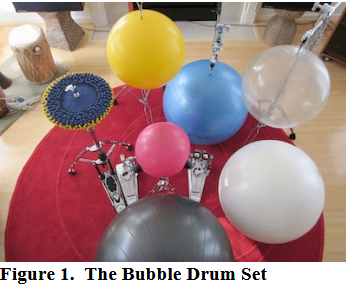
As seen on the picture, this project wanted to re-imagine drum kits capable of input. Regular drums are loud and can damage hearing, but provide a steady exercise value. Rubber drum kits for practicing with input also exist in the form of Guitar Hero or Rock Band.
What the author wanted to achieve was to eliminate the feeling of no feedback and thus no feeling when it comes to hard rubber kits. The data is captured using an accelerometer, microphone and camera inputs, to make it possible to play rhythm games. There are microphones placed closely to the bubble drum and they use Drumagog to replace the drum samples, while replicating the original performance responsively and accurately.
The paper also mentions that both aural and visual feedback are provided, but this is within the games themselves. The game that was developed by the author was a simple flash game “Polynome”. The objective and challenge is for the player to perform polyrhythmic patterns to existing songs, using the drums as controllers. The drum samples are using different elements depending on the song, in order to create unique remixes of rhythm and sound.

What’s interesting to me is the UI shown, the circles with the lines inside them are a reoccurring motif that is, I assume, meant to be the main indicator of what to do within this game. I’m not very well versed with music theory, but I am well versed with rhythm games, so I would have to wonder what these symbols mean and how this game actually makes things clear to the player. Unfortunately, these aspects aren’t described or analysed in this paper.
Overall, I find the idea fun because I like rhythm games and unique interaction methods acting as controllers. However, I find the paper to be a bit shallow and lacking more technical information. I can’t fully imagine the interaction, how the game would work, or how this entire thing would provide a “rigorous workout” (as stated many times in the text).
References
- [1] J. A. Jackson, “Bubble Drum-agog-ing: Polyrhythm Games & Other Inter Activities,” in Proc. 12th Int. Conf. on New Interfaces for Musical Expression (NIME), Ann Arbor, MI, USA, May 22, 2012, exhibit.
