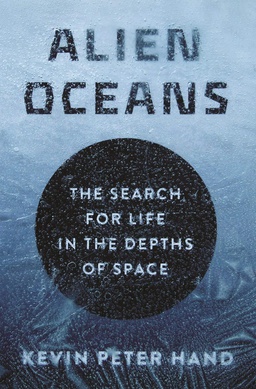
In order to continue my research into how we could depict life outside our known world, I began reading the book Alien Oceans by the astrobiologist and planetary scientist Kevin Peter Hand. The book explores the possibility of life within our solar system – though not on a planet, but on Jupiter’s moons.
I want to explore what alien life on one of these moons, more specifically Europa, could look like – what environment could exist, what flora, what fauna. What intelligent life could look like – how it would behave, communicate, what culture it would develop. Using both science and my own imagination I want to create a far-off world and use this book as basis for storytelling.
Life Here and Possibly Elsewhere
But first of, what’s so special about Jupiter’s moons? How could life possibly exist there? Well, for a long-time we believed alien life was only possible in the habitable zone, on a planet not too hot or too cold. But that’s not true. Life is possible on the floor of our oceans, down where no light or warmth from the sun may ever reach. Entire ecosystems have grown around hydrothermal vents deep in the Arctic Ocean. It’s quite likely that under the frozen surface of Jupiter’s moons lie unknown oceans, brimming with life.
What is needed to sustain an ocean out there?
Ice: The ice surface of Saturn’s moons serves as a kind of blanket – it keeps in the heat generated in the bottom of the ocean.
Seafloor: The moons would need the necessary space and materials to form hydrothermal vents – it has to have a rocky seafloor.
Tidal Pull: The heat needed for creating and sustaining liquid water oceans would be most likely generated by tidal energy – for this the moons would need to experience a changing gravitational field. Meaning they would need elliptical orbits. E.g..: Europa and Ganymede
Planet Size: If a moon is too large, it’s possible that that the pressure within may be high enough for ice to form at the bottom of the ocean, thus stopping hydrothermal vents from forming. Thus, smaller to medium-sized high-density moons are more likely to have the right measurements for chemically rich liquid water oceans in contact with rocky seafloors. E.g.: Enceladus and Europa
This leaves three moons as possible hot spots for alien life – Europa and Enceladus possess the right combination of liquid water, elements, and energy to sustain life. While Titan might be too big to have a rocky seafloor, it’s flush with carbon and interesting organic chemistry that could support life.
Sources
- Hand, Kevin Peter: Alien Oceans. The Search for Life in the Depths of Space. New Jersey, Oxfordshire: Princeton University Press 2020 [E-Book]
