Last time I talked about using Jupiter’s moon Europa as basis for worldbuilding. Today, let’s look at what the parameters are – what we can surmise about Europa as well as the bottom of the sea floor.
The Oceans of Europa
Europa is covered by an ice shell, which could be from a few kilometres to as much as 30 km thick. The fractures in the ice criss-cross along its surface, showing regions that are “geologically chaotic”. Here the ice would be especially thin and allow sunlight to peak through.
Europa has a density of about 3,000 kg/m3, same as our moon. This means it has enough rock mass to form a proper sea floor. Unlike our moon however, water makes up about 6% of its total mass. In comparison, Earth is about 0.02% water. This means the oceans on Europa are much vaster and deeper than on Earth – about 100 km of depth. Earth’s deepest point, the Challenger Deep, only ranges about 11km.
Europa has a lot of sulfur, as seen in the yellowish-reddish-brown regions on its surface. It has about the same amount of carbon dioxide as in our atmosphere, which means carbon as a basis for life is available.
Life Around the Hydrothermal Vents
Hydrothermal vents exist in total darkness, under relentless water pressure. They spew hot water loaded with dissolved gases and minerals, which quickly cools down and forms solid structures around the vent – these are also known as vent chimneys. Depending on the temperature these vents expel white or black “smoke”.
White smokers occur at lower temperatures, they appear white because of the minerals they carry. These are usually silica and barite. Black smokers are hotter and carry iron sulphides for the most part.
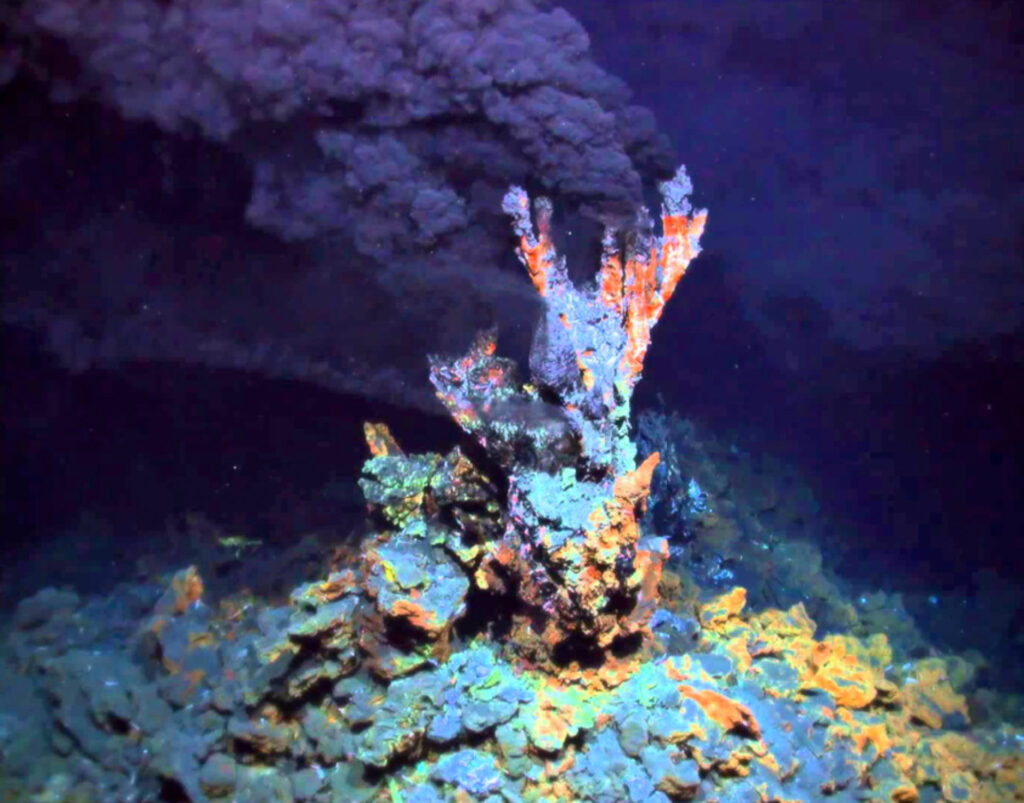
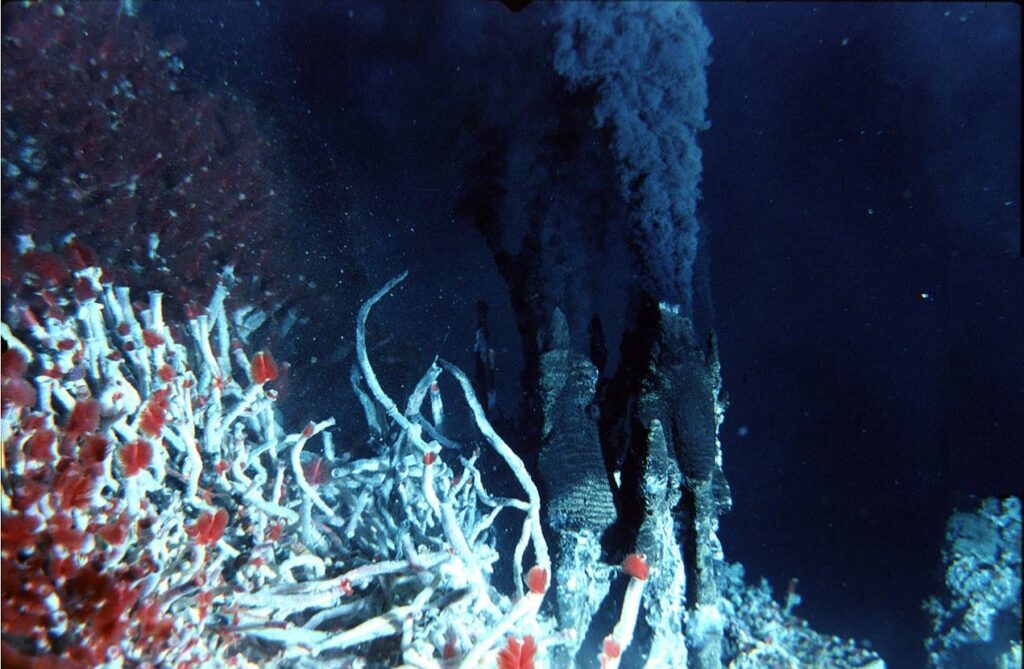
Life around the hydrothermal vents is rich and bizarre – ranging from red tube worms, molluscs and crustaceans all the way to octopuses and eelpout fish. The food chain relies on chemosynthesis, which works similar to photosynthesis. But instead of using sunlight as energy, the bacteria use chemicals from the vent smoke.
First Explorations
I started my process by looking at how life by the thermal vents looked like – making studies of the structures, finding ways to translate what I see into my personal drawing style.
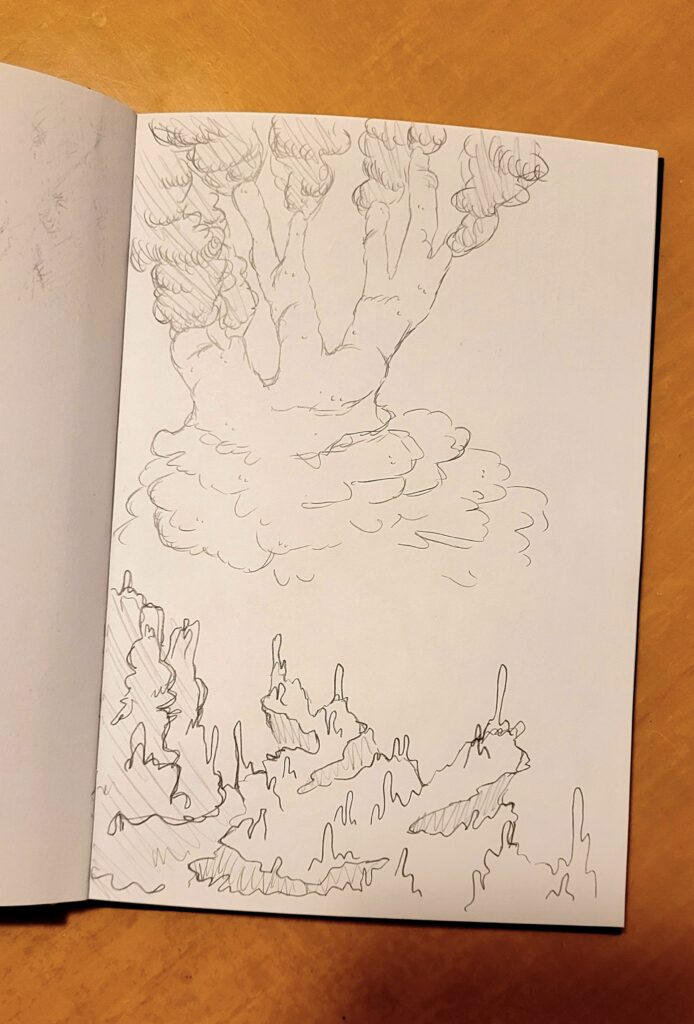
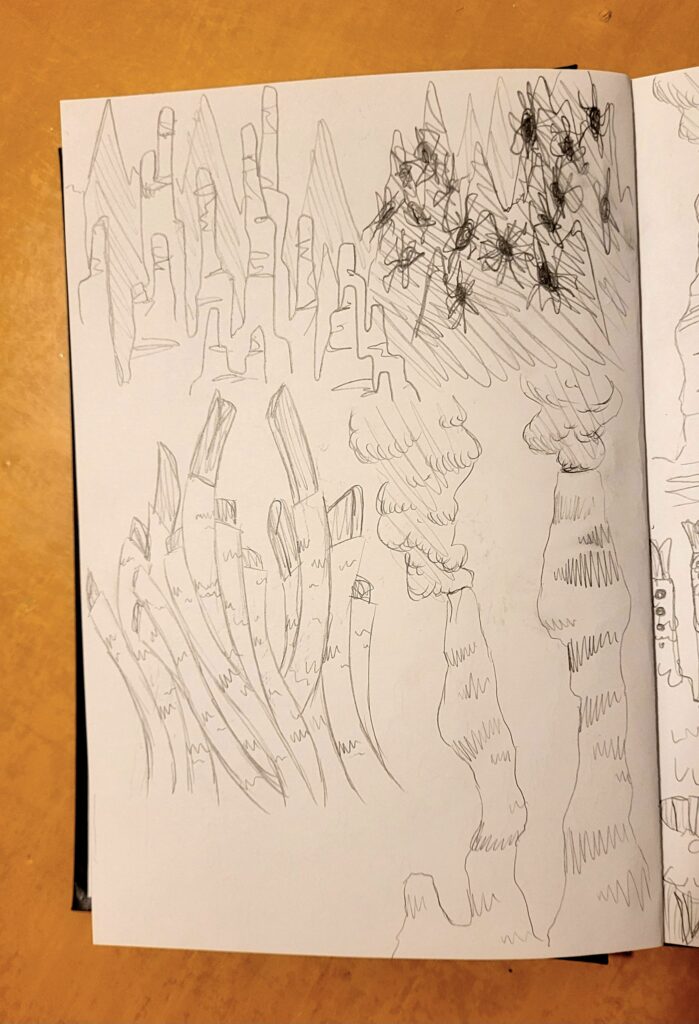
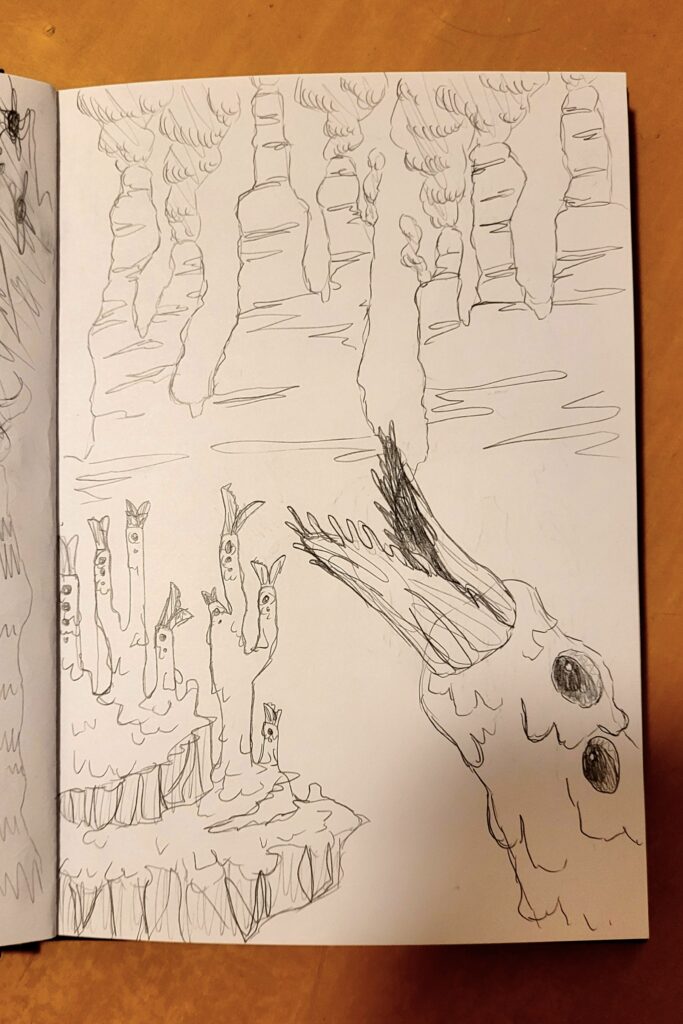
Afterwards I started to experiment; how could I estrange the shapes, but keep them looking believable? What diversity could exist in its forms?
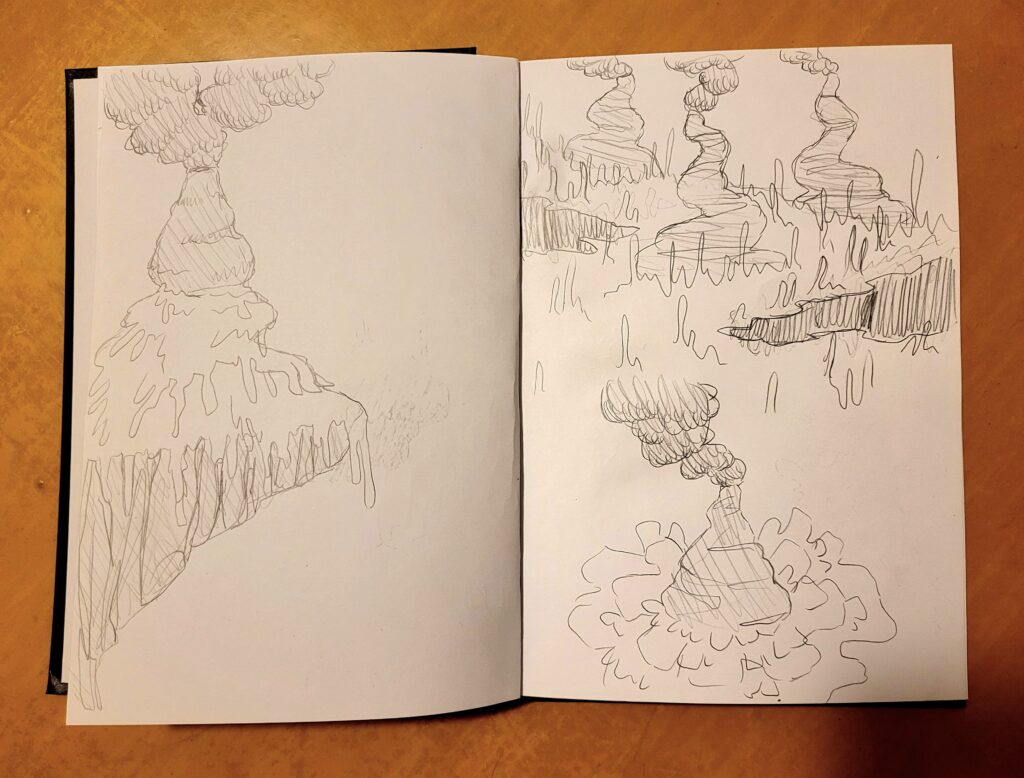
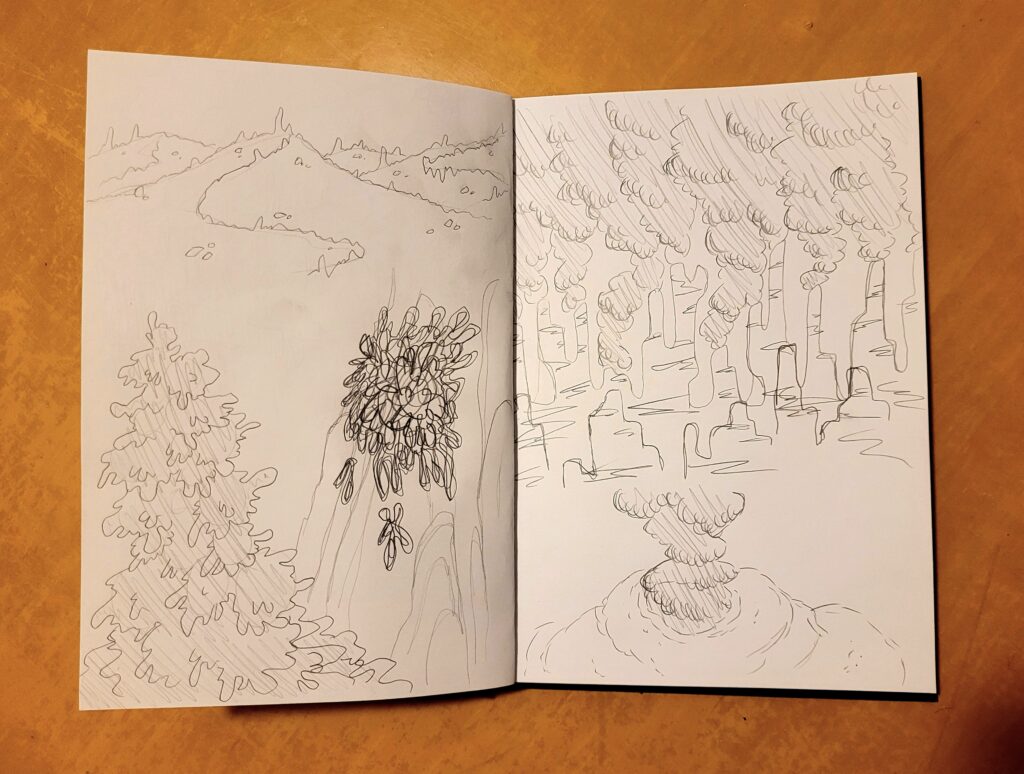
Sources
- Hand, Kevin Peter: Alien Oceans. The Search for Life in the Depths of Space. New Jersey, Oxfordshire: Princeton University Press 2020 [E-Book]
- Tamisiea, Jack: Strange Ecosystem Found Thriving below Seafloor Hydrothermal Vents. An expedition using a deep-sea remotely operated vehicle has uncovered a hidden underground ecosystem below hydrothermal vents on the seafloor. In: Scientific American 9.8.2023, https://www.scientificamerican.com/article/expedition-discovers-worms-and-other-life-below-hydrothermal-vents/ (zuletzt aufgerufen am 07.03.2026)
- Osterloff, Emily: Hydrothermal vents: survival at the ocean’s hot springs. In: Natural History Museum O.D., https://www.nhm.ac.uk/discover/survival-at-hydrothermal-vents.html (zuletzt aufgerufen am 07.03.2026)
