Yesterday, I tried out the 3 prototypes with 3 different participants (henceforth referred to as P1, P2, and P3) of intermediate aerial silks level. The following are the findings of the research through design process.
- Hanger silk
This prototype was not really useful for the intermediate aerialist, since they all have knowledge of the basic knots used in most figures (e.g. footlock, hip key, russian climb, etc.) There was no use case for this object in their case. I tried to use it to teach catcher’s pose to P3, but it didn’t really help. This is because catcher’s pose is not a mentally complex knot, rather a physically complex one. She understood what she had to do, but she mentioned she didn’t have the proper bodily proportions (her arm is not long) to do it properly, nor was she strong enough to hold herself in an inverted position for a long time to try out other solutions.
However, an interesting finding when talking with P3 is that she uses a longer (3m) piece of old silk to teach these same knots to kids. She explains that while it’s a useful tool for base knots, when it comes to kids, the problem becomes that she doesn’t know how to get them to stop playing with the silk and use it in a serious manner. As such, this made me reformulate my intended audience to exclude kids. This is because kids pose an extra challenge in their interaction with physical objects, and it’s outside of the scope of this investigation, even if I hadn’t explicitly known it before.
- Neon sleeves
P2 and P3 seemed the most interested in this prototype, since they both mentioned they have trouble remembering to distinguish between left and right, both when watching the teacher and when in the air. P2 mentioned that, when both her and the teacher wore it on the same arm, it made communication easier and faster. Not only could she visibly see the teacher’s colored vs bare arm, but also when there were errors in P2’s attempts, it was easier to identify and correct. It removed the extra layer of thinking for her. P2 noted that it sped up the learning process for her, since she was able to copy the teacher’s moves without too much mental load. Plus, after 2 times practicing the move with the sleeves on, she managed to do the 3rd try all on her own without any mistakes.
- Little guy
I had high hopes for the little guy, hoping he would be the star of the show. However, when externalizing the internal bodily sensations, little guy proved to be somewhat of a nuisance rather than a help. This doesn’t mean to say that this kind of 3d model is not useful; rather, that the framing of the model was lacking, and the fact that it was a quick-and-dirty prototype made the model itself harder to use in practice.
The first problem encountered was the fact that one person can’t manipulate both the little guy and the mini-silks. Luckily, P3 had a camera tripod to lend me, which made the usage of the little guy much easier (a second, smaller learning through this process was the fact that we had to tie the mini-silks to the tripod, as they can’t balance on their own).
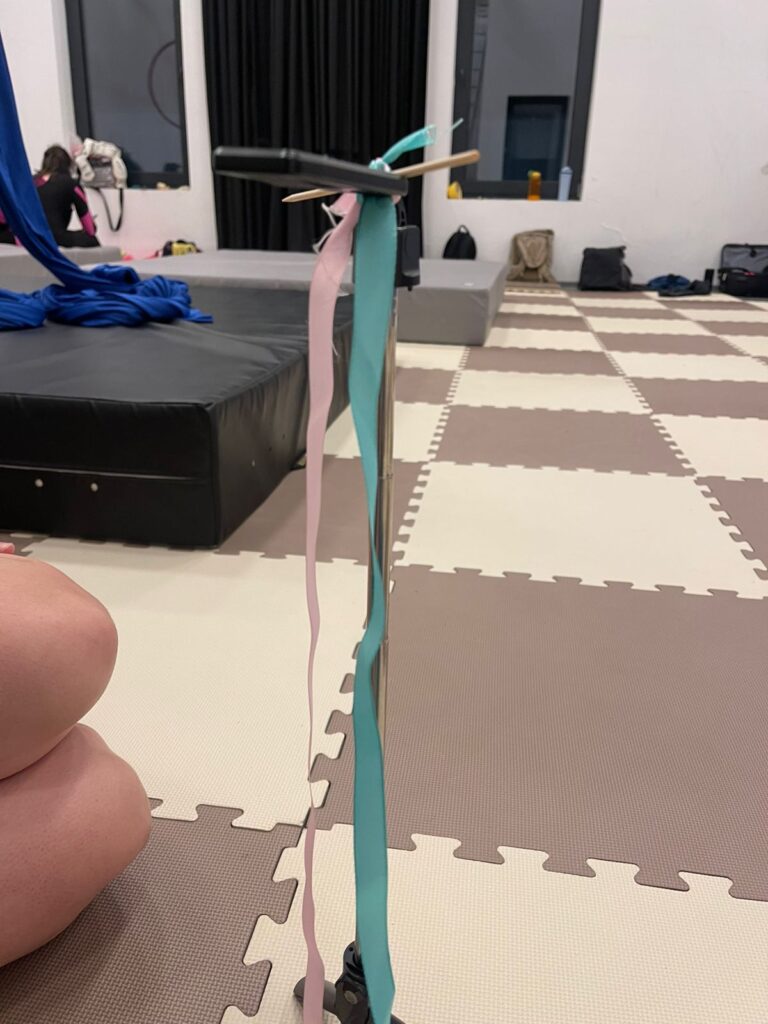
Own image.
In using the little guy to teach a new sequence to P1, we found that the characteristics of the mini-silk didn’t quite match up with the intended use – the ribbons used in the prototype are much too big (width wise), too short (length wise) and don’t allow for the flowiness that real silks have. This made smaller moves like a footlock harder to display on the little guy, and it made it hard to use as a teaching tool for footlock-based sequences. Another learning was the fact that he’s missing a clearly identifiable front and back, something that both P1 and P3 agreed they would like for him to have.
P1, a very good aerialist, mentioned she wanted to play around with the little guy and make him do a hip key. Despite being able to do this skill in her sleep, she failed to understand what she was doing wrong that made the little guy unable to hold the hip key in the mini-silks. In reality, what was missing was the fact that even if she knew what to do when she herself was up on the silk, she forgot to fold the little guy inward. This step is critically important – as I showed a few weeks ago in the prototype video, the “lock” on the hip key that makes you not fall is the physical act of folding yourself inward. When I told her what she forgot, she mentioned that she “didn’t want to break the prototype”, which is another piece of evidence supporting the fact that for the little guy to work, his model form must be easy to manipulate and visibly tough. Through this process, however, P1 mentioned that she found it much easier to learn from the little guy when it was not just the teacher showing a figure through him, but when she was actually able to touch and manipulate his figure.
—
Sources:
Own research.
